
When you’re getting ready to buy or sell a home in Dallas, one of the first questions that always pops up is about realtor commissions. It can seem a little confusing, but the straight answer is pretty simple: the seller traditionally pays the realtor fees in Texas. This includes the commission for their own agent and the agent who brings the buyer to the table.

The Straight Answer on Who Pays Realtor Fees in Dallas
For anyone selling a property in a hot market like Dallas, getting your head around who pays the realtor fees is crucial. The long-standing practice here in Texas is that the home seller covers the entire commission for both agents involved in the deal.
This isn’t some upfront cost you have to worry about. Instead, the total commission is simply taken out of the seller’s proceeds when everything is finalized at closing. Think of it like a concert promoter paying all the performers out of the total ticket sales. The seller, like the promoter, is hosting the main event—the sale of the home—and pays the professionals who made it happen from the final sales price.
This handy visual breaks down how the commission flows from the initial agreement all the way to the payout.
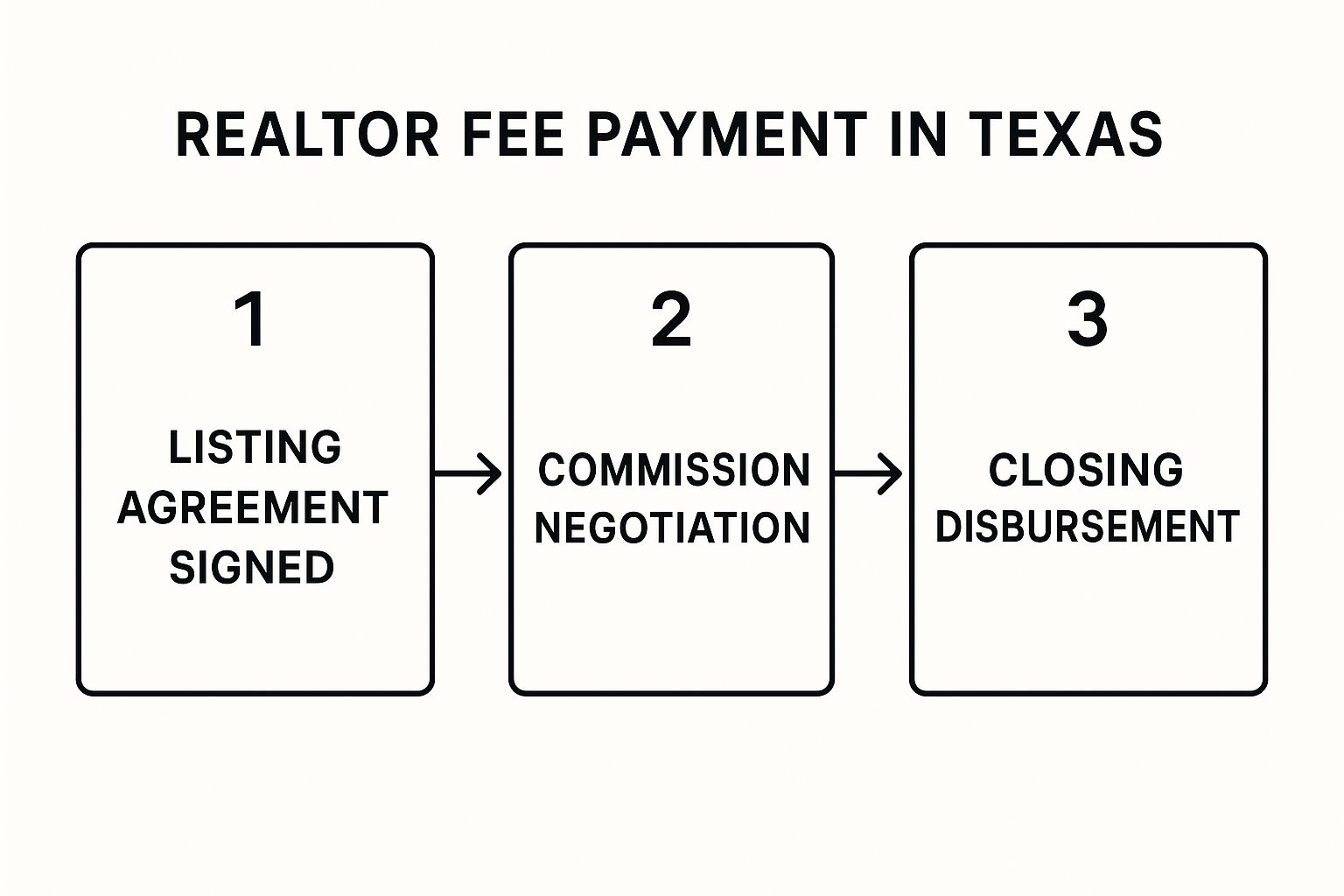
As you can see, the commission structure gets locked in with the listing agreement and doesn’t get paid out until closing. This model is smart because it gives the buyer’s agent a powerful incentive to bring qualified, serious buyers to see your property. Ultimately, it widens your pool of potential buyers. If you want to dig deeper into their role, you can learn more about why using a buyer’s agent is such a standard and valuable part of the process.
How Realtor Fees Flow in a Dallas Home Sale
To make it even clearer, let’s trace the money from start to finish. This table outlines exactly how the commission is handled at each stage of a typical home sale in Dallas.
| Stage of Transaction | Who is Responsible? | Key Action |
|---|---|---|
| Listing Agreement | Seller and Listing Agent | The seller agrees to a total commission percentage to be paid at closing. |
| Marketing the Property | Listing Agent | The listing agent offers a portion of that total commission to the buyer’s agent. |
| Offer and Acceptance | Buyer and Seller | The agreed-upon sale price forms the basis for the final commission calculation. |
| Closing Day | Title/Escrow Company | The total commission is deducted from the seller’s final proceeds. |
| Final Payout | Title/Escrow Company | The commission is split between the listing brokerage and the buyer’s brokerage as agreed. |
This cooperative structure is the backbone of the Dallas residential real estate market, ensuring all parties are compensated for getting the deal across the finish line.
The Financial Impact for Dallas Sellers
So, what does this actually look like in dollars and cents? In Texas, the combined commission for both agents usually lands somewhere between 5.6% and 6% of the home’s final sale price.
Let’s put that into perspective. With the median home price in the Dallas area hovering around $460,000 in recent years, a 6% commission would come out to approximately $27,600. That’s a significant number, and it’s essential for sellers to factor it into their calculations to understand their true net proceeds from the sale.
The whole idea of the seller paying both commissions is built on cooperation. By offering a competitive commission to the buyer’s agent, sellers attract a much wider audience and encourage more showings. This dramatically increases the odds of a faster sale at a better price in a competitive market like Dallas.
Breaking Down the Average Realtor Commission in Dallas

Okay, so we’ve established that sellers usually handle the commission fees. The natural next question is, what’s the damage? In the Dallas-Fort Worth area, realtor commissions are almost always a percentage of the home’s final sale price. While there’s no state-mandated rate, the market has settled into a pretty standard range of 5% to 6%.
Now, that figure isn’t just for one agent. It’s a cooperative fee, meaning it’s designed to pay both the agent listing your home and the agent who brings the buyer to the table. Think of it as a single pie that gets sliced right down the middle.
Key Takeaway: That 5-6% commission isn’t one giant paycheck for a single agent. It’s the total pot that gets split between the two brokerages involved, making sure both the buyer and seller have professional representation working for them in their Dallas transaction.
This split is typically an even 50/50, though like anything in real estate, it can be negotiable. So, if the total commission is 6%, 3% goes to the listing agent’s brokerage, and the other 3% goes to the buyer’s agent’s brokerage. From that point, each agent gets paid based on their specific agreement with their brokerage.
A Real-World Dallas Example
Let’s put some real numbers to this to see how it plays out. Say you’re selling a house in a hot Dallas neighborhood like Lakewood. Based on current market trends, a median-priced home there might fetch around $460,000.
Across Texas, the average total commission shakes out to be about 5.64%. This amount is customarily split right down the middle, giving each agent’s brokerage around 2.82%. For a home selling at $460,000, the total realtor fees would come to roughly $25,944. That breaks down to $12,972 for the seller’s agent and $12,972 for the buyer’s agent. For more details on how rates can differ across the state, you can check out some great insights on Texas commission rates on AnytimeEstimate.com.
To keep it simple, let’s break down the math for that $460,000 sale using a standard 6% total commission:
- Final Sale Price: $460,000
- Total Commission (6%): $27,600
- Listing Agent’s Share (3%): $13,800
- Buyer’s Agent’s Share (3%): $13,800
This $27,600 is paid directly from your sale proceeds when you close on the house. Seeing the actual dollar amount helps paint a much clearer financial picture, allowing you to accurately calculate your net profit—which is absolutely critical for planning your next move in the Dallas area.
Why Sellers Traditionally Cover All Agent Fees
It might seem strange that a Dallas seller pays the agent representing the person buying their home, but there’s a powerful and practical reason this became the industry standard in Texas. The whole system is built on one simple, powerful principle: incentive. By offering a commission to the buyer’s agent, sellers cast a much wider net.
Think of it as a supercharged marketing tool. You aren’t just hiring your own agent; you’re essentially recruiting every single real estate agent working with qualified buyers across the Dallas-Fort Worth metroplex. They are now motivated to show your property because they know there’s a pre-arranged commission waiting for them if their client’s offer is the winning one.
This structure transforms the commission from a simple payment into a “finder’s fee.” The seller pays to get access to a massive, cooperative network of professionals who are actively out there searching for homes. It’s a system designed to get you more showings, attract more competitive offers, and ultimately, get your home sold in a fast-paced market like Dallas.
The Power of Cooperative Compensation
This traditional seller-pays model fosters a cooperative environment between agents, rather than a purely competitive one. When a listing agent advertises a specific commission split in the Multiple Listing Service (MLS), it’s a clear signal to all buyer’s agents that their hard work will be compensated.
This has several major benefits for you, the Dallas seller:
- Maximum Exposure: Your property gets in front of the largest possible audience of potential buyers. Agents are naturally more likely to prioritize showing homes where a commission is clearly offered and understood.
- Qualified Buyers: Buyer’s agents spend their time pre-qualifying clients, which means the people walking through your door are serious contenders, not just window shoppers.
- Streamlined Process: This setup keeps the transaction simple. The commission is handled in one place—the seller’s closing statement—instead of creating a separate financial hurdle for the buyer to overcome.
A big part of what these fees cover are comprehensive marketing strategies. This can even include using advanced resources like AI content tools for real estate marketing to make sure your property gets seen everywhere. By shouldering the fee, sellers ensure their home gets top-tier marketing attention from all sides.
This cooperative commission is really the engine of residential real estate in Dallas. It ensures that both sides of the deal are represented by motivated professionals who are dedicated to getting everyone to a successful closing.
At the end of the day, this structure is less about who physically writes the check and more about achieving the same goal. For sellers, paying the full commission is a strategic investment in efficiency, marketing reach, and a smoother sale. Getting the timing right is also crucial; you can learn more about finding the best time to sell a house to further boost your final return.
How to Strategically Negotiate Realtor Fees in Dallas

Here’s a fact that can empower any Dallas home seller: realtor commissions aren’t set in stone. They are absolutely negotiable. While the thought of haggling over fees might feel a bit uncomfortable, walking into that conversation with a clear strategy can save you thousands of dollars.
The trick is to treat it like a professional business discussion. You’re not just asking for a random discount. Instead, you’re proposing an adjustment based on the unique details of your property and the services you actually need. A good, collaborative conversation often leads to an agreement where everyone feels they’ve won.
Understanding Your Leverage Points
Your power to negotiate effectively comes down to the specifics of your home and its place in the hot Dallas market. Certain factors naturally give you more room to have a productive discussion about the commission structure.
Here are a few common leverage points to consider:
- High Property Value: If you’re selling a luxury home in an exclusive Dallas neighborhood like Highland Park or Preston Hollow, the agent is already positioned for a substantial payday, even at a lower percentage. The math is straightforward: a 2.5% commission on a $2 million home is a much bigger check than 3% on a $500,000 property.
- Desirable Location: Is your home in a sought-after area where properties fly off the market? If so, it likely requires less time, money, and marketing effort from the agent. You can frame your negotiation around the high probability of a quick sale, which justifies a modest fee reduction.
- Repeat Business: Agents value long-term relationships. If you’re a repeat client or an investor with plans for multiple deals in the Dallas area, they are often far more willing to be flexible on their commission to keep your business for years to come.
On top of these factors, recent legal shifts have brought more transparency to the fee structure, particularly regarding the buyer’s agent commission. This puts Dallas sellers in a much stronger position to have direct conversations about how the total commission is split and what they’re willing to offer.
New Rules and Increased Seller Power
Even though you might hear “standard” rates quoted, negotiation has always been a key part of determining who pays what in Texas real estate. While the average commission for both the listing and buyer’s agent has hovered around 2.82%, the latest rules and regulations confirm that sellers can—and should—negotiate these rates.
Following a major NAR lawsuit settlement, brokerage fees must now be negotiated separately, which hands more control directly to you. We’re already seeing Dallas sellers successfully negotiate listing agent commissions as low as 1.5%, especially when they partner with alternative brokerage models.
A small percentage point can make a huge difference. Shaving just one point off a 6% commission, down to 5%, on a $750,000 Dallas home saves you $7,500. That’s real money going straight back into your pocket.
Ultimately, an open and informed discussion about the services you’re getting for the fee you’re paying is the best path forward. To sharpen your skills before the conversation, exploring effective negotiation tactics in real estate can arm you with valuable strategies.
How Dallas Market Conditions Affect Agent Commissions

Real estate is always local. The answer to who pays realtor fees in Texas often comes down to the current pulse of the Dallas market. Your power to negotiate an agent’s commission is directly tied to basic supply and demand, so you need to have a feel for the local climate before you decide to sell.
Think of it like a seesaw. In a hot “seller’s market,” with few homes for sale and tons of buyers, you’re sitting in the power seat. But in a “buyer’s market,” where listings are plentiful and sales are sluggish, that advantage shifts away from you.
In simple terms, if your home is a hot commodity that’s likely to sell fast, a Dallas agent has more room to be flexible on their commission. If it’s going to be a tougher sale requiring a lot of marketing and time, they have far less incentive to take a pay cut.
Knowing which way the Dallas market is leaning gives you a huge leg up. It helps you understand your negotiating position before you even start talking to agents.
Navigating a Dallas Seller’s Market
When the Dallas market is on fire, homes get snapped up fast. Just imagine listing a beautiful home in a high-demand area like Frisco or Plano. You’d likely see bidding wars and go under contract in just a few days.
In this scenario, you have more leverage. An agent knows the sale will probably be quick and won’t demand a massive marketing budget. Because of this, they’re often more willing to discuss a slightly lower commission. The logic is simple: an easier, faster payday for them can justify a more competitive rate for you. You can frame the conversation around your property’s undeniable appeal and the high probability of a swift transaction.
Facing a Dallas Buyer’s Market
Now, let’s flip that coin and consider a slower market. Maybe interest rates have climbed, or there’s a flood of listings in a specific neighborhood like Oak Cliff. A home here might linger on the market for a while, demanding a lot more work from an agent.
In this environment, agents are much less likely to budge on their fees. Selling your home is going to be a bigger hill to climb, requiring:
- Increased Marketing: More open houses, a bigger push on digital ads, and maybe even professional staging to make your home pop.
- More Time and Effort: This means more showings over a longer period and tougher negotiations with buyers who hold all the cards.
- Greater Financial Risk: The agent invests their time and money upfront with no guarantee of when—or if—they’ll see a return.
In a Dallas buyer’s market, a full commission isn’t just a number; it’s the fuel an agent needs to dedicate the right resources to get your home sold when the odds aren’t in your favor.
Where It All Becomes Official: Your Texas Listing Agreement
Talk is cheap, but your signature on a listing agreement? That’s what makes your commission structure official. This legal document is where a friendly handshake turns into a binding contract, so it’s absolutely vital for any Dallas home seller to understand what they’re signing.
Think of the agreement—often a standardized form from the Texas Association of Realtors (TAR)—as the official roadmap for your home sale. It spells out exactly who pays what and how your agent, along with the buyer’s agent, gets compensated when the deal closes.
Finding the Commission Clause
So, where is the magic number? Buried in that paperwork, you’ll find a specific paragraph, usually titled something like “Broker’s Compensation” or “Broker’s Fees.” This is where the total commission is explicitly stated as a percentage of the final sales price.
This clause is the single source of truth for your fee obligation. It also breaks down how that total commission gets split and offered to a buyer’s agent through the Multiple Listing Service (MLS). Knowing where to find this—and what it says—is the key to avoiding any nasty surprises on your closing statement. Getting a handle on the transaction basics is a huge help, and our guide on how to buy a house in Texas gives you excellent foundational knowledge, whether you’re buying or selling in Dallas.
To make sure you’re fully prepared, keep an eye out for language that covers these key points:
- Total Commission: The overall percentage you, the seller, agree to pay.
- Cooperative Compensation: The slice of the total commission that your agent will offer to the brokerage representing the buyer.
- Protection Period: A clause ensuring your agent gets paid if you sell the home to a buyer they introduced, even if it’s shortly after your agreement expires.
A sample clause might look something like this: “Seller agrees to pay Broker a total fee of X% of the gross sales price. Broker is authorized to offer Y% of the sales price to other brokers as compensation for procuring a buyer.”
Taking the time to read this section carefully empowers you. You’ll know exactly what financial commitment you’re making before putting pen to paper. This transparency ensures that when you see the final numbers at closing, they line up perfectly with what you agreed to in your Dallas listing contract. No guesswork, no confusion.
Got Questions About Realtor Fees in Texas?
Even after you get the basics down, the financial side of a real estate deal can throw some curveballs. It’s totally normal for sellers to have those “what if” questions pop up, especially when it comes to their specific situation. Let’s tackle some of the most common ones I hear from my clients in Dallas.
These are the nitty-gritty details that can make a real difference to your bottom line, from trying to sell on your own to figuring out the tax implications. Getting these right means you’ll walk away from the closing table with a complete picture of your sale.
If I Sell My Dallas Home Myself, Do I Still Owe a Realtor Fee?
This is a big one. If you go the For Sale By Owner (FSBO) route and a buyer—with no agent of their own—knocks on your door and makes a deal, you would pay zero realtor fees. That’s the dream FSBO scenario, for sure.
But here’s the reality in the Dallas market: the vast majority of buyers are working with a real estate agent. To even get your home on their radar, you’ll almost certainly need to offer to pay their agent’s commission. This is typically 2.5% to 3% of the final sale price. So, while you’re saving money by not hiring a listing agent, you’re still likely on the hook for the buyer’s agent fee to attract the largest possible pool of buyers.
Can I Make the Buyer Pay Their Own Agent’s Commission?
Technically, yes. In Texas, you can absolutely write a clause into the sales contract stating that the buyer is responsible for their own agent’s fee. With recent rule changes in the industry, this is becoming a more common point of negotiation in Dallas than it used to be.
Whether this is a smart move really depends on the market. If it’s a red-hot seller’s market in Dallas and you have multiple offers, you might have the leverage to pull this off. The downside? It can make your home a lot less appealing. Most buyers are already stretching to cover their down payment and closing costs; adding a 3% agent fee on top of that might be a deal-breaker for them.
Expert Insight: Asking a buyer to cover their agent’s fee is a double-edged sword. It could save you thousands, but it might also shrink your pool of interested buyers, potentially leaving your home on the market for longer.
Are Texas Realtor Fees Tax Deductible?
For home sellers, realtor commissions aren’t a direct tax deduction like, say, a business lunch. You can’t just write it off on a specific line of your tax return.
Instead, the commission plays a vital role in lowering your capital gains tax. The fee is subtracted from your home’s final sale price, which reduces your net profit from the sale. A smaller profit means a smaller tax bill. It’s a crucial calculation, and I always advise my clients to sit down with a great Dallas tax professional to see exactly how this will work for their financial situation.
Ready to navigate the Dallas real estate market with an expert who puts your financial interests first? Dustin Pitts REALTOR Dallas Real Estate Agent provides the strategic guidance and negotiation skills you need. Visit us online to start the conversation.