
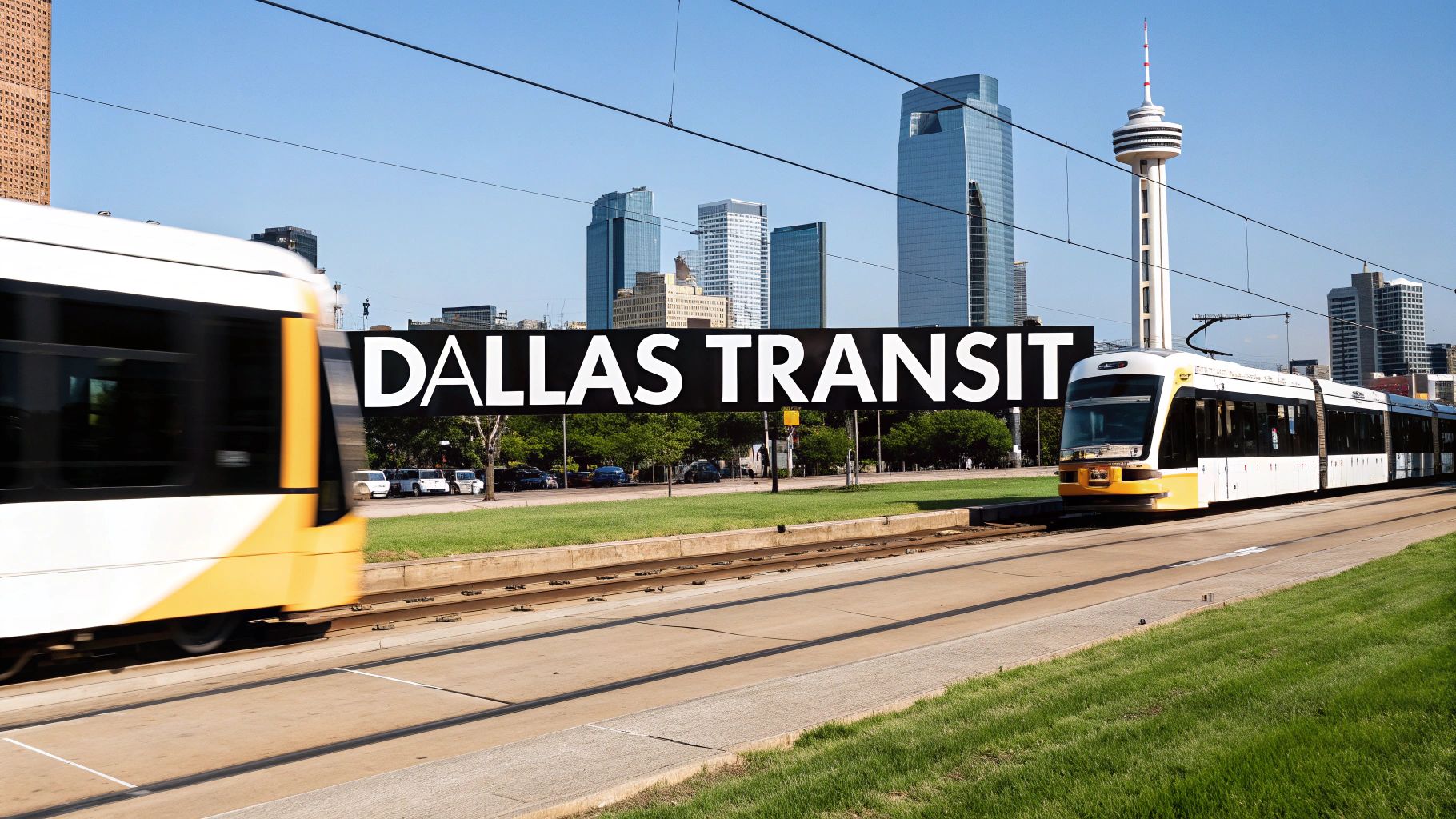
Figuring out Dallas public transportation is easier than you might think. The whole network is run by Dallas Area Rapid Transit (DART), a system that weaves together light rail, buses, a streetcar, and even on-demand shuttles to connect the sprawling DFW metroplex. It’s more than just a way to get from A to B; it’s a major force shaping the city’s growth and its real estate market.

Your Guide to Getting Around Dallas
Let’s be honest, Dallas has a reputation for being a car city. But if you look a little closer, you’ll find DART offers a surprisingly solid alternative for commuting, exploring, or just running errands. It’s not just a random collection of routes—it’s a thoughtfully integrated system designed to link diverse neighborhoods, bustling business districts, and far-flung suburban hubs.
This guide will walk you through every piece of the puzzle, from the far-reaching light rail lines to the neighborhood bus routes and modern on-demand services. Once you see how they all work together, you’ll have a much better handle on navigating the city and understanding how transit access impacts where people choose to live and work.
The Foundation of Dallas Transit
The DART system we know today has roots going back to 1983. That’s when voters in 14 Dallas County cities gave the green light to a one-cent sales tax to fund a truly regional network, replacing the old Dallas Transit System. This was a huge step toward a coordinated, multi-city approach.
DART really hit its stride when it launched its light rail service in 1996, becoming the first modern light rail system in the entire Southwestern U.S. It has since expanded to an impressive 93 miles of track. You can get the full story by checking out the official DART history page.
Dallas’s long-term investment in public transit shows a clear vision for a more connected and accessible city. Getting to know this system is crucial for anyone looking to live, work, or invest here, as it directly influences property values and daily life.
To make sense of it all, it helps to see how each service fits into the bigger picture. Here’s a quick look at the main players.
Dallas Public Transportation At a Glance
This table breaks down the primary transit options in Dallas, giving you a snapshot of what each one does best and where it operates.
| Transit Mode | Primary Use Case | Key Service Areas |
|---|---|---|
| DART Light Rail | Long-distance commuting and connecting major hubs | Downtown Dallas, suburbs, airports, medical districts |
| DART Buses | Local neighborhood travel and connecting to rail | Throughout the DART service area, including places rail doesn’t reach |
| Dallas Streetcar | Short trips between downtown and nearby districts | Union Station to the Bishop Arts District |
| GoLink | On-demand “first and last mile” connections | Specific zones, connecting riders to and from transit stations |
Each mode of transportation serves a distinct purpose, but they all work together to provide comprehensive coverage across the region. Let’s dig into the details of each.
The Core DART Services
Here’s a breakdown of the four main ways to get around on DART.
- DART Light Rail: This is the backbone of the entire system. Its four color-coded lines connect key destinations across Dallas and its suburbs, making it the go-to for commuters and anyone traveling longer distances.
- DART Buses: The bus network is the workhorse, providing local and express service that fills in the gaps. These routes give you granular access to neighborhoods and areas not directly served by the trains.
- Dallas Streetcar: Think of this as a convenient connector. It runs a short, dedicated route linking the downtown Union Station with the vibrant Bishop Arts District, perfect for a quick hop over the Trinity River.
- GoLink: This is DART’s modern answer to the “first and last mile” problem. It’s an on-demand shuttle service that provides curb-to-curb rides within specific zones, making it easy to get to or from a DART station.
Mastering the DART Light Rail System
If there’s one piece of Dallas public transportation that acts as the system’s powerful engine, it’s the DART Light Rail. Think of it as the city’s circulatory system, with four main arteries—the color-coded Red, Blue, Green, and Orange lines—pumping people between Downtown, DFW Airport, and major suburban hubs like Plano and Irving. This is your key to unlocking real mobility in Dallas without ever getting behind the wheel.
Instead of just staring at a map, you need to understand how these lines actually work on the ground. Whether you’re commuting from Richardson, catching a Mavericks game at the American Airlines Center, or exploring the shops at Mockingbird Station, the light rail offers a direct, hassle-free path. Once you get the hang of it, that complex web of tracks becomes your personal guide to the city.
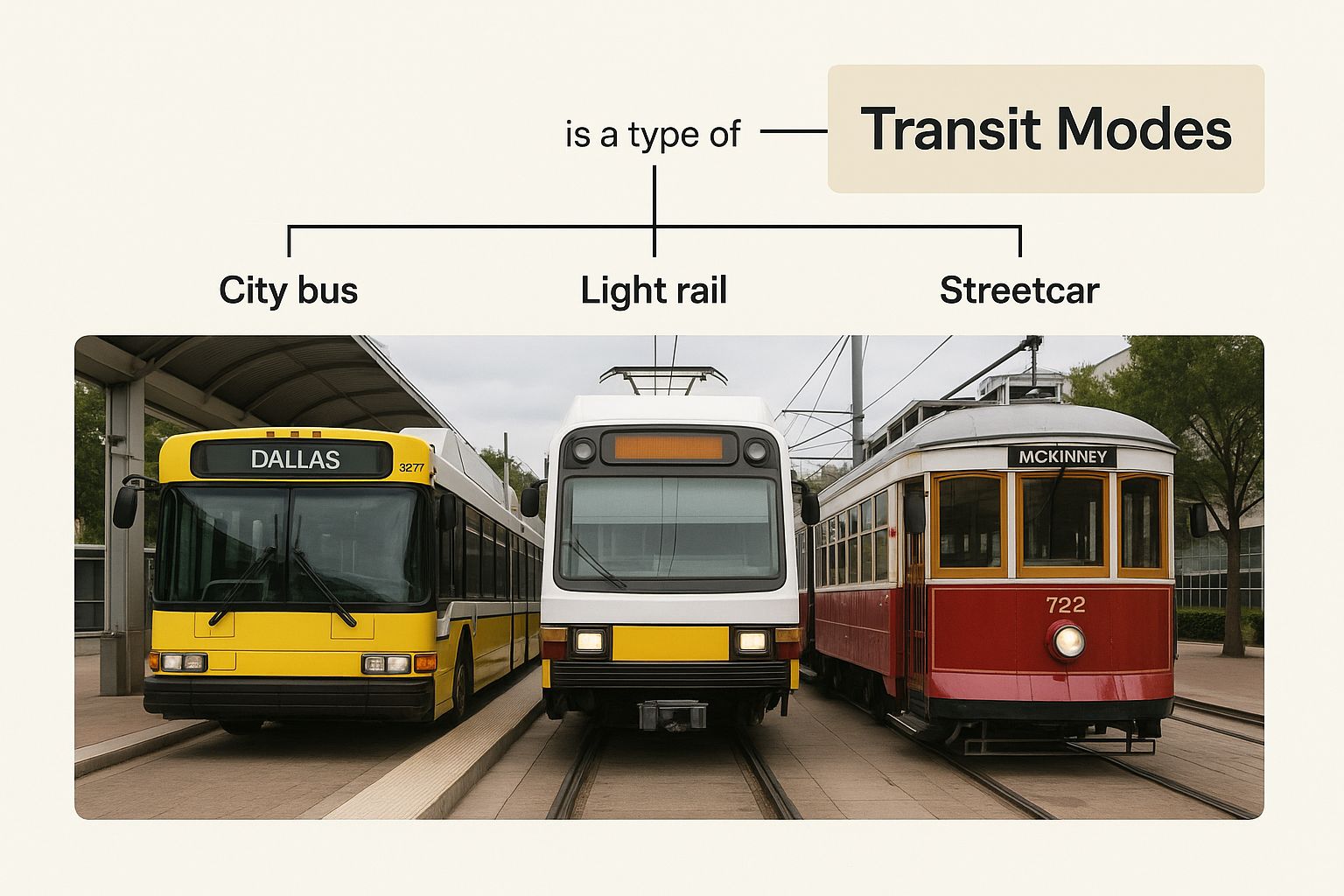
This image gives you a great snapshot of the main ways to get around Dallas—the trains, buses, and streetcars. It shows how they all fit together, with the light rail serving as the long-range connector while other services handle the local routes.
Understanding the Four Key Rail Lines
Each DART line is designed to serve a specific corridor, but they all cleverly converge in Downtown Dallas. This creates a central hub that makes hopping from one line to another incredibly simple. Knowing what each line is for is the first step to planning your trips like a pro.
Here’s a quick rundown of what each one does:
- The Red Line: This is a major north-south workhorse. It runs all the way from Parker Road in Plano, cuts through Downtown Dallas, and ends at Westmoreland Station in Oak Cliff. It’s the go-to for thousands of commuters in the northern suburbs.
- The Blue Line: Connecting Rowlett in the northeast to the UNT Dallas campus way down south, this line slices right through Downtown. It’s your lifeline to Garland and parts of East Dallas.
- The Green Line: Stretching from North Carrollton/Frankford to Buckner Station in the southeast, the Green Line is your ticket to the Dallas Medical District, the nightlife in Deep Ellum, and the State Fairgrounds at Fair Park.
- The Orange Line: This is the traveler’s best friend. The Orange Line provides the crucial, direct link to DFW International Airport. It shares a lot of track with the Red and Green lines but peels off to serve the business district of Las Colinas before hitting the airport.
Strategic Trip Planning and Transfers
Using the DART Light Rail effectively really comes down to mastering the transfer. All four lines meet up at four key stations in the downtown core: West End, Akard, St. Paul, and Pearl/Arts District. This downtown loop makes it seamless to switch between any of the lines.
For instance, say you live up in Plano (Red Line) and need to catch a flight at DFW (Orange Line). You don’t actually have to ride all the way into the heart of downtown. You can make the switch at any station where both lines run parallel, like Mockingbird Station. Figuring out the most efficient transfer point can shave a good bit of time off your trip.
A crucial tip for new riders: multiple lines often use the same tracks through busy areas. Always, always check the destination sign on the front of the train before you hop on.
Real-World Scenarios for Using the Rail
Let’s make this practical. Imagine you work in the Dallas Arts District but live near the Galleria. You could brave the traffic on I-635 every day, or you could take a much smarter approach.
- Board the Red Line: Start your trip at the LBJ/Central Station.
- Ride Southbound: Enjoy a direct ride straight into Downtown Dallas.
- Exit at Pearl/Arts District Station: You’ll step off the train right in the middle of the district, just a short walk from your office.
That’s it. A simple, one-seat ride that completely bypasses the stress and expense of rush-hour driving and parking. The light rail is built for these kinds of daily wins, making it an incredible asset for anyone living or working near its corridors.
Getting Around Town with DART Buses and Streetcars
If the DART Light Rail is the backbone of Dallas public transit, then the buses and streetcars are the circulatory system, bringing life to every corner of the city. They handle the crucial “last mile” of your journey, connecting sprawling neighborhoods and entertainment districts that aren’t right next to a train station.
Think of it this way: the light rail is the major highway system that gets you across town quickly. The buses are the local streets that take you from that highway right to your destination’s doorstep. This partnership is what makes the DART network a truly comprehensive system for day-to-day life, not just for commuting. Without them, living car-free in many parts of Dallas would be nearly impossible.
The DART Bus System: Your Neighborhood Connector
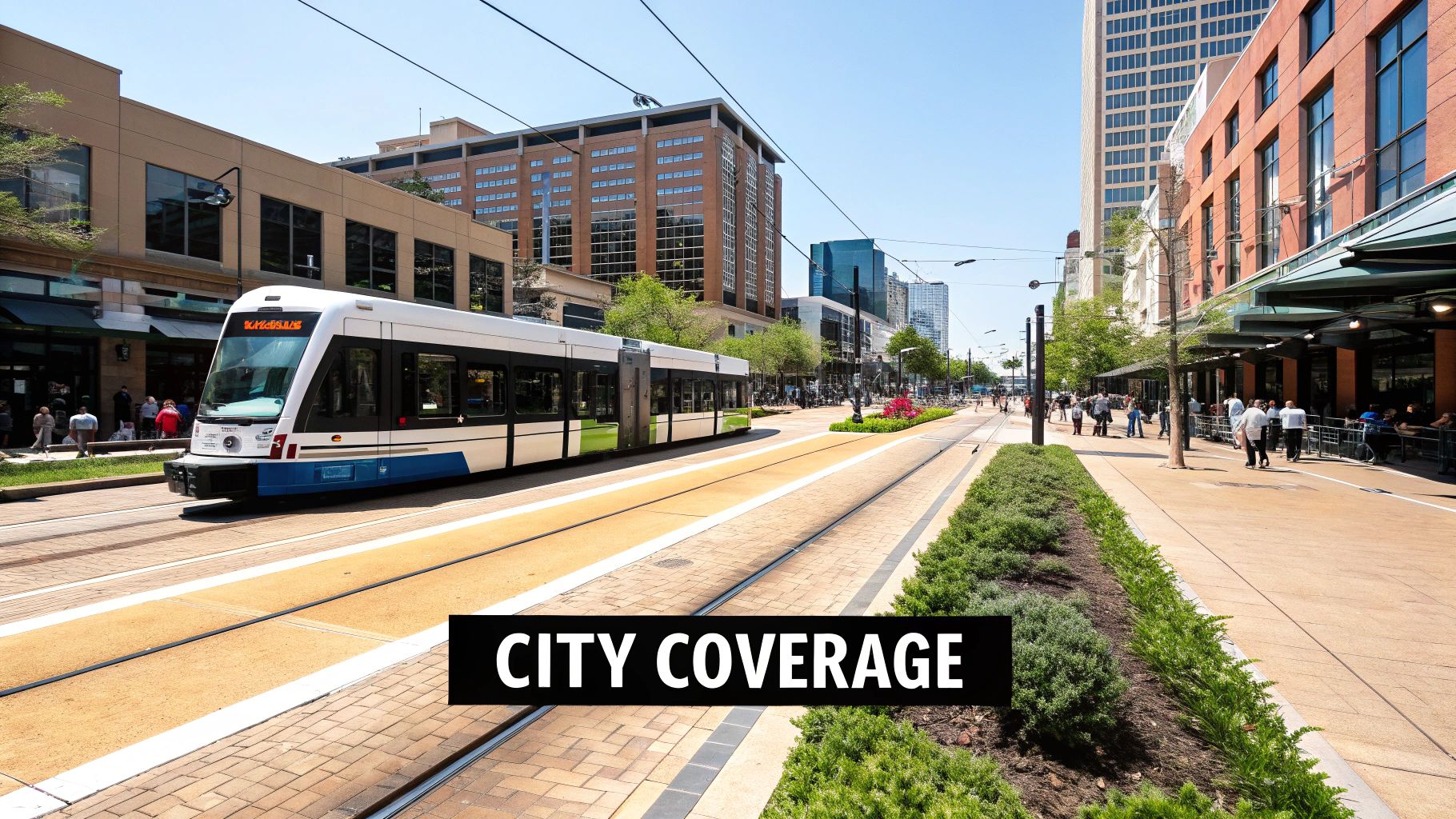
The bus network is the real workhorse of Dallas transit. With over 100 routes crisscrossing the region, it’s an incredibly extensive system that ensures you’re never too far from a public transit option, even if a train station is miles away.
DART’s bus services are tailored for different kinds of trips:
- Local Routes: These are your everyday neighborhood buses. They make frequent stops along major roads, connecting residential areas with local businesses, grocery stores, and shopping centers. They’re perfect for running errands or making shorter trips within a specific part of town.
- Express Routes: Built for the daily commute, these buses are designed for speed. They make very few stops and often jump on the highway to connect suburban Park & Ride lots directly with major job hubs like Downtown Dallas or the Medical District.
- GoPass App Integration: Honestly, you can’t be a serious bus rider without the GoPass app. It gives you real-time bus tracking—so you can stop guessing and know exactly when your bus is arriving—and lets you map out your entire trip from A to B.
Once you get the hang of using these routes, you’ll find that huge swaths of the city open up to you, no car needed.
The bus system gets to the very heart of DART’s original mission. When DART was formed in the early 1980s, the goal was to tackle Dallas’s growing traffic congestion and poor air quality. That vision is more critical than ever, with transportation now accounting for over 30% of greenhouse gas emissions in the city. You can read more about the history and environmental goals behind DART’s creation on texasce.org.
The Dallas Streetcar: A Modern Link to a Historic Gem
Don’t mistake the Dallas Streetcar for just a tourist ride. It’s a genuinely practical and slick transit link connecting two of the city’s most important hubs: Union Station in Downtown and the super-popular Bishop Arts District in Oak Cliff.
This modern streetcar makes getting across the Trinity River a breeze. If you live or work downtown, it puts one of the city’s best dining and shopping scenes just a short, easy ride away—no need to circle for parking or sit in traffic. The route is simple and direct, making it incredibly easy to use, even if it’s your first time.
How It All Works Together
The true power of Dallas public transit isn’t in any single service, but in how seamlessly they all connect. These aren’t separate options competing with each other; they’re interlocking pieces of one massive, coordinated network. This integration is what makes a “car-lite” lifestyle in Dallas a reality.
Here’s how a typical trip might look:
- You leave your home in a North Dallas neighborhood and walk to a nearby bus stop.
- You take a local DART bus to the nearest DART Light Rail station, like Forest Lane or LBJ/Central.
- You hop on a light rail train for the long haul, riding it down to a central station in the city.
- From there, you might jump on another bus or the free M-Line Trolley (which is integrated with the DART system) to get to your final stop in Uptown.
It’s this elegant dance between high-capacity rail and flexible, on-the-ground bus routes that makes the system work. Master how to combine them, and you can navigate nearly anywhere in the vast DFW metroplex with confidence.
Choosing the Right Fares and Passes
Figuring out DART’s fare system is pretty simple once you get the hang of it. It’s built to be flexible, whether you’re just taking a one-off trip or commuting every single day. The goal is to make sure you only pay for what you actually use. It all comes down to choosing between single rides, day passes, or monthly passes.
The easiest way to manage all this is with the GoPass app. It’s DART’s official app and it’s your best friend for trip planning and buying tickets right on your phone. If you’re not a fan of apps, you can grab a reloadable GoPass Tap Card instead. You can find them at station vending machines or various retail spots around town.
Comparing Your DART Fare Options
Which fare is right for you? It really just depends on how much you plan to ride. If you’re a tourist here for a day, your needs are totally different from someone who takes the train to work five days a week. A little forethought here can save you a surprising amount of cash.
To make it easier, let’s look at the most common DART fare options and see which one fits your travel style.
DART Fare Options Comparison
This table breaks down the most common DART fare types to help you pick the best option based on how often you’ll be traveling.
| Fare Type | Best For | Key Feature |
|---|---|---|
| Two-Hour Pass | Quick, one-way trips with a short return or transfer | Unlimited rides on all DART services for a two-hour window. |
| Day Pass | A full day of exploration or multiple appointments | Provides unlimited rides until 3 a.m. the next day for one flat price. |
| Monthly Pass | Daily commuters and frequent riders | Offers the best value for anyone using the system regularly. |
Basically, the more you ride, the more a monthly pass makes sense. For anything else, a day pass or a simple two-hour pass will likely cover you.
Digital vs Physical Payment Methods
DART has done a great job of making payments quick and painless. You can still use cash on the bus (just make sure you have exact change!), but most people find the digital and tap-to-pay options much more convenient.
- GoPass App: This is your all-in-one tool. You can buy and keep any pass on your smartphone. When you’re ready to board, just activate your pass and show the screen to the driver or fare inspector. It’s that simple.
- GoPass Tap Card: Think of this as a physical, reloadable transit card. Add money to it online or at a station vending machine, then just tap the card on the reader as you get on the train or bus.
- Contactless Payment: For maximum ease, you can tap your contactless credit/debit card or your phone’s mobile wallet on the reader to pay for a single ride. No app or ticket needed.
Choosing the right fare is like creating a small budget for your transportation. By matching your pass to your travel needs, you can significantly reduce your monthly expenses, freeing up funds for other goals. For those looking at larger investments, understanding financing is equally important; our guide on financing multi-family properties offers deeper insights into managing significant financial commitments.
Scenarios for Choosing the Best Pass
Let’s walk through a couple of real-world examples to see how this works.
Scenario 1: The Occasional Rider
You live in Uptown and have plans for dinner and shopping in the Bishop Arts District. You’ll take the streetcar there and be back within a few hours.
- Best Choice: A Two-Hour Pass is perfect for this. Buy it on the GoPass app, and it will easily cover your round trip for one low price.
Scenario 2: The Weekend Explorer
You’re visiting Dallas for the weekend and want to hit several spots. Your list includes the Dallas Museum of Art near St. Paul Station, a walk through Klyde Warren Park, and then a train ride to Deep Ellum for some live music later that night.
- Best Choice: The Day Pass is a no-brainer here. It gives you total freedom to hop on and off any bus or train you want, all day and well into the night, for one flat fee.
How Transit Access Shapes Dallas Real Estate
In Dallas, public transportation is more than just a way to get from point A to B. It’s a powerful force that actively shapes the city’s real estate market. The proximity of a DART station acts as an economic catalyst, directly impacting property values, driving rental demand, and influencing where people choose to live.
The formula is simple: convenience equals value. In a metroplex as sprawling as Dallas, having easy access to reliable transit is a highly sought-after commodity.
Time and again, we see properties within a short walk of a DART rail station fetching higher prices than similar homes just a bit further out. Studies of the Dallas market have consistently shown that homes within a half-mile radius can see a significant bump in value. This “transit premium” is no accident—buyers and renters are willing to pay for the convenience, the lower transportation costs, and the direct line to the city’s best jobs and entertainment.
The Rise of Transit-Oriented Developments
This demand from the market has lit a fire under the growth of Transit-Oriented Developments (TODs) across North Texas. A TOD is much more than just an apartment building near a train station; it’s a meticulously planned, mixed-use community designed around a central transit hub. The entire point is to build dense, walkable neighborhoods where you can live, work, and play, often without ever needing to get in a car.
These developments have become magnets for investment, completely redefining the character of the neighborhoods they’re in. They’re a blend of residential apartments and condos, retail shops, great restaurants, and even office spaces, all working together to create a self-contained, vibrant community.
Transit-Oriented Development is really about creating communities of opportunity. By connecting housing, jobs, and amenities through reliable public transportation, Dallas is building a more sustainable and accessible urban future for its residents.
The impact is impossible to miss. TODs boost property tax revenues, attract new businesses, and foster a genuine sense of place. For the people who live there, the benefits are even more immediate—a lifestyle built on convenience and connection.
Prime Examples of TODs in Dallas
Several Dallas neighborhoods have become shining examples of the TOD model, turning once-overlooked areas into some of the city’s most in-demand addresses.
- Mockingbird Station: This is probably the most well-known TOD in Dallas. Built directly on the Red, Blue, and Orange DART lines, it’s a bustling hub with upscale apartments, a movie theater, dozens of shops and restaurants, and office towers, creating a genuine 24/7 environment.
- The Cedars: Just south of downtown, The Cedars has undergone a serious renaissance, thanks in large part to its DART station. New apartment buildings and townhomes have popped up, attracting people who want a quick commute into the city center and love the neighborhood’s growing arts and music scene.
- Suburban Hubs (Plano and Richardson): The TOD concept isn’t just for the urban core. Developments like CityLine in Richardson and the area around the Downtown Plano Station show how suburbs are using transit-centric design to create their own walkable, dynamic downtowns.
For a closer look at these and other great spots, our guide to Dallas transit-accessible neighborhoods breaks down the best places to live along DART’s various lines. These communities are really the blueprint for how Dallas is growing.
The Financial and Lifestyle Perks
Choosing a home near a DART station is a strategic move with real-world benefits that go far beyond just a shorter commute. Financially, it can be a game-changer. With the average cost of owning a car always on the rise, ditching a second vehicle—or even your only one—can save you thousands of dollars a year in car payments, insurance, gas, and repairs.
This shift in lifestyle also buys you back something invaluable: time. Instead of being stuck in gridlock on I-75, your commute on the train becomes a chance to read, answer emails, or just decompress. This improved quality of life is a huge draw, making properties near public transportation in Dallas a smart investment for both your wallet and your well-being.
Future Growth and On-Demand Transit
Dallas isn’t just maintaining its public transit system; it’s actively looking for ways to make it better and more accessible for a growing population. The system is constantly evolving, and a big part of that evolution is embracing flexible, tech-driven solutions to meet modern demands.
The best example of this is the GoLink service, which is DART’s clever answer to the classic “first and last mile” problem. It’s for those people who live just a bit too far to walk to a rail station or whose neighborhoods don’t have a dedicated bus route. Essentially, GoLink acts as a flexible, on-demand shuttle you can book with an app.

GoLink: The Modern Transit Solution
Instead of following a fixed schedule and route, GoLink offers curb-to-curb rides within specific zones, all hailed through the GoPass app. For many suburban areas, this service is a total game-changer, acting as a bridge to the broader DART network. Best of all, a GoLink ride is included with any valid DART pass, so it’s a seamless and affordable extension of the system.
This kind of flexibility is crucial. Imagine you live in a quiet Plano neighborhood and need to get to the Parker Road Station to catch the Red Line downtown. Instead of driving and dealing with parking, you can just book a GoLink shuttle to take you right there. It makes the whole system so much more practical for so many more people.
GoLink marks a real shift in public transit thinking. It moves away from rigid, one-size-fits-all routes toward a more personalized, on-demand model. This service is key to making the entire DART network accessible to everyone, no matter where they live in the region.
Major Expansion Projects on the Horizon
Beyond innovative on-demand services, DART is also making huge investments in major infrastructure to keep up with the region’s explosive growth. The centerpiece of this effort is the D2 Subway project—a second light rail line running right through Downtown Dallas.
This is a massive undertaking. It involves building a new subway tunnel under the city center to create an alternate path for the Green and Orange lines. The goals of the D2 project are ambitious:
- Boost Capacity: It will effectively double the number of trains that can run through downtown, which will be a huge help in relieving congestion on the current surface-level tracks.
- Improve Reliability: A separate route means fewer delays and operational headaches when lines have to cross paths. Things will just run smoother.
- Enhance Connectivity: The new alignment adds several new stations downtown, opening up easier access to major job centers and entertainment districts.
The D2 Subway, along with other planned expansions, is a clear signal of a long-term commitment to the future of public transportation in Dallas. The city isn’t just planning for today; it’s building a system designed to serve a much larger, more connected metroplex for decades to come.
Got Questions About Dallas Public Transit? We’ve Got Answers.
Jumping into a new transit system always comes with a few questions. Even with a good map, figuring out the little details can feel a bit overwhelming at first. But don’t worry, a few quick answers are all you need to ride like a local.
Let’s clear up some of the most common things people ask about using DART. Getting these details down will make the difference between a frustrating first trip and a smooth, easy ride.
How Often Does the Light Rail Run?
This is probably the number one question. During the morning and afternoon rush hours (think 6:00 a.m. to 9:00 a.m. and 3:00 p.m. to 6:00 p.m. on weekdays), you can expect a DART light rail train to show up every 15-20 minutes. In the middle of the day, in the evenings, and on weekends, they usually run a bit less frequently, about every 20-30 minutes.
But here’s a pro tip: schedules can change, and things happen. Your best bet is to always have the GoPass app handy. It gives you real-time arrival info so you’re never left guessing at the station.
Can I Bring My Bicycle on DART?
Absolutely! Bringing your bike along is one of the best ways to bridge that “first and last mile” gap between the station and your final destination. It makes the whole system so much more convenient.
Here’s how it works:
- Light Rail: All DART rail cars have space for bikes. Just look for the designated areas, which are usually in the middle of the train cars where they bend.
- Buses: Every DART bus has a bike rack on the front that holds two bikes. They’re surprisingly easy to use, and there are instructions printed right on the rack to guide you.
Are Pets Allowed on the System?
Service animals are welcome on all DART vehicles, no questions asked. If you’re traveling with a non-service pet, they can come along too, but they need to be in a proper pet carrier. The carrier has to be small enough to sit on your lap or fit under your seat without blocking the aisle for other riders. It’s all about making sure everyone has a safe and comfortable trip.
Getting a handle on these practical tips is key to making DART a part of your daily life. For a deeper dive, check out our Dallas public transportation guide for young professionals, which is packed with more insider advice.
Knowing these simple rules ahead of time helps you avoid any hiccups and truly get the most out of Dallas’s public transit system. DART really is designed to be accessible for everyone once you know the basics.
Navigating the Dallas real estate market requires an expert guide who understands how details like transit access impact property value and lifestyle. Contact Dustin Pitts REALTOR Dallas Real Estate Agent today to find a home that connects you to everything Dallas has to offer. https://dustinpitts.com