

When you make an offer on a house in Dallas, it’s rarely a simple “yes” or “no” transaction. Often, your offer comes with a few strings attached—and that’s exactly what a contingent offer is. It’s a formal proposal to buy a property, but with specific conditions, or “contingencies,” that must be met for the deal to move forward.

Think of it like a job offer that’s conditional on you passing a background check. You’ve got the job, as long as everything checks out. For Dallas homebuyers, this is a critical safety net in a market that can move at lightning speed.
What Is a Contingent Offer in Dallas Real Estate

As you navigate the Dallas real estate scene, you’ll find that contingent offers are one of the most powerful tools in your arsenal. At its heart, a contingent offer is a standard purchase agreement with some very important “if/then” statements built in. These clauses are your escape hatches, giving you a legal way to back out of the contract—and get your earnest money back—if certain things don’t go as planned.
Let’s say you’ve fallen in love with a home in the M Streets, but your mortgage isn’t finalized yet. You can submit an offer with a financing contingency. This gives you a specific timeframe to get your loan approved. If, for some reason, the lender turns you down, you can walk away from the deal without penalty. It’s all about protecting your investment in the competitive Dallas market.
Key Protections for Dallas Buyers
Contingencies aren’t just suggestions; they are legally binding parts of the purchase agreement that provide essential safeguards for you as a buyer. To see how these pieces fit together into the main document, it’s helpful to understand what is a real estate contract. These conditions turn your offer from a simple bid into a smart, strategic move, allowing you to proceed with confidence.
Here’s a quick look at the most common contingencies we see in and around Dallas.
Common Contingencies in Dallas Real Estate at a Glance
This table breaks down the five most common contingencies you’ll likely encounter in the Dallas-Fort Worth area. Each one serves a unique purpose, designed to protect you from a different kind of risk during the home-buying process.
| Contingency Type | Primary Purpose for the Buyer |
|---|---|
| Inspection | Allows you to uncover hidden issues common in Dallas homes (like foundation trouble) and either renegotiate or walk away. |
| Financing | Ensures you won’t lose your deposit if your mortgage loan application is unexpectedly denied by a Dallas-area lender. |
| Appraisal | Protects you from overpaying by confirming the home is worth at least what you’ve offered in the competitive DFW market. |
| Title | Guarantees the seller has the legal right to sell the property and there are no liens against it. |
| Home Sale | Makes your purchase dependent on selling your current home first, so you’re not stuck with two Dallas-area mortgages. |
Understanding these basic protections is the first step. Each one provides a crucial layer of security, giving you peace of mind as you move toward closing day.
For example, the home sale contingency is incredibly common for Dallas-area residents who are already homeowners. Imagine you’re planning to sell your house in Preston Hollow to fund a new purchase in Lakewood. This contingency connects the two transactions, ensuring you don’t have to buy the new place until your old one sells. It’s a financial safety net that prevents you from being overextended.
The Five Common Contingencies You Will Encounter in Dallas

While every real estate deal in Dallas has its own unique quirks, most contingent offers are built around a handful of standard protective clauses. Think of these as your safety nets—they give you, the buyer, the confidence to move forward while making sure your interests are covered.
Let’s break down the five most common ones you’ll see here in North Texas.
The Financing Contingency
This is the big one, probably the most common contingency out there. It simply states that your offer to buy the home is dependent on you successfully securing a mortgage.
Imagine you’ve found the perfect place in Oak Cliff and are working with a local lender. This clause gives you a set amount of time, usually 21 to 30 days, to get that final, official loan approval. If for some reason your financing falls through—something outside your control—this contingency is your get-out-of-jail-free card. You can back out of the contract and get your earnest money back.
The Inspection Contingency
Dallas homes come with their own set of potential issues. We’ve got shifting clay soil that can affect foundations and, of course, those notorious Texas hailstorms that do a number on roofs. An inspection contingency gives you a critical window, typically 7 to 10 days, to hire a professional inspector to dig in and see what’s really going on with the property.
Let’s say the inspector finds signs of foundation movement in an otherwise perfect East Dallas bungalow. With this contingency, you have options:
- You can ask the seller to make the repairs before closing.
- You can negotiate a lower price to offset the cost of fixing it yourself.
- If the problems are just too big, you can walk away from the deal entirely.
This clause is your single best tool for understanding the true condition of the property beyond its cosmetic appeal. Skipping it can lead to unexpected and costly repairs down the road.
The Appraisal Contingency
In a hot market like Dallas, it’s easy for prices to get a little ahead of actual values. The appraisal contingency is your protection against overpaying. It requires that the home appraises for at least the amount you agreed to pay for it.
For instance, you offer $550,000 for a home in Richardson. Your lender will send a third-party appraiser to determine its value. If that appraiser comes back and says the home is only worth $535,000, the contingency kicks in. The lender won’t finance the extra $15,000, creating an “appraisal gap.” At this point, you can try to renegotiate the price with the seller, bring the extra cash to closing yourself, or terminate the contract. It ensures the price is backed up by the home’s true market value. To better grasp the difference, we have a helpful guide comparing https://dustinpitts.com/uncategorized/appraisal-vs-inspection/ you can review.
The Title Contingency
This one is a crucial, though often overlooked, backstop. A Dallas-based title company researches the property’s public records to make sure the seller actually has the legal right to sell it. They’re looking for any skeletons in the closet.
The search confirms there are no outstanding liens or claims against the property from other parties. Things can get complicated, so understanding how to sell a home with an IRS lien, for example, is critical. A clean title is non-negotiable for a smooth closing, and this contingency ensures you get one.
The Home Sale Contingency
This contingency is specifically for buyers who need to sell their current home before they can close on a new one. Let’s say you’re selling your place in Plano to buy that dream home in Lakewood.
This clause connects the two deals. It prevents you from being on the hook for two mortgages if your Plano home doesn’t sell in time. It’s a logistical lifesaver, though it can make an offer less attractive to sellers in a competitive Dallas market.
How Contingencies Affect Dallas Buyers and Sellers
Every tool in a real estate negotiation has two sides, and a contingent offer is a perfect example. For both buyers and sellers navigating the fast-paced Dallas market, these “what if” clauses bring their own unique set of pros and cons. Getting a handle on this balance is the key to figuring out if a contingent offer actually makes sense for you.
For a buyer, the biggest advantage is simple: protection. Think of contingencies as your financial safety net. They let you confidently put an offer on that dream home in Uptown or Preston Hollow, even if all your ducks aren’t perfectly in a row just yet. If something goes wrong—the financing falls through or the inspection reveals a deal-breaker—you have a legal, penalty-free exit ramp to walk away with your earnest money.
On the other side of the table, a Dallas seller sees one major drawback: uncertainty. When a seller accepts a contingent offer, they’re essentially taking their home off the market for a deal that’s not a sure thing. That’s a big risk, especially if there are other, more straightforward offers on the table.
A Tale of Two Perspectives
The way you view a contingent offer completely depends on which side of the closing table you’re sitting on. A buyer sees a smart precaution; a seller often sees a potential headache and delay.
In a hot Dallas market where multiple offers are the norm, a contingent offer can look a lot less attractive. Imagine a seller in Highland Park looking at five offers. They’re almost always going to favor the clean, non-contingent offer over one that hinges on the buyer selling their current home first. But when the Dallas market cools down a bit, sellers might be much more open to accepting those conditions just to lock in a serious buyer.
At its core, a contingent offer is a trade-off. The buyer gets security, and the seller gives up certainty. How willing each side is to make that trade often determines whether a deal gets done in Dallas.
Let’s break down the good and the bad for everyone involved.
Contingent Offers: A Dallas Buyer and Seller Perspective
Here’s a side-by-side look at the advantages and disadvantages of using a contingent offer, whether you’re buying or selling a home in the DFW area.
| Perspective | Pros (Advantages) | Cons (Disadvantages) |
|---|---|---|
| Dallas Buyer | Financial Safety: Your earnest money is protected if key conditions like financing or inspection fail. | Less Competitive: Your offer might be overlooked in favor of non-contingent bids in hot DFW markets. |
| Peace of Mind: You have time to conduct due diligence without being locked into a bad deal. | Potential for Delays: The closing process can be extended as you work to satisfy your conditions. | |
| Dallas Seller | Wider Pool of Buyers: You attract purchasers who need to sell their current home before buying. | High Uncertainty: The sale is not guaranteed and could fall through, forcing you to relist your property. |
| Potential for a Higher Offer: Buyers may offer a higher price to make their contingent offer more attractive. | Longer Time on Market: The property is effectively off the market while waiting for contingencies to be met. |
As you can see, what feels like a smart move for one party can feel like a gamble to the other. Understanding both viewpoints is crucial for structuring a deal that has a real shot at closing.
How Contingencies Shape Timelines and Negotiations in Dallas
In any Dallas real estate deal, contingencies aren’t just legal jargon buried in the contract. They’re the engine that drives the entire timeline. Each condition you add creates a specific deadline, building a structured calendar that sets the pace for everything from the moment the seller says “yes.”
Think of it as a series of crucial checkpoints. For instance, a buyer might have 10 days to get their home inspection done, 21 days to get the final green light from their lender, and maybe 45 days to sell their current home in Frisco. These aren’t just suggestions—they are hard deadlines agreed upon by both sides, and they play a massive role in the give-and-take of negotiations.
This visual gives you a clear picture of how a contingent offer moves from that initial handshake to the closing table.
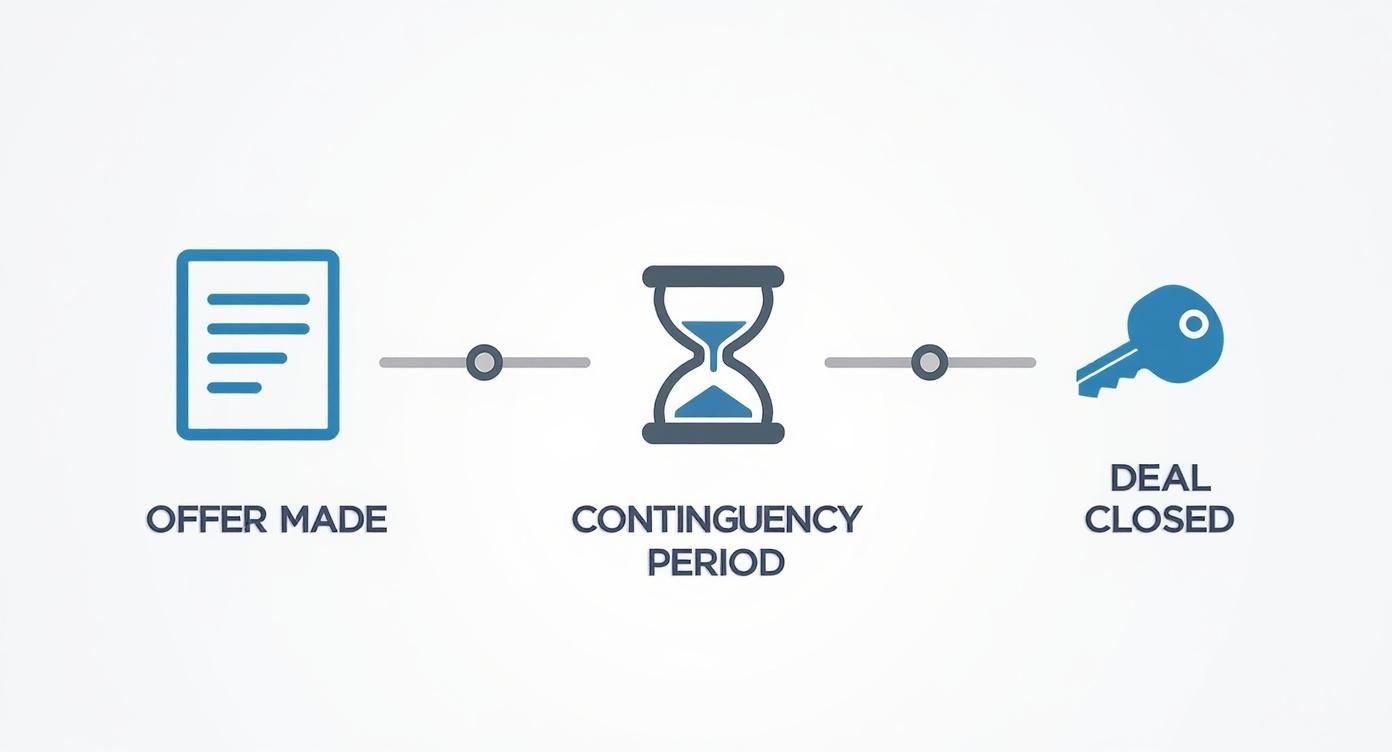
As you can see, the contingency period is where all the action happens. It’s the most uncertain phase, where the deal either solidifies or falls apart.
Negotiation Leverage in the Dallas Market
The length of these contingency periods is a huge point of negotiation. In a hot Dallas seller’s market—think Lakewood or the M Streets—sellers have the upper hand. They can push for shorter deadlines or even favor “clean” offers with fewer contingencies to reduce their risk and get to closing faster.
But when the market cools down, the tables turn. A buyer looking at homes in a less competitive area might have more leverage to ask for longer contingency periods. This gives them the breathing room they need to do their homework without being under the gun. Knowing how to negotiate a house offer is absolutely critical for both buyers and sellers to protect their interests here.
A missed deadline can be costly. If a buyer doesn’t meet a contingency deadline, they could be in breach of contract and might have to forfeit their earnest money deposit to the seller.
When Contingencies Cause Delays in Dallas
Don’t underestimate the impact contingencies can have. A significant percentage of real estate contracts in Texas face delays, and many are terminated before ever reaching closing. The culprits are often unresolved issues tied to financing, inspections, or appraisals.
In a dynamic market like Dallas, appraisal issues are a common hurdle. When home prices are moving quickly, it can be tough for the appraised value to keep up with the agreed-upon sales price.
It’s also worth noting how savvy marketing, including smart real estate video marketing strategies, can influence the negotiation dance. A property that’s marketed exceptionally well often attracts stronger, less contingent offers, which can naturally lead to a shorter, smoother timeline for everyone involved.
Winning with a Contingent Offer in Competitive Dallas Neighborhoods

Let’s be honest: making a contingent offer in hot Dallas neighborhoods like Bishop Arts or Southlake can feel like you’re climbing a mountain. But it’s not impossible. Not by a long shot.
With the right strategy, your offer can absolutely catch a seller’s eye, even when you’re up against all-cash deals. It’s all about making your offer so strong in other areas that the seller barely notices the contingency. You have to reduce their perceived risk and show them you’re the right buyer.
The first move is to beef up your offer where it counts. That often starts with the earnest money deposit. A standard deposit is around 1% of the sale price. To show you mean business, consider putting down 2-3%. This tells the seller you’re serious, confident, and have skin in the game. It’s a powerful signal of your commitment to closing the deal.
Next, let’s talk financing. A simple pre-qualification letter isn’t going to cut it here. You need to go the extra mile and get a full mortgage pre-approval from a Dallas-area lender, where they have already gone through your finances with a fine-tooth comb. This transforms your financing contingency from a question mark into a near-certainty in the seller’s mind.
Advanced Strategies to Strengthen Your Offer
Once you’ve got the basics locked down, a few more advanced moves can really set you apart. These aren’t for every person, and they depend on your comfort level with risk, but they can be incredibly effective.
- Write a Compelling Offer Letter: Don’t underestimate the human element. A heartfelt letter explaining what you love about the home and why you’re a stable, reliable buyer can sometimes be the deciding factor. It puts a face to the offer.
- Offer Flexibility on Closing: Can you work on the seller’s timeline? Maybe they need to stay in the home for a bit after closing. Offering a flexible closing date or a seller lease-back can be a massive convenience for them, making your offer much more appealing without costing you a dime.
A contingent offer doesn’t have to be a weak offer. By strengthening every other aspect of your proposal, from financing to flexibility, you create a package that a Dallas seller will take seriously.
High-Risk, High-Reward: The Option to Waive
Waiving certain contingencies is the ultimate power move, but it’s also the riskiest. This is a strategy you should never attempt without talking it through with an expert. For instance, if you have deep cash reserves for potential repairs, you might consider waiving the inspection contingency for minor fixes, while still reserving the right to inspect for major structural issues.
Waiving the appraisal contingency is another big one, but it only works if you have the cash to make up the difference if the home appraises for less than your offer price. In a market like Dallas where bidding wars are common, this can make your offer nearly as strong as cash.
Finally, there are financial tools that can get rid of the need for a home sale contingency altogether. A bridge loan can give you the money to buy the new house before you’ve sold your current one, letting you write a clean, non-contingent offer. A Home Equity Line of Credit (HELOC) can work similarly, unlocking cash for your down payment. These options can instantly turn you from a regular contingent buyer into a power buyer ready to compete with the best of them.
Common Questions About Contingent Offers in Dallas
When you’re dealing with contingent offers, a lot of questions pop up. It’s completely normal. Let’s walk through some of the most common ones I hear from buyers and sellers here in Dallas.
Can a seller take another offer if they already accepted a contingent one?
Absolutely. Sellers in Dallas can—and often do—keep showing their home and even accept backup offers after going under contract with a contingent buyer.
This is usually handled with a “kick-out clause.” Think of it as the seller’s safety net. If a better offer comes along (say, one without a home-sale contingency), the seller can give the first buyer a deadline, usually 72 hours, to drop their contingency and move forward. If the original buyer can’t, the seller can legally “kick them out” and move on to the new, stronger offer.
How long do contingencies usually last in DFW?
There’s no single answer for this; the timeline really depends on the type of contingency and how hot the Dallas market is at that moment.
- An inspection contingency is usually quick, typically wrapping up in 7-14 days.
- A financing contingency needs more time for the lender to work, so expect 21 to 45 days.
- The home sale contingency is the longest of the bunch, often running anywhere from 30 to 90 days.
Keep in mind, in a hot Dallas market, buyers who can tighten these timelines often have a serious advantage. A shorter period signals to the seller that you’re serious and ready to move quickly.
What happens to my earnest money if the deal falls through because of a contingency?
This is the whole reason contingencies exist: to protect your earnest money. If you have to walk away from the deal for a reason that’s covered by one of your contingencies, you should get your deposit back.
For instance, if your lender denies your loan application within the financing contingency window, you can cancel the contract and your earnest money is returned to you. No harm, no foul.
The key here is following the deadlines in the contract to the letter. If you miss a deadline or try to back out for a reason your contingencies don’t cover, you could lose that deposit to the seller.
Making a contingent offer work in the Dallas market takes more than just paperwork—it takes a solid strategy. At Dustin Pitts REALTOR Dallas Real Estate Agent, we’ve helped countless clients navigate this process to land their ideal homes. If you’re ready to talk strategy, reach out to us today and let’s get started.