
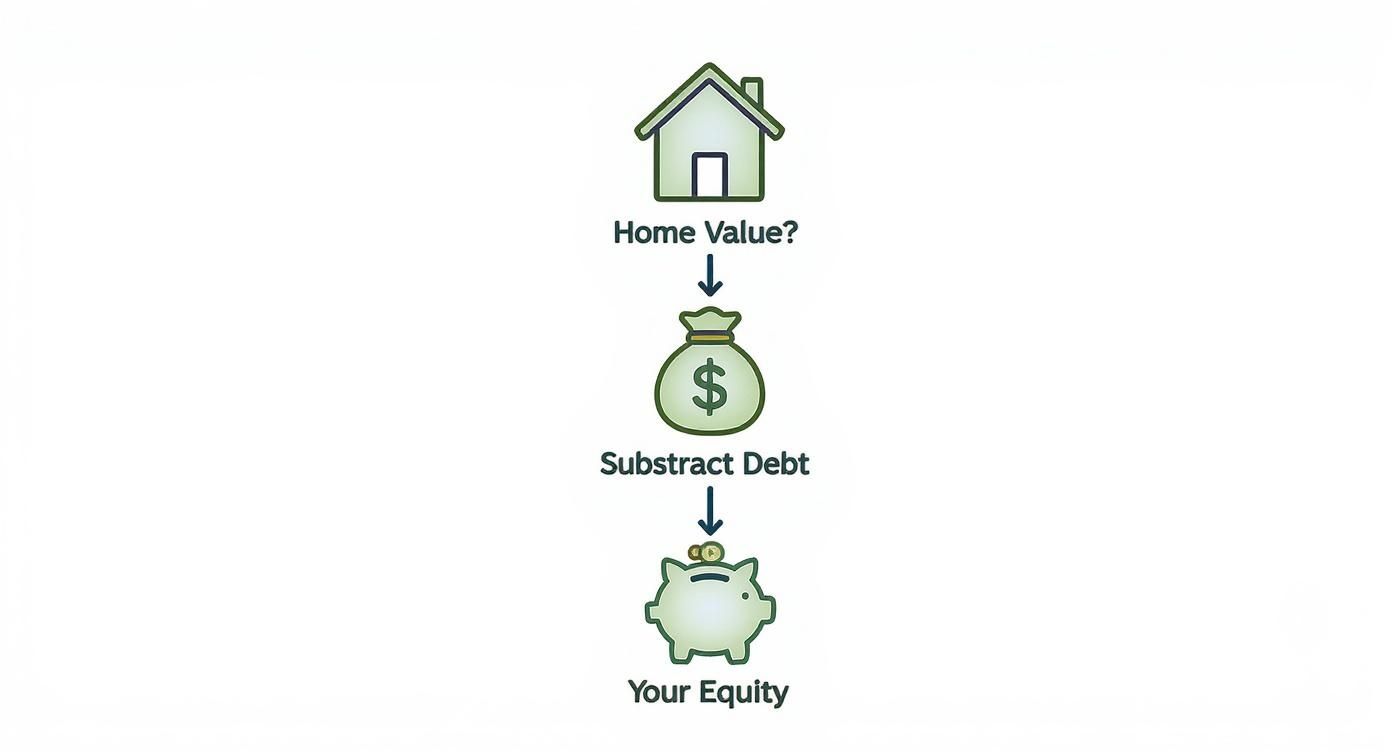
Here’s the simple truth when it comes to figuring out your home equity: you just subtract what you owe on your property from what it’s worth today. That’s it.

The formula is straightforward: Current Market Value – Total Debt = Your Home Equity. This simple calculation is the key to understanding the real financial stake you have in your Dallas home.
Your Quick Guide to Dallas Home Equity
Think of your home equity as a financial health report for your biggest asset. It’s the part of your home you actually own, completely clear of what the bank is owed. Especially here in Dallas, where property values can fluctuate based on which neighborhood you’re in, knowing this number is essential for making smart moves.
But what does this calculation really mean for you? It’s much more than just a figure on a piece of paper; it’s a direct measure of your wealth and a powerful financial tool you can tap into.
Here’s why tracking it matters:
- Selling Your Home: It gives you a solid estimate of the profit you could walk away with after a sale.
- Accessing Funds: Your equity is what you borrow against for things like a Home Equity Line of Credit (HELOC) or a home equity loan.
- Refinancing Your Mortgage: Lenders look at your equity to decide if you qualify for a refinance and on what terms.
The Basic Equity Formula
At its core, the math is simple. Let’s say your home in a Dallas neighborhood like Lake Highlands is currently valued at $450,000. If you still owe $300,000 on your mortgage, your equity is a solid $150,000. This number is your true ownership stake, free and clear of debt.
This calculation shows you exactly how much of your home you own and how much financial leverage you have. The math might be easy, but getting the inputs right—especially an accurate market value for your home—is what truly counts.
If you want to dig a little deeper into the concept, our guide on what equity is in real estate is a great place to start. Getting this initial number is the first step, but the real work is in accurately valuing your Dallas home and tracking down all the debts against it, which we’ll tackle next.
Finding Your Dallas Property’s Market Value
Before you can figure out your home equity, you need a solid number for your property’s current market value. This isn’t just a wild guess; it’s a crucial figure that reflects the unique, hyper-local trends happening right here in Dallas. What a home is worth in the Bishop Arts District, for instance, can be worlds away from a similar property in Preston Hollow. A generic online calculator often misses these critical, neighborhood-level distinctions.
The trick is to find a valuation that’s based on real-world data. We’re not just looking at today’s prices, but also considering the property’s history and the sales trends in your specific corner of Dallas. Real estate professionals live and breathe this stuff, often creating a Comparative Market Analysis (CMA) by digging into recent sales of homes just like yours. While online tools can show you a history of their estimates—Zillow, for example, offers a 10-year Zestimate history—these algorithms have their limits. Just ask any local agent.
Automated Estimators vs. Professional Analysis
So, where do you start? Many Dallas homeowners first turn to online valuation tools for a quick ballpark figure. They’re a decent starting point, but they’re spit out by an algorithm and often lack the human insight needed for true accuracy.
An automated value might not see the full picture. It can easily miss:
- Recent Upgrades: Did you just gut the kitchen or add a killer outdoor living space? An algorithm won’t know about that unless it’s been publicly recorded, and that can take time.
- Hyper-Local Nuances: An online tool might see your home’s ZIP code but miss the fact that it’s on a quiet, sought-after street while the “comps” it pulled are on a much busier road. That’s a huge difference in value.
- Property Condition: These tools work on averages. They assume your home is in average shape, completely overlooking significant wear-and-tear or, conversely, your pristine, move-in-ready interiors.
For a much sharper, more reliable figure, a Comparative Market Analysis (CMA) from a Dallas real estate professional is the gold standard for an informal valuation. A good CMA is a detailed report on recently sold properties (comps) that are genuinely similar to yours in size, location, and features. Our guide on how to determine fair market value walks you through this process in more detail.
The Role of a Formal Appraisal
Sometimes, a well-researched estimate just isn’t enough. If you’re refinancing your mortgage, applying for a Home Equity Line of Credit (HELOC), or getting any kind of loan against your property, your lender is going to require a formal appraisal.
A formal appraisal is a legally recognized, detailed valuation performed by a licensed appraiser. They conduct an in-person inspection of your home and use specific, industry-standard methodologies to determine its official value. This is the number the bank will use to approve your loan.
While we’re focused on residential property, the core principles of valuation are universal in real estate. You can even see how they apply on a larger scale in guides on how to value commercial real estate.
Ultimately, for your own calculations, using recent, local comps is the most reliable method you can use without paying for a formal appraisal. It gives you a realistic snapshot of what your home is worth today.
Tallying Up Every Dollar You Owe
Getting an accurate market value for your home is only half the battle. The other, equally crucial part of the equity equation is tracking down every single dollar you owe against your Dallas property. Your final equity number is only as good as your debt total, and trust me, it often goes beyond just your primary mortgage.
To get the real picture, you have to hunt down every lien and loan attached to your home. This is the only way to ensure your calculation is precise and not just a hopeful guess.

Looking Beyond the Main Mortgage
Your main mortgage is the obvious starting point. The number you need is the principal balance—that’s what you still owe, not the original loan amount. The easiest place to find this is on your latest monthly statement or by logging into your lender’s online portal.
But here’s where a lot of Dallas homeowners get tripped up: other debts secured by the property. You have to include every single one in your total. These commonly include:
- Home Equity Lines of Credit (HELOCs): For a HELOC, you need the current outstanding balance, not the total credit limit you were approved for.
- Home Equity Loans: This is essentially a second mortgage with a fixed amount. You’ll need to find the remaining principal owed.
- Contractor or Mechanic’s Liens: Did you have a new roof put on or a major renovation done and haven’t paid the contractor in full? They might have placed a lien on your property.
- Other Judgments: It’s less common, but sometimes other legal judgments can result in a lien against your home.
Forgetting even one of these can give you a dangerously inflated sense of your actual equity. It’s a mistake I’ve seen people make before they try to sell or refinance.
A Quick Dallas Debt Scenario
Let’s walk through a real-world example. Imagine a homeowner in Dallas’s M Streets neighborhood. Based on recent sales, they think their home is worth around $700,000. They log into their mortgage portal and see a remaining principal of $410,000.
At first glance, their equity looks like a healthy $290,000. But they forgot about the HELOC they took out for a kitchen remodel a few years back. After checking that account, they see they still owe $35,000.
The real debt isn’t just the mortgage; it’s the sum of all liabilities tied to the home. In this case, the total debt is $410,000 + $35,000 = $445,000. This drops their actual, usable equity down to $255,000.
This more complete picture is essential for making sound financial decisions. The ways homeowners have been able to access and build equity have changed so much over the years. Historical data shows that as policies shifted—like when the Federal Housing Administration lowered down payment requirements in the mid-20th century—it became easier for more people to build wealth through their homes, even with larger initial loans. Today, understanding your full debt load is just a non-negotiable part of getting an accurate financial snapshot in the Dallas market.
Dallas Home Equity Calculations in Action
Alright, let’s put this into practice. Theory is great, but seeing real numbers from familiar Dallas neighborhoods is where the concept of home equity really clicks. It’s one thing to know the formula; it’s another to see how a hot market or years of steady payments can dramatically change your financial picture.
To show you what I mean, we’ll walk through two very different homeowner situations. One is a home in a rapidly appreciating neighborhood like Oak Cliff, and the other is a property in a stable, established suburb like Plano. This will give you a solid feel for how to calculate home equity in the real world.
Scenario 1: Riding the Appreciation Wave in Oak Cliff
Let’s imagine a homeowner who bought a renovated craftsman in the Bishop Arts District about five years ago. This area has been on fire, and that market momentum has done wonders for their net worth.
Here’s how the numbers stack up:
- Current Estimated Market Value: Based on recent comps, their home could now sell for $625,000.
- Original Mortgage Balance: They initially borrowed $400,000.
- Remaining Mortgage Balance: After five years of paying it down, they now owe $371,000.
- Other Debts: They haven’t taken out any other loans against the property.
So, let’s do the math:
$625,000 (Market Value) – $371,000 (Total Debt) = $254,000 in Home Equity
In just five years, they’ve built an impressive $254,000 in equity. The lion’s share of that came from market appreciation ($225,000!), while their principal payments chipped in a solid $29,000.
Scenario 2: The Power of Consistency in Plano
Now, let’s head north to Plano. A homeowner bought their home here ten years ago. Appreciation in their neighborhood has been solid but not as explosive as in central Dallas. For them, the story is more about the slow-and-steady power of paying down their mortgage.
Here’s their financial snapshot:
- Current Estimated Market Value: The home is now worth around $550,000.
- Original Mortgage Balance: Their initial loan was for $380,000.
- Remaining Mortgage Balance: A decade of consistent payments has brought the principal down to $295,000.
- HELOC Balance: They took out a Home Equity Line of Credit a few years back for a kitchen remodel and still have a $30,000 balance.
The calculation here has one extra step:
$550,000 (Market Value) – ($295,000 Mortgage + $30,000 HELOC) = $225,000 in Home Equity
Remember, all debts tied to the property count. Combining the mortgage and HELOC gives us a total liability of $325,000. Subtracting that from the market value reveals their true equity position of $225,000.
To help visualize how these factors play out, here’s a side-by-side comparison of our two Dallas-area homeowners.
Dallas Home Equity Calculation Scenarios
| Metric | Scenario 1: Oak Cliff Property | Scenario 2: Plano Property |
|---|---|---|
| Years Owned | 5 Years | 10 Years |
| Current Market Value | $625,000 | $550,000 |
| Primary Mortgage Owed | $371,000 | $295,000 |
| Other Property Liens | $0 | $30,000 (HELOC) |
| Total Property Debt | $371,000 | $325,000 |
| Total Home Equity | $254,000 | $225,000 |
| Main Equity Driver | Market Appreciation | Principal Paydown |
As you can see, the path to building equity isn’t one-size-fits-all. The Oak Cliff owner benefited from a hot market, while the Plano owner built wealth through long-term discipline. Both approaches are powerful, and seeing them laid out like this really drives home how your specific situation and neighborhood trends influence your financial standing.
How to Use Your Dallas Home Equity
Alright, you’ve crunched the numbers and figured out your home equity. Now what? That number isn’t just for show; it’s a powerful financial asset sitting right under your roof. For Dallas homeowners, knowing how to tap into this value can be a game-changer, whether you’re dreaming of a big renovation or looking for a smarter way to manage your finances.
Think of your equity as the value you’ve built up in your home. In a hot market like Dallas, lenders see that value as solid collateral, making it easier for you to borrow against your ownership stake for all sorts of goals.

Unlocking Your Equity with Loans and Lines of Credit
The most common ways to access your home’s value are through a home equity loan or a Home Equity Line of Credit (HELOC). They sound similar, but they work quite differently.
A home equity loan gives you a single, lump-sum payment with a fixed interest rate. It’s perfect for a big, one-time expense, like finally remodeling that kitchen in your Lakewood home or covering a large chunk of college tuition.
A HELOC, on the other hand, works more like a credit card. You’re approved for a specific credit limit and can draw money as you need it, paying interest only on what you use. This flexibility is ideal for ongoing projects with unpredictable costs or for having a financial safety net ready to go. If you’re curious about the specifics, you can learn more about what a Home Equity Line of Credit is and see if it’s the right fit for you.
Understanding Loan-to-Value Ratios in Dallas
Before a lender hands you any money, they’re going to look closely at your Loan-to-Value (LTV) ratio. This is the key metric that determines how much you can borrow. It’s a simple calculation: your total loan amount divided by your home’s current appraised value.
Lenders typically want your combined LTV—that’s your original mortgage plus the new loan or HELOC—to stay at or below 80% to 85%. This buffer gives them a cushion in case the market shifts.
Let’s run through a quick example. Say your Uptown condo is valued at $500,000, and you still owe $300,000 on the mortgage. Your current LTV is 60% ($300k / $500k). A lender might allow you to borrow up to $100,000 more, bringing your total debt to $400,000 and pushing your combined LTV to 80%.
Other Smart Ways to Use Your Home Equity
Borrowing isn’t the only way to put your equity to good use. Here are a few other strategic moves Dallas homeowners often make:
- Make Your Next Move Easier: Having a lot of equity means you’ll pocket more cash when you sell. That profit can become a massive down payment on your next home, helping you move up to a better neighborhood or a bigger house without a giant mortgage.
- Refinance for a Better Deal: Once you have at least 20% equity, you’re in a prime position to refinance. You could snag a lower interest rate, shorten the life of your loan, or finally get rid of that pesky Private Mortgage Insurance (PMI), saving you a bundle over time.
- Fund Other Investments: Some savvy owners tap into their equity to buy an investment property in a fast-growing Dallas suburb or to finance a new business. This approach definitely carries more risk, but the potential for serious financial growth is there.
Knowing your equity number is just the first step. The real power comes from understanding how to strategically use that value to hit your financial goals.
Common Questions About Dallas Home Equity
Once you get the hang of the basic formula, you’ll find that real-world situations here in Dallas bring up some specific questions. Let’s tackle a few of the most common ones I hear from homeowners.
How Often Should I Calculate My Dallas Home Equity?
With a market as active as ours, a yearly check-in is a great rule of thumb. Think of it as an annual financial physical for your biggest asset. It keeps you tuned in to how your net worth is tracking with the local market.
That said, you’ll want to run the numbers more often if you’re planning a big financial move. Gearing up for a major renovation? Thinking about refinancing? Getting ready to sell? Each of these is a perfect time to get an up-to-date equity figure. Honestly, in some of our faster-moving Dallas neighborhoods, even a quick calculation every six months can reveal some pretty significant changes.
Do Property Taxes Affect My Home Equity Calculation?
This is a great question, and the answer has two parts: directly and indirectly.
Directly, no. Your regular property tax and HOA payments are considered running costs of homeownership. They don’t factor into the equity formula itself.
But they can have an indirect impact. A home with unusually high taxes or HOA dues might be less appealing to buyers, which could subtly influence its market value. The most crucial thing is to never fall behind on those payments. A delinquent tax bill can lead to a lien on your property, and a lien is a debt that absolutely reduces your equity until it’s paid off.
When calculating equity, always stick to the core formula: Market Value minus Secured Debts. Running costs like taxes only become part of that equation if they turn into a formal lien against your home.
What Is the Difference Between a CMA and an Appraisal?
It’s easy to get these two mixed up, but knowing the difference is key when you’re trying to pin down your home’s value here in Dallas.
- Comparative Market Analysis (CMA): This is what a REALTOR® like me puts together for you. It’s a detailed report based on what similar, nearby homes have recently sold for. We use it to get a sharp, real-time estimate of your home’s value, usually to figure out the best list price.
- Official Appraisal: This is a formal valuation done by a state-licensed appraiser. Lenders absolutely require an appraisal for any transaction involving a mortgage—whether you’re buying, refinancing, or opening a HELOC. It’s their way of confirming the property’s value as collateral for the loan.
The easiest way to think about it is this: a CMA is a savvy, educated estimate to guide your decisions. An appraisal is the official number that banks will use to lend money.
Getting the details right in the Dallas market is what separates a good guess from a smart financial move. If you’re ready for a professional, data-driven look at your home’s value and equity, Dustin Pitts REALTOR Dallas Real Estate Agent can provide the clarity you need. Let’s connect and review your numbers—reach out for a personalized consultation at https://dustinpitts.com.