
Negotiating your real estate commission is a business conversation, plain and simple. It’s not personal. The secret is knowing that the typical 5-6% commission in Dallas isn’t set in stone—it’s always negotiable. If you walk into that conversation with solid Dallas market data and a clear grasp of what you bring to the table as a client, you’re already ahead of the game.

Decoding Realtor Commissions in the Dallas Market
Before you can really start negotiating, you need to know exactly what you’re negotiating about. Here in the Dallas-Fort Worth metroplex, the standard commission usually lands somewhere between 5% and 6% of the home’s final sale price. But that’s just a starting point, not a legal requirement.
It’s also crucial to understand that this entire amount doesn’t just go into your agent’s pocket. The total commission is almost always split, typically 50/50, between the agent representing you (the listing agent) and the agent who brings the buyer. From there, each agent gives a cut to their brokerage. Knowing this helps you see the full picture—your agent isn’t keeping that entire percentage.
Even a small reduction can mean a huge difference in your bottom line.
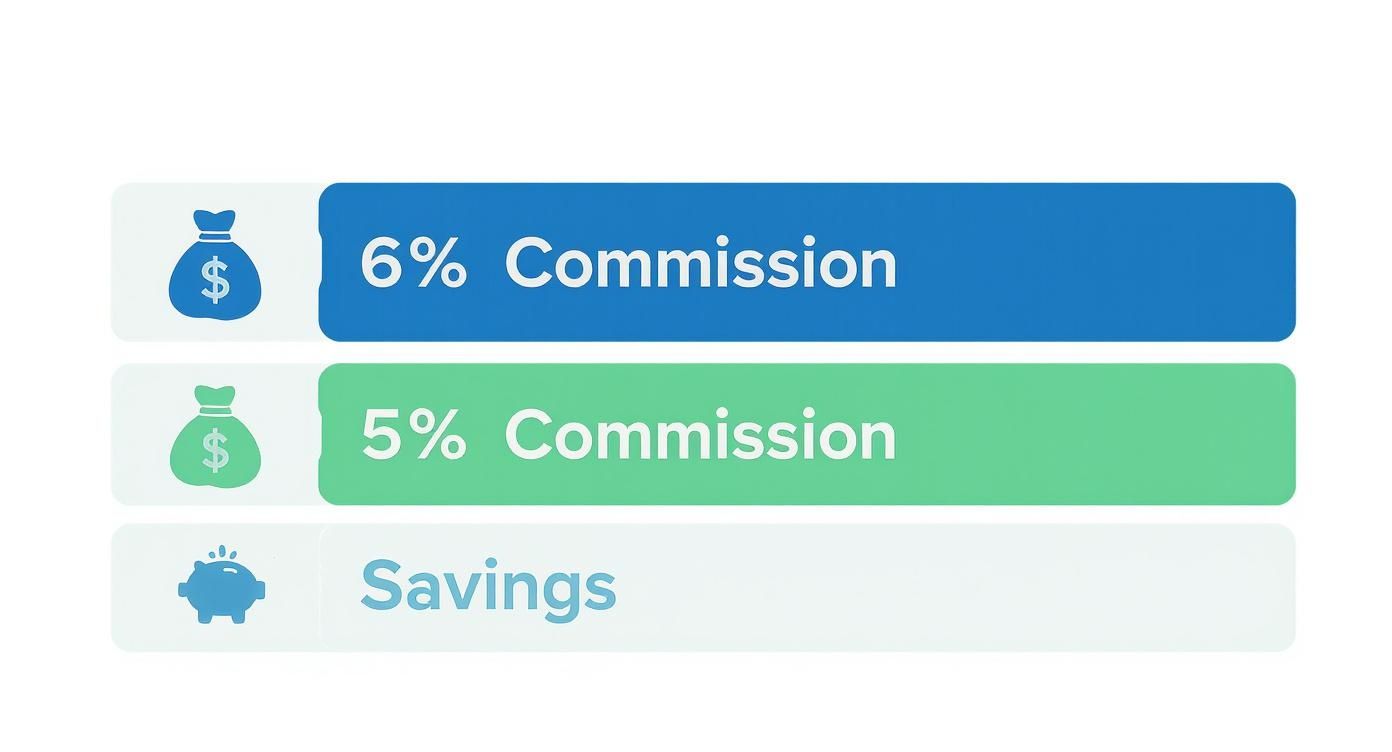
As you can see, dropping the commission from 6% to 5% on a typical Dallas home leaves thousands of extra dollars with you after closing.
How Dallas Market Dynamics Influence Negotiation
The DFW real estate scene is anything but one-size-fits-all, and local market conditions are a big factor in how flexible an agent can be. Honestly, an agent’s willingness to negotiate often comes down to how much work they think your sale will be.
- Hot Seller’s Markets: Think of fast-paced suburbs like Frisco or Plano. If your home is priced right, it might get multiple offers over a single weekend. In these cases, agents might be more open to a reduced rate because a quick sale means less of their time and marketing budget is spent.
- Balanced or Buyer’s Markets: In more established Dallas neighborhoods like Lakewood or even up in Preston Hollow, a sale might take a bit longer. When a home is on the market for an extended period, it means more marketing dollars and more hours from the agent, making them less likely to discount their fee.
Here’s the bottom line: An agent’s commission covers a ton of work—professional photos, digital marketing, open houses, and countless hours of coordination you never see. Your negotiation should focus on the value exchange, not just the price tag.
Talking about commissions is becoming more common in Dallas. A recent survey showed that nearly 37.4% of home sellers tried to negotiate their agent’s fee in the last year. It’s a clear sign that people are starting to question the standard rates.
The Financial Impact of a 1% Difference
Let’s run the numbers on a real-world Dallas example. The median home price here is always changing, but we’ll use a round $400,000 for this illustration.
The table below breaks down what a 1% difference really looks like in your wallet.
| Commission Rate | Total Commission Paid | Your Potential Savings |
|---|---|---|
| 6.0% | $24,000 | $0 (Baseline) |
| 5.5% | $22,000 | $2,000 |
| 5.0% | $20,000 | $4,000 |
That 1% reduction gives you an extra $4,000. That’s serious money you can put toward closing costs, moving trucks, or new furnishings for your next home. This simple math shows why knowing how to negotiate real estate commission is one of the most valuable skills you can have as a Dallas property owner.
To truly understand an agent’s commission, it helps to know what goes into their business, including how they find clients in the first place. Learning about the Top Real Estate Lead Generation Companies can shed some light on the overhead costs baked into their fees. For a more detailed breakdown of how compensation works, you can read our deep dive on https://dustinpitts.com/uncategorized/real-estate-agent-commission-rates/.
Building Your Negotiation Game Plan
A successful commission negotiation doesn’t start with a tough conversation. It starts long before you ever sit down with an agent. You need to build a solid game plan based on local Dallas data, your home’s unique selling points, and a crystal-clear picture of your financial goals. This prep work is your foundation for a confident, business-like discussion.
First things first, you have to get a feel for what’s typical right here in Dallas-Fort Worth. National averages are one thing, but they don’t tell you what’s happening in Southlake versus the Bishop Arts District. Do a little digging on what sellers with homes similar to yours are actually paying. This gives you a realistic benchmark, not just a national statistic.
Speaking of national numbers, it’s interesting to see that the average commission across the U.S. is around 5.57%. Many people expected that number to drop after some recent industry lawsuits, but it’s actually ticked up slightly. It’s worth reading up on these national commission rate trends just to have the bigger picture in mind.
Assess Your Property’s Leverage
Your home’s marketability is your biggest bargaining chip. Period. An agent’s flexibility on their fee is almost always tied to how much time and money they think it’ll take to sell your place. A turnkey property in a hot Dallas neighborhood is a powerful asset.
Here are a few leverage points that really matter in the Dallas market:
- Move-In Ready Condition: Is the paint fresh? Is it decluttered and professionally cleaned? The less an agent has to advise you on (or pay for out of pocket), the more attractive your listing is. That gives you an edge.
- Location, Location, Location: This old cliché is everything. Being zoned for a top-tier school district like Highland Park ISD or having the walkability of a neighborhood like Lower Greenville are massive selling points that can mean a quick sale.
- Favorable Market Timing: Listing during the peak spring selling season in Dallas, when buyers are out in full force, naturally speeds up the process. A faster, easier transaction is always a plus for an agent.
The concept is simple: The easier you make the agent’s job, the more open they might be to discussing their commission. You’re bringing them a high-quality product that’s ready to go.
Define Your Financial Bottom Line
Before you talk to a single agent, you need to know your numbers cold. This isn’t just about your dream sale price. You need to calculate your estimated closing costs, figure out your mortgage payoff, and account for any other expenses to find your true net proceeds.
When you have that bottom line, you can see exactly what a 0.5% or 1% commission reduction actually means for the cash in your pocket. This clarity keeps you from getting emotional during a negotiation and agreeing to something that doesn’t actually hit your financial target.
Create a Competitive Environment
Here’s one of the most effective things you can do: interview multiple agents. This isn’t about finding the cheapest person. It’s about creating a dynamic where top Dallas agents have to prove their value to win your business.
Set up interviews with at least three different agents from respected Dallas brokerages. In each meeting, have them walk you through their specific marketing plan for your home and justify their proposed commission. When agents know they’re competing, they’re far more likely to put their best foot forward—both in the services they offer and the fee they charge. This process ensures you find a true expert whose price is justified by their value.
Proven Tactics for Dallas Home Sellers
https://www.youtube.com/embed/BLBRRNwMZNE
Alright, you’ve done your homework and have a clear game plan. Now it’s time to actually talk to agents. Negotiating in a market like Dallas requires a specific touch—what works for a starter home in Plano might not fly for a luxury estate in Preston Hollow.
The real key is to change the conversation entirely. Don’t make it about haggling over a percentage point. Instead, frame it as a discussion about performance, value, and partnership. You need to confidently lead the negotiation by connecting their commission directly to their marketing plan and the results you expect.
Start with Performance, Not Price
When you sit down with a potential agent, resist the urge to jump straight to the commission question. That can put them on the defensive. Instead, have them walk you through their exact marketing strategy for your home. This immediately establishes a professional, business-first dynamic.
Get specific. Show them you know what you’re talking about.
- “What’s your digital marketing plan for targeting buyers specifically looking in the Park Cities?”
- “Could you give me a rough breakdown of how my commission would be used for marketing expenses?”
- “My M Streets home has some unique architectural features. How will you make sure those stand out in photos and descriptions?”
See the difference? You’re not just asking for a discount; you’re asking them to justify their fee with a concrete plan. This makes the transition to the money talk feel much more natural.
Here’s a way to phrase it: “I’m really impressed with the marketing plan you’ve laid out. My home is in turnkey condition and sits in a top-tier school district, so I expect it to move quickly with your strategy. To reflect that, I’d be more comfortable with a listing commission of 2.5%.”
This approach validates their expertise while using your home’s strong points as the reason for the proposed rate. It’s collaborative, not confrontational.
Pitch a Tiered Commission Structure
One of the most effective strategies I’ve seen work in Dallas is proposing a performance-based or tiered commission. This is a fantastic way to incentivize your agent to shoot for the highest possible price. It shows you’re happy to pay for top-dollar results.
Let’s say you’re selling a home in Lakewood with a target price of $850,000. You could structure the deal like this:
- 5.0% total commission if the home sells at or below your asking price.
- 5.5% total commission if it sells for between $850,001 and $875,000.
- 6.0% total commission if the final sale price is over $875,000.
This creates a true win-win. The agent is now highly motivated to push past your goal because it puts more money directly in their pocket. It turns the whole dynamic into a partnership, which is always more productive than a simple tug-of-war over fees.
Know When You Have the Upper Hand
Your negotiating position isn’t static; it gets a lot stronger in certain situations. If you’re bringing an agent a listing that’s easier, more profitable, or more prestigious than their average deal, you have more room to negotiate.
For example, if you’re selling a high-value property in Highland Park or Preston Hollow, the agent’s payday is substantial even with a lower commission rate. A 1% reduction on a $2 million home is still a huge win for them, making them far more likely to be flexible.
A script for a high-value home: “At this price point, a 4.5% total commission still provides a very strong payout for both agents. I feel this rate is more aligned with Dallas’s luxury market, and I’d like to move forward on that basis.”
The same logic applies if you have a practically guaranteed quick sale on your hands—maybe an all-cash offer from a friend is already on the table. Here, the agent’s job is less about marketing and more about transaction management. Their time, effort, and marketing spend are cut dramatically, which absolutely justifies a lower fee. In a scenario like that, you should be pushing for a flat fee or a significantly reduced percentage.
How Dallas Home Buyers Can Negotiate Fees
For years, negotiating real estate commission was a conversation reserved for sellers. That’s not the case anymore. Recent shifts in the industry have given Dallas home buyers a brand-new seat at the negotiating table, and it’s critical to talk about agent compensation before you sign a buyer representation agreement.
Frankly, the old assumption that the seller just magically covers the buyer’s agent fee is on its way out. You now have a direct financial stake in this discussion, and understanding that is the first step toward getting a fair deal that matches the work you actually need done.
Timing Your Conversation Correctly
Don’t wait until you’re emotionally invested in a home in Lakewood or Uptown to bring up fees. The best time—the only time, really—is during your initial interviews with potential agents. Bringing it up later is just awkward for everyone.
Treat it like you’re hiring any other professional. A simple, direct opener works wonders. Try something like, “Before we get started, I’d like to understand your fee structure and discuss how it aligns with the services I’ll need.” This frames it as a business discussion, not a confrontation.
Tailoring the Fee to Your Needs
Why should a buyer who found their dream home online in a weekend pay the same fee as someone who needs six months of guided tours? They shouldn’t. Your power to negotiate comes from clearly defining the scope of work you expect from an agent.
Think about how different Dallas buyer situations can be:
- The Relocating Professional: You’re moving here for a job downtown and have already picked out three condo buildings in the Arts District you want to see. Since you’ve done most of the homework, you can make a strong case for a lower fee or a flat rate just for writing the offer and managing the closing.
- The Experienced Investor: You’re hunting for your next rental property near SMU and know the exact numbers you need to hit. Your agent is there for access and execution, not education. That limited scope absolutely warrants a reduced commission.
- The First-Time Buyer: You need the whole package—help finding a lender, understanding East Dallas vs. Oak Cliff, and guidance through every step. A full-service commission makes more sense here, but it’s still smart to have the conversation so you know exactly what value you’re getting for that fee.
By laying out your specific needs, you change the conversation from a generic percentage to a value-based proposal. That’s how you successfully negotiate as a buyer in this new environment.
Practical Negotiation Approaches for Buyers
Once you’ve established the workload, you can get into specifics. Remember, everything is on the table, from percentages to flat fees. The goal is to land on a number that fairly pays the agent for their expertise and time.
Here are a few ways to approach it:
- Propose a Flat Fee: “I’ve already narrowed my search to three specific properties in Richardson. Would you be open to a flat fee to handle the offer, negotiations, and closing process?”
- Discuss a Reduced Percentage: “I’m pre-approved and ready to move quickly. Since my search will be pretty straightforward, I’d like to discuss a buyer’s agent commission of 2%.”
The secret is showing you’re an organized, decisive client. An agent who sees a clear and relatively quick path to a closing is almost always more willing to be flexible on their fee. To get a better handle on the traditional payment models, it helps to read up on who pays Realtor fees in Texas in our detailed guide. Knowing the baseline will make your conversation that much more effective.
Understanding the Legal Rules in Texas
When you sit down to talk about real estate commissions in Dallas, it’s more than just a business chat—you’re working within a legal framework. Knowing the ground rules, set by the Texas Real Estate Commission (TREC), is your best defense. It keeps everything fair and transparent.
Here’s the most important thing you need to know: real estate commissions in Texas are always negotiable. Period. There’s no such thing as a “standard” or “official” rate in Dallas or anywhere else in the state. If an agent tells you otherwise, that’s a major red flag, and they’re likely violating professional ethics.
That knowledge is power. It gives you the legal standing to open up a conversation, ask questions, and propose a fee structure you’re comfortable with.
Spotting Unethical Pressure Tactics
Since commissions are legally negotiable, you have to be on the lookout for certain pressure tactics. A good agent’s job is to prove their value, not to bend the truth about the law to get a higher fee.
Keep an ear out for phrases like these:
- “My broker makes me charge a 6% commission.”
- “The standard rate for a home like yours in Dallas is X%.”
- “It’s against the rules for me to charge less than the going rate.”
Statements like these are designed to shut down the negotiation before it even starts. A true professional will have an open conversation about their fees and explain them based on the services they deliver, not by leaning on imaginary rules.
Knowing your rights is your strongest negotiation tool. The law is firmly on your side, ensuring you can have a fair discussion about fees. An agent who misrepresents TREC rules to pressure you isn’t the partner you want for such a significant financial move.
Get Your Negotiated Rate in Writing
A handshake and a smile aren’t enough. Once you’ve landed on a commission structure—whether it’s a straight percentage, a tiered rate, or a flat fee—you absolutely must get it documented in writing. This isn’t about mistrust; it’s just smart business that protects everyone involved.
The rate you agree on becomes a legally binding part of your contract.
- For Sellers: The commission will be clearly spelled out in the listing agreement you sign.
- For Buyers: The details will be laid out in your buyer representation agreement.
Putting it on paper clears up any potential for confusion later on. It guarantees the terms you talked about are the ones that will be honored at the closing table. Before your pen ever touches that paper, double-check that the numbers in the contract perfectly match what you agreed to verbally.
To get a better handle on this critical document, it’s worth understanding what a listing agreement entails and why every single detail is so important. This step makes your negotiation official and protects your bottom line throughout the entire process.
Common Questions on Dallas Commission Negotiation
Diving into the Dallas real estate market can feel overwhelming, and agent commissions often top the list of concerns. Having clear answers before you even start talking to agents gives you the confidence to have a productive, business-like conversation about their fees.
Here are some of the most frequent questions I hear from sellers and buyers in Dallas, answered straight up.
What Is a Realistic Real Estate Commission in Dallas?
There’s no law setting a “standard” rate, but in practice, you’ll often see commissions in the Dallas area land somewhere between 5% and 6% of the home’s final sale price. Remember, that’s the total commission, which gets split between the seller’s agent and the buyer’s agent.
Think of that range as a starting point, not a hard-and-fast rule. The actual rate is always up for discussion and can shift based on a few key factors:
- Property Value: An agent might be more flexible on the percentage for a high-dollar home in Preston Hollow, since their final paycheck will still be significant.
- Market Conditions: When homes in Frisco are getting multiple offers in a single weekend, an agent might see a faster, easier payday and be willing to adjust their rate.
- Scope of Work: The depth of an agent’s marketing plan and the specific services they’re bringing to the table play a huge role in justifying their fee.
Can I Negotiate the Buyer’s Agent Commission as a Seller?
Absolutely. As the seller, you’re the one paying the commission, so you have the final say on the total amount offered in your listing agreement. You and your listing agent will decide how that total pie is split, including the portion offered to the agent who brings the buyer.
But tread carefully here. While you can offer a lower co-op commission, being too aggressive can backfire. Offering a rate that’s way below the Dallas market average might discourage some buyer’s agents from showing your home. It’s a delicate balancing act. A good agent will advise you on what’s competitive for your neighborhood to make sure you attract the biggest possible pool of qualified buyers.
The goal is to set a buyer’s agent commission that’s attractive enough to get your property maximum exposure. More showings from motivated agents often lead directly to a better final sale price.
When Is the Right Time to Bring Up the Commission Rate?
The best time—really, the only time—to negotiate commission is before you sign anything. Once that listing agreement or buyer representation agreement is signed, the terms are locked in and legally binding.
If you’re selling, this conversation needs to happen during your initial interviews with potential agents. It’s the perfect moment to compare not just their fees, but the total value and marketing plan each one offers. For buyers, the talk should happen before you sign a buyer representation agreement, ensuring you’re aligned on compensation from day one.
Should I Use a Discount Broker in Dallas to Save Money?
The appeal of a discount or flat-fee brokerage is obvious—lower upfront costs. But it’s crucial to look past the sticker price and understand what you might be giving up. These services often run on an à la carte model.
This means you might be paying extra for things a full-service agent includes, like professional photography, virtual tours, or a robust digital ad campaign. For a unique property in the M Streets or a luxury home that needs a sophisticated touch, the expertise and network of a full-service agent can easily generate a higher sale price that more than covers the difference in commission. It all comes down to what you need to get your specific home sold in a competitive market like Dallas.
Navigating the Dallas real estate market requires an expert guide who understands the local nuances of negotiation and value. At Dustin Pitts REALTOR Dallas Real Estate Agent, we provide the strategic advice and market knowledge you need to achieve your goals. Whether you are buying or selling, we are committed to securing the best possible outcome for you. Start your Dallas real estate journey with an expert on your side.