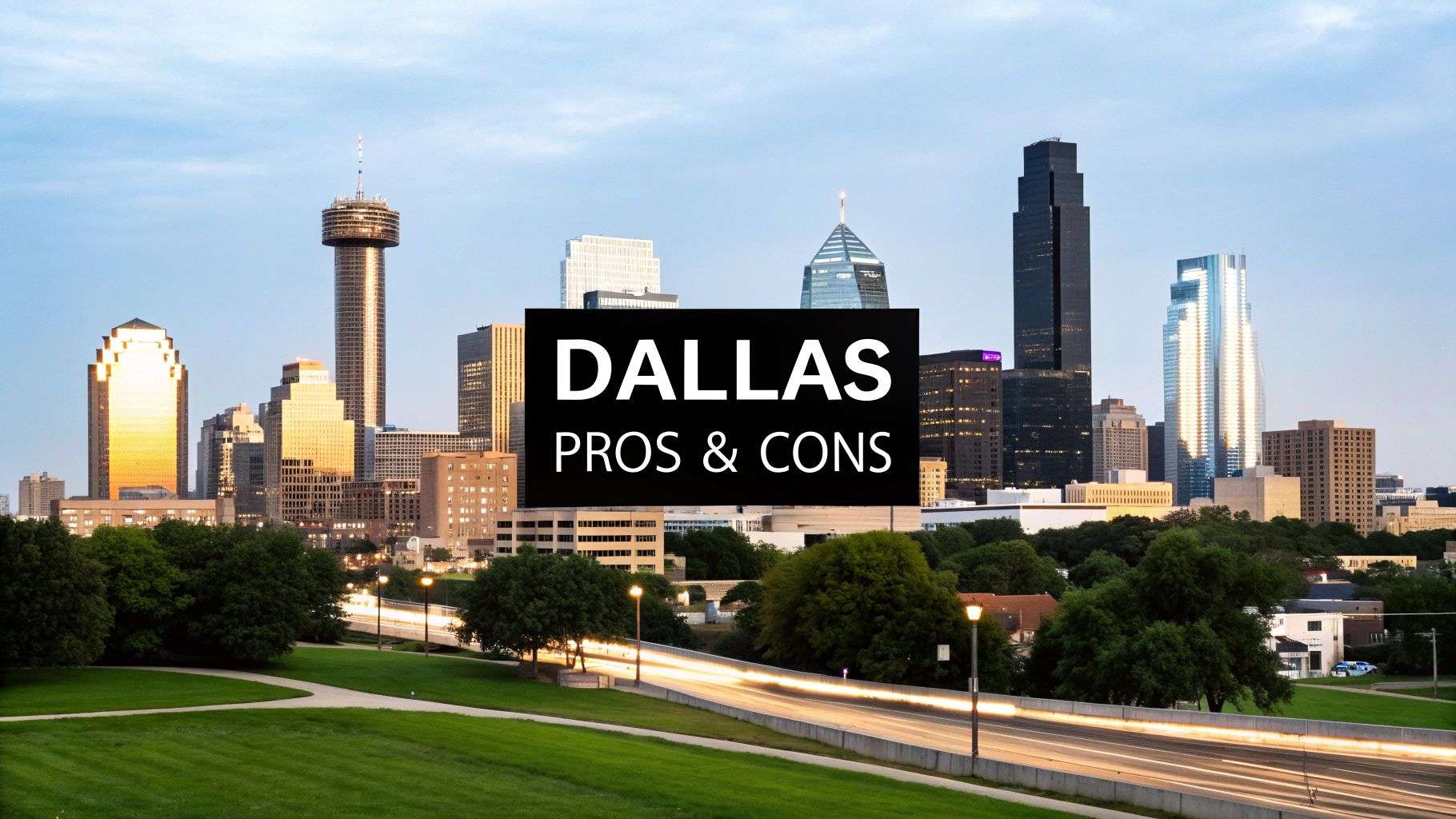
Dallas is a magnet for growth, drawing professionals and newcomers with its booming job market and vibrant culture. But what is it really like to live here? Beyond the headlines of corporate relocations and low taxes lies a complex city with distinct advantages and real challenges. This guide cuts through the noise to provide a balanced, in-depth look at the living in Dallas pros and cons. We will move beyond the typical highlights to offer a clear-eyed perspective on the day-to-day realities of calling this North Texas hub home.

This is not a generic overview. We will explore ten critical factors that directly impact your quality of life and financial outlook. These include the nuances of the cost of living, from housing affordability in sought-after neighborhoods to the state’s significant property tax burden. We will also analyze the robust job market, the infamous traffic, and the often-extreme weather patterns.
By examining real data, neighborhood specifics, and practical insights, you will gain the information needed to decide if Dallas truly aligns with your lifestyle and career goals. This detailed breakdown provides the substance required for an informed relocation or home-buying decision. Let’s dive into the essential details that will shape your Dallas experience.
1. Pro & Con #1: The Financial Equation of Cost of Living and Housing
One of the most compelling arguments for living in Dallas is its unique financial landscape, which presents both significant advantages and critical trade-offs. The primary draw is Texas’s lack of a state income tax, a direct financial benefit that increases take-home pay for every resident. This creates immediate purchasing power that is often a deciding factor for professionals relocating from high-tax states.
The Affordability Advantage vs. Hidden Costs
While housing has appreciated, Dallas still offers remarkable value compared to coastal markets. A spacious home in a desirable Dallas suburb might cost $400,000, while a comparable property could easily exceed $1.2 million in a city like San Francisco. However, this affordability comes with a major caveat: Texas has some of the highest property tax rates in the nation. Budgeting for an annual property tax bill of approximately 2% of your home’s assessed value is essential. When evaluating your finances, you must also account for household upkeep. For instance, understanding the potential appliance repair costs for high-end appliances in North Dallas is crucial for homeowners in upscale neighborhoods.
Actionable Financial Strategies
- Model Your Net Income: Before moving, use an online calculator to see how the absence of state income tax directly offsets the high property tax burden based on your specific salary and potential home price.
- Explore Diverse Neighborhoods: While areas like Preston Hollow command premium prices, exploring unique neighborhoods like Oak Cliff or The Cedars can reveal distinctive housing stock at more accessible price points.
- Budget for Property Taxes: Factor a monthly escrow payment for property taxes into your housing budget from day one to avoid a large and unexpected annual bill. This is a non-negotiable part of the Dallas cost of living.
2. Pro & Con #2: Job Market and Economic Opportunities
Dallas boasts one of the most dynamic and robust job markets in the United States, a key factor that pulls professionals from across the country. The city’s diverse economy is a major pro for those living in Dallas, anchored by major corporations across multiple sectors like telecommunications, finance, technology, and logistics. This economic resilience translates into consistent job creation and abundant opportunities for career advancement.

The Corporate Powerhouse vs. Competitive Landscape
The sheer number of corporate headquarters, including AT&T, Southwest Airlines, and Texas Instruments, provides a stable employment base. The growing tech corridor in areas like Las Colinas and North Dallas further fuels this growth. However, this vibrant market creates a highly competitive landscape; top-tier roles often attract a national pool of applicants. While opportunities are plentiful, securing a position requires a strategic approach and a strong professional network. For more detailed insights, you can explore this overview of the job market in Dallas, Texas.
Actionable Career Strategies
- Target Key Industries: Focus your job search on Dallas’s high-growth sectors, such as financial services, healthcare technology, and logistics, where demand for skilled professionals is consistently strong.
- Leverage Networking Events: Actively participate in professional meetups and industry-specific events held in hubs like Downtown, the Arts District, and the technology parks to build critical connections.
- Join Professional Organizations: Engage with Dallas chapters of professional associations in your field to gain local insights and access a network of established executives and specialists.
3. Pro & Con #3: Traffic and Transportation Infrastructure
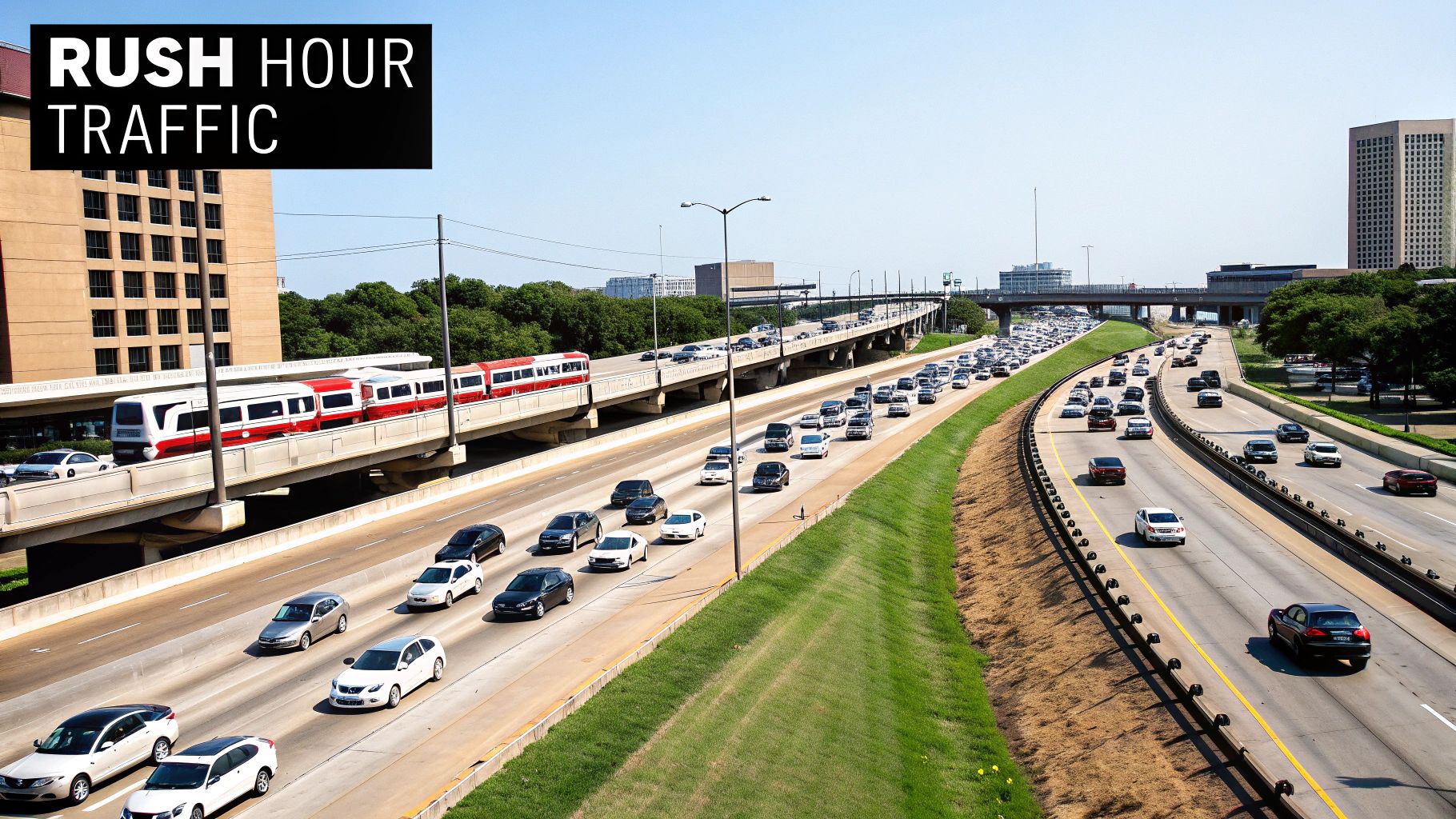
Navigating Dallas requires a realistic understanding of its transportation landscape, a defining factor in the daily lives of its residents. The Metroplex is overwhelmingly car-dependent, with a sprawling network of highways and tollways that form the primary arteries of movement. This infrastructure is both a pro, offering extensive reach, and a major con, creating significant traffic congestion that is a core part of the living in Dallas pros and cons debate.
The Commuting Reality vs. Strategic Living
The reliance on personal vehicles is a critical consideration. Major thoroughfares like the Dallas North Tollway handle hundreds of thousands of vehicles daily, leading to predictable rush-hour bottlenecks. While Dallas Area Rapid Transit (DART) offers a light rail system connecting downtown to various suburbs, its service frequency and reach may not be sufficient for everyone, particularly outside of standard business hours. This makes commute times a crucial variable when selecting a neighborhood. Exploring the nuances of the system can provide valuable insights; you can learn more about public transportation options in Dallas to see if it aligns with your lifestyle.
Actionable Transportation Strategies
- Prioritize Proximity: When searching for a home, heavily weigh the commute to your primary destinations, such as your workplace or social hubs. A shorter drive can dramatically improve your quality of life.
- Leverage DART: If your work is near a DART station, consider living along the same rail line. Neighborhoods like Uptown, the Cedars, or areas near the Red Line in Plano offer more transit-friendly options.
- Budget for Mobility: Factor transportation costs beyond just a car payment. Include a monthly budget of $200-$300 for fuel, tolls, and routine vehicle maintenance, as this is a significant and recurring expense in a car-centric city.
4. Pro & Con #4: Weather and Climate Conditions
Dallas’s climate is a study in extremes, offering mild, enjoyable winters at the cost of intensely hot summers and the risk of severe weather. The humid subtropical climate means residents can often enjoy outdoor activities from October through April, a significant pro for those escaping harsh northern winters. This mild season provides a long window for everything from patio dining to exploring the city’s extensive park systems.
The Trade-Off: Extreme Heat and Severe Storms
The primary con of living in Dallas is the summer heat. The metroplex frequently experiences long stretches of 100°F+ temperatures, as seen in the summer of 2023 when the city recorded 71 days over the century mark. This heat drives up electricity bills significantly and can limit daytime activities. Furthermore, the region is susceptible to severe weather, including tornadic activity, primarily in the spring, and disruptive ice storms. The 2021 winter storm, which caused widespread power outages for over four million Texans, serves as a stark reminder of the infrastructure’s vulnerability to extreme cold snaps.
Actionable Climate Strategies
- Prepare Your Home for Heat: Install high-efficiency HVAC systems and consider upgrades like reflective roofing materials or solar screens to mitigate heat absorption and lower energy consumption.
- Budget for Seasonal Utilities: Expect summer electricity bills to potentially reach $300-$400 per month or more for a standard-sized home during peak usage in July and August.
- Create an Emergency Plan: Maintain an emergency supply kit for power outages caused by ice storms or other severe weather. Stay informed during tornado season (typically April and May) by signing up for local weather alerts.
5. Pro & Con #5: The Vibrant but Sprawling Cultural Scene
Dallas boasts a dynamic and surprisingly deep cultural landscape, offering a compelling blend of world-class institutions and grassroots entertainment. This richness provides residents with endless options, from high art to live music, but its decentralized nature means accessing it all requires intentional effort. The city has firmly established itself as a major cultural destination, a significant factor for those considering the pros and cons of living in Dallas.

World-Class Institutions vs. Neighborhood Gems
The Dallas Arts District stands as the largest contiguous urban arts district in the nation, housing renowned venues alongside architectural marvels. However, some of the city’s most exciting cultural energy is found in distinct neighborhoods. Deep Ellum, with iconic music venues like Trees and The Bomb Factory, offers a stark contrast to the emerging Michelin-starred dining scene in the Bishop Arts District. Similarly, massive events like the State Fair of Texas, which draws over three million visitors, coexist with intimate gallery openings and local festivals, forcing residents to choose how and where they engage with the city’s offerings.
Actionable Cultural Strategies
- Plan Your Arts Engagement: To maximize access to premier institutions, consider a membership pass that grants entry to multiple museums. Also, monitor museum websites for free admission days, often held on the first Tuesday of the month.
- Explore by Neighborhood: Dedicate weekends to exploring specific cultural pockets. Experience the live music and art scene during a Deep Ellum First Friday event or spend an afternoon discovering the independent galleries and unique eateries in Bishop Arts.
- Leverage Local Calendars: Follow neighborhood-specific event calendars for areas like Oak Cliff, Carrollton, and East Dallas to discover local festivals, markets, and performances that showcase the area’s diverse character.
6. Pro & Con #6: The Spectrum of Education and School System Quality
Navigating the educational landscape is a critical aspect of living in Dallas, presenting a complex picture of exceptional highs and concerning lows. The Dallas-Fort Worth area is home to some of the most highly-rated school districts in Texas, making it a powerful draw for those who prioritize top-tier public education. This creates a distinct advantage for residents in certain suburbs, but also highlights significant disparities across the region.
The Excellence vs. Inconsistency Divide
The primary challenge is the sheer variability between districts. For example, Highland Park ISD and suburban districts like Plano ISD are nationally recognized for their strong academic programs and high student achievement rates. Plano ISD, serving a large student body, is particularly noted for its robust STEM offerings. Conversely, Dallas ISD, the largest district in the area, faces challenges where elementary school proficiency rates can lag behind state averages. This quality gap often forces newcomers to make strategic decisions about where to live based almost exclusively on school district boundaries.
Actionable Educational Strategies
- Prioritize District Research: Use resources like the Texas Education Agency (TEA) accountability ratings and GreatSchools.org to conduct in-depth research on specific districts and individual school campuses before committing to a neighborhood.
- Explore Alternative Options: Investigate the growing number of charter school networks, such as Uplift Education, and specialized magnet programs within Dallas ISD that offer focused curriculums and may provide a better fit than a zoned school.
- Align Location with Educational Goals: For those seeking consistent, highly-rated public schools, suburbs like Frisco, Coppell, and Southlake are often the primary focus of a home search, as their property values are intrinsically linked to school performance.
7. Pro & Con #7: Urban Growth, Sprawl, and Infrastructure Challenges
One of the most complex aspects of living in Dallas is navigating its relentless growth. The Dallas-Fort Worth metroplex is one of the fastest-growing in the nation, and this rapid expansion creates a dynamic yet challenging environment. On one hand, growth signifies a thriving economy and high demand; on the other, it strains infrastructure and constantly reshapes neighborhoods, presenting a significant pro and con for residents.
The Double-Edged Sword of Development
Dallas’s explosive growth fuels constant development, from the ongoing redevelopment in established areas like Preston Center to the rapid creation of new suburban communities in cities like Prosper and Frisco. This can bring new amenities and modern housing stock. However, this progress often outpaces planning, leading to infrastructure challenges like strained utility capacity and perpetual construction. For instance, the gentrification of historic areas like Deep Ellum has raised property values but also displaced long-standing local businesses, altering the area’s original character. This constant state of flux is a critical factor in the daily experience of living in Dallas.
Actionable Strategies for Navigating Growth
- Research Zoning and Master Plans: Before committing to a neighborhood, investigate the city’s long-term development plans and zoning regulations. This provides insight into future construction and potential changes.
- Consider Established Neighborhoods: To minimize disruption, explore established, built-out areas like parts of Lakewood or the Park Cities, which are less likely to undergo massive redevelopment projects.
- Factor in Construction Delays: When mapping your commute or daily routes, proactively account for potential traffic and detours caused by the numerous construction projects across the city.
- Investigate Utility Infrastructure: In newer developments, inquire about the capacity and reliability of water, power, and internet services to ensure they can support the growing population.
8. Pro & Con #8: The Social and Political Landscape
Navigating the social and political environment is a key aspect of living in Dallas, presenting a dynamic blend of traditional Texan conservatism and burgeoning urban progressivism. The Dallas-Fort Worth metroplex is a microcosm of the state’s shifting demographics, creating a complex and often contrasting atmosphere that can be either a pro or a con depending on your personal viewpoints. While the state government in Austin leans conservative, Dallas County itself has become a Democratic stronghold.
A Tale of Two Politics: Urban vs. Suburban
The city’s core neighborhoods, such as Uptown and Oak Lawn, are distinctly more progressive, attracting residents who value diversity and liberal social policies. Conversely, many of the affluent northern suburbs, like Frisco and Plano, remain reliably conservative. This political dichotomy means your daily experience and community conversations can vary dramatically just by crossing a highway. This is a crucial consideration for anyone evaluating the pros and cons of living in Dallas, as state-level policies on issues like healthcare and education directly impact all residents, regardless of their local political bubble.
Actionable Social and Political Strategies
- Research Neighborhood Leanings: Before choosing a neighborhood, use voter registration data and local election results to gauge its political climate if value alignment is a priority for you.
- Engage with Community Groups: To connect with like-minded individuals, explore specific community organizations, from neighborhood associations in conservative areas to activist groups in more progressive districts.
- Understand State vs. Local Governance: Acknowledge that while Dallas city officials may align with your views, you will still be subject to Texas state laws, which may differ significantly from where you’re moving from.
9. Pro & Con #9: World-Class Healthcare Infrastructure
One of the significant pros of living in Dallas is its robust and advanced healthcare infrastructure, offering access to some of the nation’s leading medical institutions. The city is a major hub for medical research and specialized care, which is a critical consideration for residents seeking top-tier health services, from routine check-ups to complex procedures.
Access to Premier Institutions vs. Navigating the System
Dallas is home to nationally recognized facilities like UT Southwestern Medical Center, a top-tier academic medical center and research institution, and Children’s Medical Center Dallas, a leading pediatric hospital. This concentration of expertise provides residents with exceptional options. However, the sheer size of these networks can be daunting. Navigating insurance plans and provider networks requires careful planning to ensure your chosen doctors and hospitals are in-network, as out-of-pocket costs can escalate quickly. Additionally, while the city core is well-served, some outlying suburbs may have more limited immediate access to specialized care.
Actionable Healthcare Strategies
- Align Insurance with Hospital Networks: When choosing a health insurance plan, start by identifying your preferred hospital systems (e.g., Baylor Scott & White, Texas Health Resources, or HCA) and then find plans that offer comprehensive in-network coverage for them.
- Establish a Primary Care Physician (PCP) Immediately: Don’t wait for a medical need to arise. Establishing a relationship with a PCP soon after moving facilitates quicker specialist referrals and ensures continuity of care.
- Budget for Healthcare Premiums and Out-of-Pocket Costs: A crucial part of your financial planning when living in Dallas should include healthcare. Individual insurance premiums can range from $300 to $500 monthly, so factor this into your budget alongside potential deductibles and copays.
10. Pro & Con #10: Parks, Recreation, and Outdoor Activities
Dallas offers a surprisingly robust network of parks and trails, providing essential green-space escapes within a dense urban core. This access to outdoor recreation is a significant advantage for active individuals, though its quality and availability can vary dramatically depending on the neighborhood, creating a clear pro and con scenario for those considering living in Dallas.
Urban Oases vs. The Texas Heat
The city’s commitment to green space is best exemplified by iconic spots like White Rock Lake Park, a 1,015-acre haven for kayaking, running, and cycling, and the Katy Trail, a 3.5-mile urban path that functions as a social and fitness hub. These well-maintained areas offer a fantastic quality of life. However, the primary drawback is the intense Texas summer heat, which can render outdoor activities unbearable during midday for several months. Additionally, while gems exist, the city’s urban sprawl means some residential areas are disconnected from significant natural landscapes, requiring a drive to access them.
Actionable Outdoor Strategies
- Prioritize Proximity: If an outdoor lifestyle is important, focus your home search on neighborhoods with direct access to major trails or parks, such as areas bordering the Katy Trail or those near White Rock Lake.
- Embrace Early Mornings: During summer, plan all outdoor activities for the early morning or late evening. Join running or cycling clubs that adhere to these cooler schedules to stay active year-round.
- Explore Hidden Gems: Look beyond the most popular spots. Lesser-known parks like Turtle Creek Parkway offer beautiful, less crowded alternatives for a quiet walk or run.
- Plan Weekend Excursions: Budget for day trips to nearby state parks like Cedar Hill State Park or the Caddo National Grasslands to experience more rugged, natural terrain outside the immediate metroplex.
Living in Dallas: 10-Point Pros & Cons
| Title | Implementation Complexity 🔄 | Resource Requirements ⚡ | Expected Outcomes ⭐📊 | Ideal Use Cases 💡 | Key Advantages ⭐ |
|---|---|---|---|---|---|
| Cost of Living and Housing Affordability | 🔄 Moderate — requires neighborhood research and tax planning | ⚡ Financial: downpayment, high property taxes; moderate monthly costs | ⭐⭐⭐ — lower baseline living costs; rising housing prices 📊 | 💡 First-time buyers, cost-sensitive movers, relocating professionals | ⭐ No state income tax; relatively affordable housing vs. coastal metros |
| Job Market and Economic Opportunities | 🔄 Moderate — networking and credentialing needed | ⚡ Time and skill investment; proximity to industry hubs | ⭐⭐⭐⭐ — diverse sectors and consistent job growth 📊 | 💡 Career changers, tech/finance/healthcare professionals, entrepreneurs | ⭐ Large employers, strong purchasing power, startup support |
| Traffic and Transportation Infrastructure | 🔄 High — car-dependent system and commute planning | ⚡ High: vehicle ownership, tolls, time costs for commutes | ⭐⭐ — frequent congestion; average commute ~26–28 min 📊 | 💡 Residents near DART or near workplaces; remote workers | ⭐ Extensive highway/tollway network; growing transit options |
| Weather and Climate Conditions | 🔄 Low — lifestyle adaptation to heat and severe weather | ⚡ High cooling costs and emergency preparedness (AC, supplies) | ⭐⭐ — long outdoor season but high summer energy use 📊 | 💡 Those preferring mild winters and long outdoor activity windows | ⭐ Many sunny days; mild winters and extended recreation season |
| Cultural Scene and Entertainment Options | 🔄 Low — broad access though some travel required | ⚡ Moderate discretionary spending for events and dining | ⭐⭐⭐ — varied museums, music, food, and sports offerings 📊 | 💡 Arts lovers, foodies, nightlife and event-goers | ⭐ Major arts district, live music hubs, annual large-scale events |
| Education and School System Quality | 🔄 High — district-level variability requires detailed research | ⚡ Potential costs for private school or relocation to top districts | ⭐⭐⭐ — top suburban districts strong; mixed urban performance 📊 | 💡 Homebuyers prioritizing K–12 quality and college pathways | ⭐ Highly-rated suburban ISDs and regional universities nearby |
| Urban Growth, Sprawl, and Infrastructure Challenges | 🔄 High — planning uncertainty and construction disruption | ⚡ Time tolerance for construction; possible infrastructure upgrades | ⭐⭐ — rapid growth brings investment but strains services 📊 | 💡 Investors, developers, homebuyers seeking new builds | ⭐ New developments, infrastructure investments, economic expansion |
| Social and Political Environment | 🔄 Moderate — neighborhood-level political variation | ⚡ Civic engagement/time to find aligned communities | ⭐⭐ — politically mixed metro; increasing diversity 📊 | 💡 Residents seeking business-friendly policies or diverse communities | ⭐ Business-friendly climate and multicultural population |
| Healthcare and Medical Facilities | 🔄 Low — good provider network but insurance navigation needed | ⚡ Moderate: insurance premiums; travel for some specialties | ⭐⭐⭐ — access to top medical centers; variable local clinic access 📊 | 💡 Residents needing specialty care or consistent medical access | ⭐ Major teaching hospitals and strong specialty care options |
| Parks, Recreation, and Outdoor Activities | 🔄 Low — access depends on neighborhood location | ⚡ Low: minimal cost, time for recreation; summer heat affects use | ⭐⭐⭐ — abundant parks and trails; seasonal limits due to heat 📊 | 💡 Active individuals and outdoor enthusiasts | ⭐ Extensive park network, Katy Trail, lakes and growing trail system |
Your Final Verdict: Weighing the Dallas Pros and Cons
Deciding whether Dallas is the right city for you is a process of balancing its powerful economic engine against its notable lifestyle trade-offs. We’ve navigated the intricate landscape of living in Dallas pros and cons, from the exceptional career opportunities in thriving sectors like tech and finance to the realities of its car-centric culture and sprawling urban footprint. The allure of no state income tax and a relatively affordable luxury housing market is a significant draw, yet it’s paired with the challenges of blistering summer heat and some of the nation’s most congested highways.
Your personal and professional priorities will ultimately tip the scales. A thriving entrepreneur might see the robust job market and networking potential as the ultimate prize, making traffic a manageable inconvenience. Conversely, someone who prioritizes walkability and a mild climate might find the city’s infrastructure and weather to be significant deterrents. The key is to move beyond the high-level summary and apply these factors to your specific lifestyle aspirations.
Key Takeaways: The Dallas Equation
To truly evaluate Dallas, consider how you weigh these core dichotomies:
- Economic Opportunity vs. Urban Sprawl: Are you willing to navigate a larger metropolitan area and potentially longer commutes in exchange for access to a world-class job market and diverse economic landscape?
- Affordability vs. Infrastructure Strain: Does the financial benefit of lower housing costs and no state income tax outweigh the daily realities of traffic congestion and the ongoing challenges of a rapidly growing city?
- Vibrant Culture vs. Extreme Climate: Can you embrace the world-class dining, arts, and entertainment scenes while adapting to the intense heat of Texas summers?
Actionable Next Steps for Your Relocation Journey
Making an informed decision requires moving from research to reconnaissance. The next logical step is to experience the city firsthand, translating these abstract pros and cons into tangible reality.
- Plan a Strategic Visit: Don’t just tour the tourist spots. Spend time in the neighborhoods that align with your budget and lifestyle. Drive the potential commute during rush hour. Visit a local park on a hot afternoon and dine at a restaurant in Bishop Arts or Uptown.
- Connect with Locals: Engage with professionals in your industry. Talk to residents in neighborhoods you’re considering. Their on-the-ground insights offer a level of detail that articles simply cannot provide.
- Analyze Your Budget: Create a detailed financial plan that accounts for property taxes, HOA fees, utility costs (especially summer air conditioning), and transportation expenses. This provides a realistic picture of the cost of living in Dallas beyond just the home price.
Ultimately, the decision to relocate is deeply personal. By methodically weighing the living in Dallas pros and cons against your own priorities, you can determine if this dynamic, ambitious city is the ideal backdrop for your next chapter. The most successful moves are made not by ignoring the drawbacks, but by understanding them and confirming that the abundant advantages are a worthy trade.
Navigating the complexities of the Dallas real estate market requires local expertise and a deep understanding of how these pros and cons play out across different neighborhoods. To get a personalized analysis tailored to your specific goals, connect with Dustin Pitts REALTOR Dallas Real Estate Agent. Let’s translate this information into a concrete strategy to find your perfect Dallas home.