

A real estate contract is more than just a piece of paper; it’s the legally binding roadmap for a property transaction here in Dallas. Think of it as the ultimate source of truth for the deal, meticulously outlining every detail—from the sales price and closing date to any specific conditions for the property. Its main job? To protect both the buyer and the seller.

The Blueprint for Your Dallas Property Deal
The best way to understand a real estate contract is to picture it as the architectural blueprint for buying or selling a property. You wouldn’t build a custom home in Preston Hollow without a detailed set of plans, right? The same logic applies to a property deal. This document takes a handshake agreement and turns it into a solid, enforceable commitment, giving everyone involved clarity and security.
This agreement really is the cornerstone of the entire transaction. It makes sure everyone is on the same page about their rights, responsibilities, and the exact timeline for every step. Historically, these modern contracts took shape as property laws became more formalized in the 19th century, evolving into the comprehensive documents we rely on today in the Dallas market.
To put it in perspective, hundreds of thousands of homes are sold in Texas each year, and every single one of those deals depends on a signed contract to make it to the finish line.
Why This Document Is Non-Negotiable
A lot of things have to be agreed upon before a property can officially change hands. The contract is the official record of all those agreements, which is crucial for preventing misunderstandings and disputes later on.
It locks down the essential details, including:
- The final sales price and how it will be financed.
- A formal legal description of the property.
- Key deadlines for inspections, appraisals, and securing the loan.
- Any special conditions or repairs the seller has agreed to handle.
Before we dive deep into the purchase agreement itself, it’s helpful to have a basic grasp of the fundamental concepts of Property Law that underpin these documents. It’s also important not to confuse it with other agreements made earlier in the process. For instance, you can learn more about how a listing agreement works in our guide: https://dustinpitts.com/uncategorized/what-is-a-listing-agreement/.
Ultimately, this contract is your primary shield, making it the single most important document in your real estate journey.
To make this crystal clear, here’s a quick summary of the core components you’ll find in a standard Dallas real estate contract.
Key Elements of a Dallas Real Estate Contract at a Glance
| Component | What It Means for Your Dallas Property Deal |
|---|---|
| Legal Names of Parties | Identifies the official buyer(s) and seller(s) involved in the transaction. |
| Property Description | Provides the official legal address and description, not just the street address. |
| Purchase Price | States the agreed-upon sale price and details on earnest money. |
| Financing Terms | Outlines how the buyer will pay, whether through a mortgage, cash, or other means. |
| Contingencies | Conditions that must be met for the deal to proceed (e.g., inspection, appraisal, loan approval). |
| Closing Date & Costs | Specifies the date the sale will be finalized and who pays for which closing costs. |
| Property Disclosures | Includes required seller disclosures about the property’s condition. |
| Signatures | The legally binding signatures from all parties, making the contract official. |
This table covers the absolute must-haves. Every one of these elements plays a critical role in ensuring your transaction is smooth, legally sound, and free of surprises.
Breaking Down the Texas TREC Contract

Let’s get practical and walk through the actual contract you’ll see in the Dallas market. Forget generic legal theory. The Texas Real Estate Commission (TREC) has a standardized form called the One to Four Residential Contract (Resale), and it’s the bedrock for almost every home sale around here.
Think of me as your guide as we go through it. We’ll pull apart the critical paragraphs that make up your agreement, turning dense legalese into something you can actually understand and act on. By the end, you’ll know exactly what you’re signing.
The Most Important Starting Points
When you first lay eyes on the contract, a few paragraphs right at the top set the tone for everything that follows. Getting these details right is non-negotiable—a simple typo here can cause major headaches or even kill the deal.
-
Paragraph 2 – Property Description: This goes way beyond the street address of that gorgeous Tudor in the M Streets. It demands the official legal description of the property, which includes the lot, block, and subdivision name. This leaves zero room for error about what, exactly, is being sold.
-
Paragraph 3 – Sales Price: Here’s where the money is laid out. This section breaks down the total sales price into the cash portion from the buyer, the amount being financed, and the final sum. It locks in the core financial agreement right from the start.
A precisely written contract is your best defense against future disputes. I’ve seen deals fall apart at the closing table because of a simple mistake or ambiguity in these first few sections.
Understanding Key Disclosures and Conditions
Once the basics are established, the contract dives into the nitty-gritty of the property’s condition and the rules of the game. For any buyer in Dallas, Paragraph 7 is one you absolutely need to understand.
This is where the seller provides the Seller’s Disclosure Notice, a document outlining everything they know about the property’s condition. If the owner of that Uptown condo knows about a plumbing leak from last year, they have to disclose it here. This paragraph also gives the buyer a specific number of days to review that notice and decide whether to proceed.
Standardized contracts like this one became common in the 20th century to bring clarity and protection to real estate deals. That evolution is still happening today, with agreements for everything from single-occupant dwellings to prime Dallas office spaces constantly adapting to the market.
For an extra layer of confidence when you’re staring at pages of complex terms, an AI-powered legal contract analyzer can be a huge help. These tools can highlight important clauses and translate confusing language, giving you a better handle on the document you’re about to sign.
Unpacking the Critical Contract Contingencies
A real estate contract is more than just a purchase price. It’s a complex document filled with crucial safety nets designed to protect you. We call these contingencies—clauses that give you a legal, penalty-free way to back out of the deal if certain conditions aren’t met.
Think of them as your “get out of jail free” cards. For any buyer in the Dallas market, these clauses are your best friends. They give you the time and space to do your homework on the property’s condition and your ability to get a loan. Without them, you risk being trapped in a bad deal or, worse, losing your earnest money deposit.
The All-Important Termination Option Period
In Texas, a buyer’s most powerful tool is found in Paragraph 23: The Termination Option. This clause gives you the unrestricted right to terminate the contract for any reason at all within a specific, negotiated number of days. It’s not a freebie, though; you pay a small, non-refundable “option fee” for this incredible privilege.
This window of time, your option period, is when you bring in the inspectors. It doesn’t matter if you’re buying a charming old property in Lakewood that might have foundation quirks or a brand-new build in Frisco you want a second opinion on—this period is non-negotiable. If an inspector uncovers a deal-breaker, you can walk away with your earnest money intact.
Your option period is your golden window. It’s your chance to dig deep, negotiate repairs, or simply decide the property isn’t the one for you, all while your earnest money is protected.
The key thing to remember is that once the option period ends, so does your unrestricted right to terminate. That’s why it’s absolutely critical to get your inspections scheduled the moment the contract is signed.
Protecting Your Investment with Financing and Appraisal Contingencies
Aside from the general inspection, two other contingencies are essential for anyone who isn’t making an all-cash offer. These are tied directly to your mortgage and protect your earnest money from situations that are mostly out of your hands.
-
The Financing Contingency: Located in the Third Party Financing Addendum, this clause lets you back out if you can’t get final loan approval within a set timeframe. If your lender denies your mortgage application even though you did everything right, this contingency allows you to terminate the contract and get your earnest money back.
-
The Appraisal Contingency: This is also part of the financing addendum. It’s your safeguard in case the property appraises for less than what you agreed to pay. In a hot market like Dallas, it’s not unheard of for appraisals to come in low. This clause gives you the right to renegotiate the price with the seller or walk away from the deal.
A huge part of this is understanding what happens to earnest money when a deal falls through. If you terminate properly under one of these contingencies, your deposit is typically returned. Without these protections, you risk losing that money for good. These clauses are the steel beams that make a real estate contract a safe and reliable path to property ownership.
Customizing Your Contract with Addenda
The standard Texas real estate contract is an incredible starting point, but it’s rarely the final word. I like to think of it as a great off-the-rack suit—it fits pretty well on its own, but the real magic happens in the tailoring. For Dallas real estate deals, that tailoring comes in the form of addenda.
Addenda are simply extra documents that attach to and modify the main contract. They allow us to adapt the agreement to the specific quirks of a property or the unique needs of a buyer or seller. Instead of trying to rewrite the core contract (which is a massive legal mistake), we use these state-approved forms to handle all sorts of common situations, ensuring the deal is both legally solid and a perfect fit.
Dealing with Dallas-Area HOAs
A huge chunk of properties in the Dallas-Fort Worth metroplex, especially in suburbs like Plano and Frisco, are part of a Homeowners Association (HOA). If you’re buying or selling one of these properties, one particular addendum is non-negotiable.
The Addendum for Property Subject to Mandatory Membership in a Property Owners Association is your best friend here. This form puts a legal requirement on the seller to hand over all the crucial HOA documents—the bylaws, rules, and financial statements. More importantly, it gives the buyer a set number of days to review everything and back out of the contract if they don’t like what they see, whether it’s overly restrictive rules or a shaky financial situation.
Handling Unique Seller and Buyer Needs
Life is messy, and real estate deals often have to bend to accommodate it. What if the seller needs to live in the house for a week after closing? Or what if the buyer and seller agreed that the fancy backyard grill stays with the house? That’s where other addenda and a special little paragraph come into play.
-
Seller’s Temporary Residential Lease: This is the go-to solution when a seller needs to rent the home back from the new owner for a short time. It formalizes the arrangement by setting the rent, security deposit, and exact dates, creating a clear landlord-tenant relationship that protects everyone involved.
-
Special Provisions (Paragraph 11): This is a small, blank section in the main contract designed for adding specific, factual statements that aren’t covered anywhere else. The key word here is factual. It’s for things like, “Pool table in game room conveys with property.”
A word of caution: Paragraph 11 is one of the most misused parts of the contract. It should never be used to draft custom legal clauses. A real estate agent’s job is to fill in the blanks on approved forms, not to practice law. Attempting to write legal language here can make the entire contract invalid.
When you get into complex territory, it’s always wise to bring in a real estate attorney.
Using these tools correctly ensures that the final contract isn’t just a generic template; it’s a precise, legally binding reflection of every single detail agreed upon, giving everyone in the deal peace of mind.
Mapping the Timeline from Contract to Closing
Think of a signed real estate contract in Dallas not just as an agreement, but as a project plan with a very strict schedule. This isn’t some casual handshake deal; it’s a series of hard deadlines that have to be met to get you from an accepted offer to a closed sale. Every single person involved—the buyer, seller, agents, and lender—is bound by this timeline.
Once that last signature hits the paper, the clock starts ticking. We call this the execution date. From that moment, the buyer usually has just a few days to deliver the earnest money and option fee. It’s that first deposit of good faith that really gets the ball rolling.
This visual gives you a bird’s-eye view of the journey from making an offer to walking away with the keys.
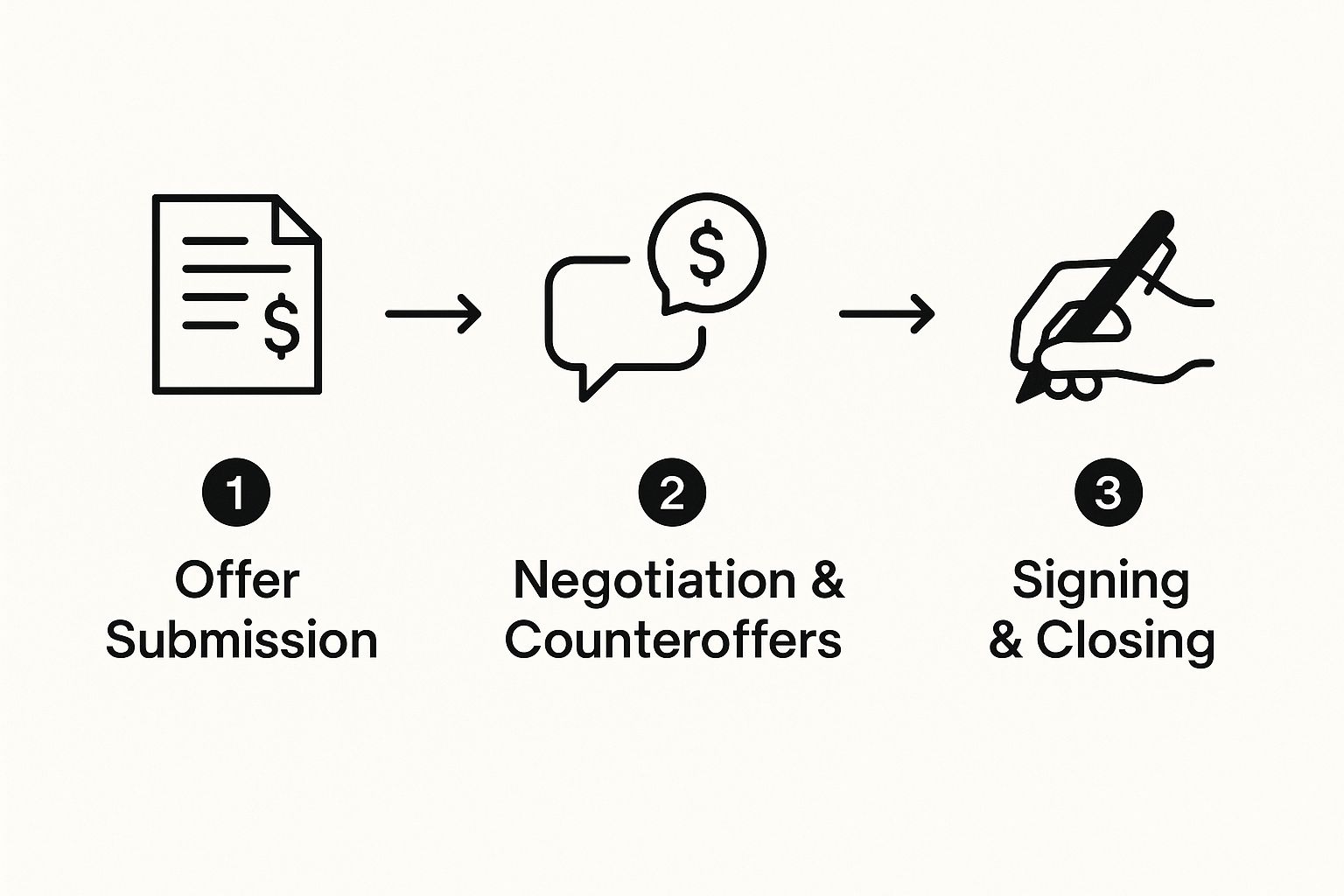
As you can see, that signed contract is the critical bridge that turns all the back-and-forth negotiation into a formal process with one goal: transferring ownership.
Key Milestones and Deadlines
The road from contract to closing is paved with specific checkpoints. Miss one, and the whole deal could be in jeopardy. The contract spells out each deadline, and it takes serious coordination to hit them all.
- Option Period: This is the buyer’s time to shine—or, more accurately, their inspector’s. It’s a negotiated window of time for due diligence, and it’s non-negotiable once it’s in the contract.
- Financing Approval: The buyer doesn’t have forever to get their loan squared away. The contract specifies a date by which they must have a firm commitment from their lender.
- Closing Date: This is the big one—the finish line. It’s the day everyone meets to sign the final papers, wire the funds, and officially hand over the keys.
In the Dallas market, where inventories have often been tight, properties can get snapped up fast. That kind of pressure makes sticking to the contract schedule absolutely essential. A delay that might seem minor could give a seller an out or cause a buyer to lose their dream property. To make sure everything goes off without a hitch, it’s smart to understand the crucial steps in the closing process.
Communication is the engine that drives a successful closing. Constant updates between agents, the lender, and the title company are essential to anticipate and resolve issues before they derail the timeline.
This whole structured process exists for a reason: to make sure ownership is transferred cleanly and legally. The last leg of this journey involves signing a mountain of paperwork, including one of the most important documents you’ll encounter. You can get the full scoop by reading our article on https://dustinpitts.com/uncategorized/what-is-a-deed-of-trust/. Getting a handle on this timeline is truly the key to a smooth and predictable closing.
What Happens When a Contract Is Breached

While everyone hopes for a smooth closing, it’s smart to know what happens if someone doesn’t hold up their end of the bargain. In legal terms, this is called a breach of contract. It happens any time the buyer or seller breaks a rule in the agreement without a valid, legal reason.
A breach doesn’t always involve a dramatic showdown. It could be a buyer who can’t get their loan approved by the financing deadline. Or maybe it’s a seller in a beautiful Highland Park property who gets a last-minute case of seller’s remorse and decides not to move.
Whatever the situation, the standard Texas real estate contract lays out a clear roadmap for what comes next.
Understanding Default and Remedies
Flip to Paragraph 15 of the standard TREC contract, and you’ll find a section titled “Default.” This is where the consequences are spelled out. If a buyer backs out improperly, the seller has a few powerful options.
The most common route is for the seller to terminate the contract and keep the earnest money. Think of this as compensation—it helps make up for the time and opportunity the seller lost while their property was off the market.
But the seller can also take a more aggressive legal path:
- Specific Performance: This is a bit more intense. The seller can actually sue the buyer and ask a judge to force them to go through with the purchase. It’s not the first choice for most, but it’s a serious option if the seller suspects the buyer just has a simple case of cold feet.
Now, what if the roles are reversed? If the seller is the one who breaches the contract—say, by refusing to hand over the keys after everything is signed—the buyer has similar protections. The buyer can sue to get their earnest money back, plus any reasonable expenses they’ve incurred. Or, just like the seller, they can seek specific performance to make the seller complete the sale.
No matter who is at fault, the contract is the final word. It lays out the consequences ahead of time, which helps keep disputes from spiraling out of control when a deal hits a snag in the fast-paced Dallas market.
These built-in protections are a fundamental part of what is a real estate contract. They provide both sides with a clear, legally enforceable plan B if things don’t go as expected.
Got Questions About Dallas Real Estate Contracts? We’ve Got Answers.
When you’re dealing with a real estate contract, a lot of questions can pop up. It’s totally normal. Here are some straightforward answers to the things I hear most often from buyers and sellers here in Dallas.
Can I Just Write My Own Real Estate Contract?
Technically, you could, but I would strongly advise against it—and that’s putting it mildly. Think of it this way: you wouldn’t perform surgery on yourself, right? In Texas, we have a huge advantage because the Texas Real Estate Commission (TREC) has already done the heavy lifting.
They provide standardized, attorney-vetted contract forms designed to protect both buyers and sellers. Trying to create your own from scratch is a recipe for disaster. You could accidentally include unenforceable clauses or leave out critical protections, opening the door to expensive legal battles later on. Using the official TREC forms isn’t just best practice; it’s the professional standard in Dallas for a reason.
What’s the Difference Between the “Effective Date” and the “Closing Date”?
This is a big one, as these two dates trigger completely different things.
The effective date is the starting pistol for the entire deal. It’s the exact date when the last person signs the contract and tells the other party, “We have a deal.” From that moment, the clock starts ticking on all your deadlines, like your option period and financing approval.
The closing date, on the other hand, is the finish line. It’s the day specified in the contract when the magic happens: ownership officially transfers, the money changes hands, and the seller gives you the keys to your new property.
Wondering who holds onto your earnest money during all this? It’s almost always held by a neutral third party—the title company handling the transaction. They keep the funds safe in an escrow account until closing day, a process detailed right in Paragraph 5 of the TREC contract.
Ready to navigate the Dallas real estate market with an expert who understands every detail of the contract process? Contact Dustin Pitts REALTOR Dallas Real Estate Agent for a seamless and successful transaction. Find your Dallas home today.