When you’re sizing up investment properties in a fast-moving market like Dallas, you need a quick way to see if a deal is even worth a second glance. That’s where the Gross Rent Multiplier (GRM) comes in. It’s a simple, back-of-the-napkin calculation that savvy investors use to quickly compare one property’s price to another based on the income it pulls in.

In essence, the GRM tells you how many years it would take for a property’s gross rental income to completely pay for its purchase price. A lower number is often better, signaling a potentially faster payback period.
Decoding The Gross Rent Multiplier For Dallas Investors
If you’re looking at income properties anywhere in the DFW area, you absolutely have to know your GRM. Think of it as your first-pass filter. When you’re scrolling through dozens of listings from Bishop Arts to Plano, it’s impossible to run a full financial analysis on every single one.
The GRM helps you cut through the noise. It lets you standardize the comparison between properties with different price tags and rental incomes, giving you a clear benchmark to decide which opportunities deserve a deeper dive.
The Core Formula Explained
At its heart, the calculation couldn’t be simpler. You just need two numbers: the property’s sale price and its total annual rental income before you subtract any expenses (like taxes, insurance, or maintenance).
Property Price / Gross Annual Rent = Gross Rent Multiplier (GRM)
Let’s say a property in Dallas is on the market for $500,000 and it brings in $50,000 a year in gross rent. The GRM would be 10 ($500,000 / $50,000). This means, hypothetically, it would take 10 years of collecting that gross rent to cover the purchase price.
Understanding the components is key, so let’s break it down.
Breaking Down the GRM Formula
This table simplifies the two core pieces of the GRM puzzle using a Dallas-centric example.
| Component | Description | Dallas Example |
|---|---|---|
| Property Price | The asking or sale price of the property. It’s the “P” in the equation. | A duplex in Oak Lawn listed for $600,000. |
| Gross Annual Rent | The total rent collected over 12 months, before any expenses are deducted. | The duplex rents for a total of $4,000/month, so the gross annual rent is $48,000. |
With these two figures, you have everything you need to calculate the GRM and start comparing properties apples-to-apples.
Putting GRM To Work In Dallas
Let’s walk through a real-world Dallas scenario. Imagine you’re eyeing a duplex in the M Streets neighborhood listed at $600,000. Based on your research of nearby rentals, you’re confident it can generate a combined $4,000 per month.
Here’s how you’d run the numbers:
- First, find the Gross Annual Rent: $4,000/month x 12 months = $48,000
- Next, calculate the GRM: $600,000 (Price) / $48,000 (Rent) = 12.5
The GRM for this property is 12.5. Now you have a solid metric. You can take this number and stack it up against other duplexes in the M Streets or even compare it to a fourplex in Richardson to see which one looks more attractive on paper. To get a better handle on the basics, you can explore this guide on What Is Gross Rent Multiplier in Real Estate.
How to Calculate GRM for Dallas Properties
Working out the Gross Rent Multiplier for a Dallas property is surprisingly simple. You only need two numbers to get started, but the secret to a meaningful result lies in making sure those numbers are grounded in reality.
The first piece of the puzzle is the property’s price. This could be the seller’s asking price, a recent appraisal value, or even the price you’re thinking of offering.
The second, and most crucial, piece is the Gross Annual Rental Income. This is the total, top-line rent you’d collect in a year before a single dollar is taken out for taxes, insurance, or repairs.
Pinpointing The Gross Annual Rent
Don’t just take the seller’s word for what a property could rent for. You need to do your own homework and find out what similar properties are actually renting for in that specific Dallas neighborhood.
A property’s true earning potential isn’t just a number on a listing sheet; it’s dictated by the market. What a duplex rents for in Uptown could be completely different from a similar one in Bishop Arts.
Here’s how to get reliable rental data in Dallas:
- Scour active rental listings: See what landlords are asking for comparable properties in the same zip code right now.
- Talk to local property managers: These folks are on the front lines and know current rental rates and tenant demand inside and out.
- Use your own portfolio: If you already own rentals in Dallas, that data is your best benchmark.
Maximizing your property’s earning potential is key to a good GRM, a discipline better known as revenue management in rental properties. While GRM is a quick-and-dirty tool, its usefulness really depends on having accurate rent figures. To avoid being misled, always verify the current rent roll and compare the GRM to other properties in the same Dallas submarket.
Running The Numbers: A Dallas Example
Let’s walk through a real-world Dallas scenario. Say you’re looking at a single-unit condo in Lower Greenville with a list price of $350,000. After doing your research, you feel confident it can pull in $2,200 a month in rent.
- Calculate Gross Annual Rental Income:
$2,200 (Monthly Rent) x 12 (Months) = $26,400 - Calculate the GRM:
$350,000 (Property Price) / $26,400 (Gross Annual Rent) = 13.25
So, the GRM for this condo is 13.25. Now you have a solid number you can use to quickly stack this property up against other potential investments across Dallas. This is the perfect first step before you start digging into the finer details. To see where this calculation fits into a broader analysis, take a look at our guide on how to calculate return on investment property.
What a Good GRM Looks Like in Dallas
So, you’ve calculated the Gross Rent Multiplier for a Dallas property. The big question is, what does that number actually tell you? Is it any good? The truth is, there’s no single magic number. What’s considered a “good” GRM is all about context, and it can change dramatically from one Dallas neighborhood to the next.
Generally speaking, a lower GRM points to a property that could pay for itself faster based on its rental income alone. For investors who are laser-focused on generating immediate cash flow, properties with a GRM between 4 and 7 often look pretty appealing in the Dallas market. This range typically suggests the purchase price is quite reasonable compared to the rent it pulls in.
But a low GRM isn’t always a green light. You have to dig a little deeper. Sometimes, that low number is a red flag, hinting that the property is in a less-than-desirable area or needs a ton of expensive repairs to be rent-ready.
High vs. Low GRM: A Dallas Comparison
In a market as dynamic as Dallas, a high GRM isn’t automatically a deal-breaker. In fact, it often signals that a property is located in a hot, high-growth area. Investors in these spots are often willing to pay a premium upfront because they’re betting on appreciation down the road.
For instance, a property in a rapidly growing suburb like Frisco or a booming pocket of North Dallas might carry a GRM of 10 or even higher. The investors buying there aren’t just looking at today’s rent; they’re banking on rising property values and the ability to charge higher rents in the future.
Let’s look at a couple of real-world Dallas scenarios to see how this plays out:
- Scenario A: Oak Cliff Duplex: Imagine you find a duplex in Oak Cliff listed for $450,000. It currently brings in $50,000 in annual gross rent. That gives you a GRM of 9. For an area known for steady demand and solid growth potential, this could be a very solid investment.
- Scenario B: Uptown Condo: Now, consider a sleek, modern condo in Uptown with a $400,000 price tag. Its annual rent is only $28,800. The GRM here is a much higher 13.8. At first glance, that seems steep. But an investor might jump on it, banking on the prime location, high-end tenant pool, and strong potential for long-term appreciation to make it worthwhile.
The key takeaway is that GRM is best used as a comparative tool. A “good” number is one that lines up with similar properties in the same Dallas submarket and, most importantly, matches your personal investment strategy—whether you’re chasing cash flow today or appreciation tomorrow.
What Shapes a Dallas GRM?
Several local factors are always at play, shaping what a typical GRM looks like across Dallas-Fort Worth. If you understand these forces, you can interpret the numbers with the confidence of a seasoned pro.
- Location, Location, Location: This is the undisputed king in Dallas real estate. A rental property near the vibrant Bishop Arts District will have a completely different GRM profile than a quiet single-unit rental in Richardson. Proximity to major employment hubs, top-rated schools, and popular entertainment options all drive property values and rents in different ways.
- Property Condition: A turnkey, newly renovated property in Dallas can demand top-dollar rent from day one, which helps push its GRM down and make it more attractive. On the flip side, an older property might have a lower asking price but also lower rent potential, which could result in a similar or even higher GRM until you sink money into upgrades.
- Market Trends: The overall pulse of the Dallas market matters. When the market is red-hot, property prices tend to climb faster than rents, which pushes GRMs higher across the board. In a cooler, more balanced market, you might see GRMs start to trend lower.
Ultimately, the GRM is a fantastic tool for quickly screening properties. But remember, it’s a blunt instrument because it completely ignores expenses. To get a truly accurate picture of a property’s potential profitability, you need to look at the numbers after all the costs are factored in. A dedicated rental yield calculator is the perfect next step to move beyond the initial screening and get a much deeper financial understanding of your potential investment.
When to Trust GRM and When to Be Skeptical
No single number ever tells the whole story, and the Gross Rent Multiplier is certainly no exception. For any Dallas investor, knowing what this metric does well—and what it completely misses—is absolutely critical to making smart decisions.
Its main superpower is speed. Think of GRM as the perfect first-pass filter when you’re staring down a long list of potential Dallas investments.
When you’re sorting through dozens of properties from East Dallas to Fort Worth, GRM lets you quickly weed out the obvious non-starters. It gives you a consistent, apples-to-apples baseline to decide which deals deserve a closer look and which ones you can toss aside immediately.
The Big Blind Spot: Operating Expenses
Here’s the catch: the GRM’s simplicity is also its greatest weakness. The formula intentionally ignores every single operating expense that comes with owning a rental property. This is a massive blind spot that can easily trap an unprepared Dallas investor.
A property might show off an attractively low GRM, but that number is practically meaningless if its expenses are through the roof. It’s like comparing two cars based only on their sticker price while ignoring their gas mileage, insurance premiums, and repair history. One might look cheaper upfront, but it could end up costing you a fortune down the road.
Crucial Warning: The GRM does not account for property taxes, insurance, HOA fees, maintenance, vacancy rates, or property management costs. In a state like Texas, where property taxes can be a huge annual hit, relying solely on GRM is a recipe for a bad investment.
GRM Advantages vs. Disadvantages for Dallas Investors
To make smart decisions, you have to see both sides of the coin. Let’s break down where GRM shines and where it falls short for investments right here in the Dallas area.
| Aspect | Pros (Advantages) | Cons (Disadvantages) |
|---|---|---|
| Speed | Excellent for rapidly comparing dozens of Dallas listings to create a shortlist. | The quick calculation can lead to overlooking critical financial details. |
| Simplicity | Easy to calculate with just two numbers: price and gross rent. | Ignores all operating expenses, which significantly impact net cash flow. |
| Market Comparison | Useful for spotting pricing trends and anomalies within a specific Dallas submarket. | Can be misleading when comparing properties with vastly different expense structures. |
| Initial Screening | A powerful first-pass tool to eliminate overpriced or underperforming properties. | Does not factor in property condition, which affects maintenance and repair costs. |
Ultimately, the GRM is a starting point, not a finish line. It’s an invaluable tool for your initial analysis, but it should never, ever be the only metric you use. Once a property passes that first GRM test, it’s time to roll up your sleeves and dig into the numbers that truly determine its profitability.
Comparing GRM and Cap Rate for Dallas Investments
While the Gross Rent Multiplier gives you a quick, back-of-the-napkin feel for a Dallas property’s value, it’s really just the opening chapter of the story. To get the full financial picture, savvy Dallas investors always dig deeper with another critical metric: the Capitalization Rate, or Cap Rate for short.
Frankly, understanding the difference between GRM and Cap Rate is what separates a casual look from a serious investment analysis in the Dallas market. Think of them as two different lenses for viewing the same property. The GRM gives you a wide-angle shot, showing the general relationship between price and rent. But the Cap Rate? That’s your zoom lens, letting you focus on the nitty-gritty details of a property’s actual profitability.
The Critical Difference: Net Operating Income
So, what’s the big dividing line between these two numbers? It all comes down to operating expenses.
The GRM formula is beautiful in its simplicity because it completely ignores every single cost of owning the property. The Cap Rate, on the other hand, puts those costs front and center, right where they belong.
A property’s Cap Rate is calculated by dividing its Net Operating Income (NOI) by the purchase price. NOI is the money you have left over at the end of the year after paying all the necessary bills to keep the property running—but before you’ve paid your mortgage or income taxes.
For any Dallas investor, those expenses are very real and include things like:
- Property Taxes: A major expense here in Texas that GRM conveniently forgets.
- Property Insurance: Non-negotiable for protecting your asset.
- Maintenance and Repairs: From leaky faucets to replacing an HVAC unit, these costs add up.
- Property Management Fees: A must if you’re not planning to manage the property yourself.
- Utilities: Any water, gas, or electric bills not passed on to tenants.
By baking these real-world costs into the formula, the Cap Rate gives you a much clearer, more honest measure of a property’s ability to actually make you money. If you want to get into the weeds on this metric, check out our detailed guide on what is capitalization rate.
This infographic really drives home the point about when and where to use GRM.
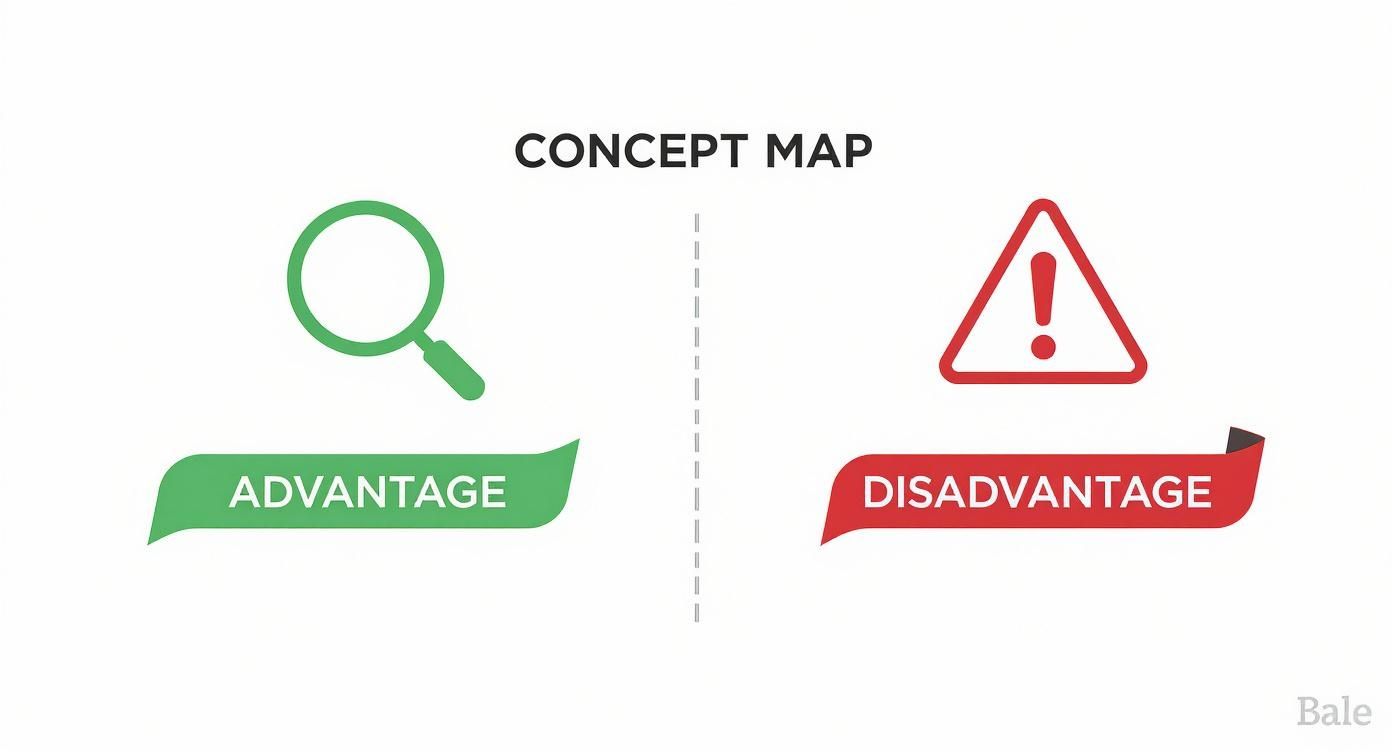
As you can see, GRM shines as a fast and simple tool for initial comparisons. Its biggest weakness, however, is that it tells you absolutely nothing about a property’s true bottom line.
GRM and Cap Rate in Action: A Dallas Scenario
Let’s put this into practice with a hypothetical duplex in Dallas’s popular Lakewood neighborhood.
Imagine the property is listed for $700,000 and brings in $60,000 a year in gross rent.
- GRM Calculation: $700,000 / $60,000 = 11.67
That GRM of 11.67 might seem perfectly fine on the surface for a desirable area like Lakewood. But wait. Let’s bring in the operating expenses, which we’ll estimate at $20,000 a year for property taxes, insurance, and general upkeep.
- NOI Calculation: $60,000 (Gross Rent) – $20,000 (Expenses) = $40,000
- Cap Rate Calculation: $40,000 (NOI) / $700,000 (Price) = 5.71%
Now you have a much richer understanding. The 11.67 GRM told you about the price-to-rent ratio, but the 5.71% Cap Rate shows you the property’s actual annual return on investment before factoring in your loan.
This is why you can never rely on GRM alone. Another property across Dallas could have the exact same GRM but much higher expenses (maybe it’s older or in a higher tax zone), leading to a painfully lower Cap Rate. The lesson? Use GRM as a quick filter to build your shortlist, but always switch to Cap Rate to confirm true profitability before you even think about making an offer.
Common Questions About Using GRM in Dallas
Once you get the hang of the Gross Rent Multiplier formula, you start to see how it can quickly size up a deal. But when you apply it to the real world here in Dallas, a few practical questions always pop up. It’s one thing to know the math, and another to understand the story the numbers are telling you across different DFW neighborhoods and property types.
Let’s dig into some of the most common questions investors have when they start using GRM in the Dallas market.
How Does Property Type Affect GRM in Dallas?
You can’t just use a blanket GRM for everything in Dallas; the type of property you’re looking at makes a huge difference. A single-unit rental in a quiet suburb is a totally different beast than a fourplex near downtown, and their GRMs will reflect that.
- Single-Unit Properties: These usually have a higher GRM in the Dallas area. Why? Because buyers are often betting on long-term appreciation. They’re willing to pay a premium that isn’t just about the immediate rental income.
- Multi-Unit Properties: A duplex in East Dallas or a small apartment building in Oak Cliff will typically have a lower (and from an investor’s perspective, better) GRM. The value of these properties is tied much more directly to the cash flow they produce from multiple tenants.
Can I Use GRM for a Short-Term Rental?
Thinking about an Airbnb in Bishop Arts or Deep Ellum? You can use GRM, but you have to be careful. The “Gross Annual Rent” for a short-term rental in Dallas can be all over the place. One great year with a big event in town doesn’t mean the next year will be the same.
Because that income can swing so wildly, basing your GRM on a single, stellar year will give you a dangerously low number that looks fantastic on paper but isn’t realistic. It’s much smarter to use a conservative average of potential annual income to get a GRM that won’t lead you astray.
Where Can I Find Good Dallas Rent Data?
Your GRM calculation is only as good as the rent numbers you plug into it. The single biggest mistake I see Dallas investors make is taking the seller’s “pro forma” numbers at face value.
A reliable GRM for a Dallas property has to be based on actual market rents. You need to know what similar properties in that specific area are getting right now, not what someone hopes they can get.
Here are a few places to get solid intel in Dallas:
- Local Property Managers: These folks are on the front lines. They know exactly what units are renting for and how long they’re sitting on the market.
- Online Rental Sites: Zillow, Apartments.com, and others give you a live look at asking rents in any given zip code. It’s a great starting point for seeing what the competition is doing.
- Your Own Properties: If you’re already a Dallas investor, your own portfolio is your best source of truth. Nothing beats your own real-world data.
Why Is a Plano GRM So Different From a Dallas One?
You’ll quickly notice that a GRM in a suburb like Plano looks nothing like one for a property in an urban Dallas neighborhood. It all comes down to what’s driving the market in that specific area.
In fast-growing suburbs like Plano, investors are often willing to pay more for a property relative to its current rent, pushing the GRM higher. They’re banking on future appreciation and the ability to raise rents down the road. In more established city neighborhoods, the game is often about steady, predictable cash flow right now, which tends to keep GRMs lower.
Ready to navigate the Dallas real estate market with an expert who understands these metrics inside and out? Dustin Pitts REALTOR Dallas Real Estate Agent provides the in-depth market analysis and strategic guidance you need to find the right investment property. Visit us at https://dustinpitts.com to start your search today.