
When you’re navigating the Dallas real estate market, one metric stands above all others for measuring an investment’s true, long-term profitability: the Internal Rate of Return (IRR).

Think of it as the unique interest rate your Dallas property generates for you each year. It’s a single percentage that captures the entire story of your investment—from the initial purchase and ongoing rental income all the way to the final profit from the sale.
Understanding Irr In The Dallas Market
Let’s cut through the financial jargon. Say you’re looking at two totally different investment properties in Dallas. One is a sleek, modern townhouse in Uptown, and the other is a multi-unit rental in a booming suburb like Plano. How do you really know which one will make your money work harder? This is where the IRR becomes your best friend.
IRR isn’t just about the final sale price or the rent you collect each month. It’s more sophisticated than that. It weaves together every single dollar that comes in or goes out over the entire life of the investment into one powerful percentage.
It boils down to three key financial pieces:
- Initial Investment: All the cash you put in upfront, including the down payment and closing costs.
- Ongoing Cash Flows: The net income you get from rent after paying the mortgage, taxes, insurance, and repairs. This can be positive or negative each year.
- Final Sale Proceeds: The net profit you walk away with after selling the property and paying off any remaining debt.
To get a solid grip on IRR, it helps to understand the basics of investment returns first. Learning about what is annualised return is a great starting point, as it explains how returns are averaged out over time—a concept that’s a close cousin to IRR.
Why Irr Matters For Dallas Investors
The Dallas real estate scene is incredibly dynamic. You have the historic charm of the M Streets, the urban energy of Knox-Henderson, and the massive suburban growth in places like Frisco. IRR gives you a standardized yardstick to compare these completely different opportunities on a level playing field.
For example, a quick property flip in a hot Dallas neighborhood might produce a large chunk of cash fast, leading to a very high IRR. On the other hand, a long-term rental in Lakewood might deliver steady, reliable cash flow for a decade, resulting in a completely different—but still strong—IRR profile.
The technical definition? IRR is the specific discount rate that makes the Net Present Value (NPV) of all your future cash flows equal to zero. In simpler terms, it’s the exact rate of return where your investment breaks even, accounting for the time value of money.
To truly succeed, you need to know which numbers to plug in. Here’s a breakdown of the essential inputs for calculating the IRR on a potential Dallas property.
Key Irr Inputs For A Dallas Property Investment
| Component | Description | Example in Dallas |
|---|---|---|
| Initial Outlay | The total cash needed to acquire the property, including down payment, closing costs, and immediate repair costs. | $125,000 on a $500,000 property in Bishop Arts (20% down + costs). |
| Annual Net Cash Flow | The yearly rental income minus all operating expenses (mortgage, taxes, insurance, maintenance, property management). | $4,800 per year ($400/month) after all expenses on a rental in Plano. |
| Holding Period | The total number of years you plan to own the investment property before selling it. | A planned 10-year hold to capture long-term appreciation in Frisco. |
| Projected Sale Price | The estimated market value of the property at the end of your holding period. | Selling the Bishop Arts property for $750,000 after 10 years. |
| Sale Proceeds | The net cash you receive after selling, paying off the remaining mortgage, and covering selling costs. | $450,000 cash-in-hand after the sale, loan payoff, and agent fees. |
Getting these inputs right is the foundation of an accurate IRR calculation. It transforms a vague “good deal” into a quantifiable, data-backed investment decision.
This metric is non-negotiable for anyone serious about building wealth through Dallas real estate. If you’re exploring the market, getting familiar with the fundamentals of Dallas real estate investing is your first move. Learning to calculate IRR is the critical next step that lets you move beyond simple profit guesses and into the world of sophisticated financial analysis.
How to Calculate IRR for a Dallas Property
Don’t let the name intimidate you; calculating the Internal Rate of Return doesn’t require a Ph.D. in finance. In fact, if you have a simple spreadsheet, you have everything you need to size up a potential Dallas property deal. It really boils down to two main things: mapping out your cash flows and then letting a formula do the heavy lifting for you.
To really get what’s happening under the hood, it helps to understand the discounted cash flow (DCF) model. The IRR calculation is directly tied to this concept of money’s value over time.
Let’s make this real with an example. Imagine we’re looking at a rental property in Dallas’s popular Bishop Arts District, and we plan to hold it for five years.
Stage 1: Map Your Cash Outflows
First things first, you have to account for every dollar that leaves your bank account to get the deal done. This isn’t just the down payment—it’s everything you spend upfront.
This initial cash outflow is your “Year 0” investment. For our Bishop Arts property, let’s say the purchase price is $400,000. After a 20% down payment, closing costs, and a small budget for some quick renovations, your total initial investment—or negative cash flow—comes out to -$90,000.
Stage 2: Project Your Cash Inflows
Now for the fun part: projecting all the money the property is going to put back into your pocket. This includes the yearly net income from rent and the big payout when you eventually sell.
You’ll need to estimate your annual rental income and then subtract all your operating costs—things like the mortgage payment, property taxes, insurance, and a buffer for maintenance. For our example, let’s project a net positive cash flow of $6,000 in the first year, and we’ll assume it bumps up slightly each year after that.
Next, you have to estimate what you’ll sell the property for in five years. Once you pay off the remaining mortgage and cover the sale’s closing costs, that final lump sum is your last major cash inflow. Let’s forecast a final net profit of $150,000 in Year 5, on top of that year’s rental income.
The infographic below really helps visualize how these pieces—your initial investment, the ongoing cash flow, and the final sale profit—all fit together to calculate the IRR.
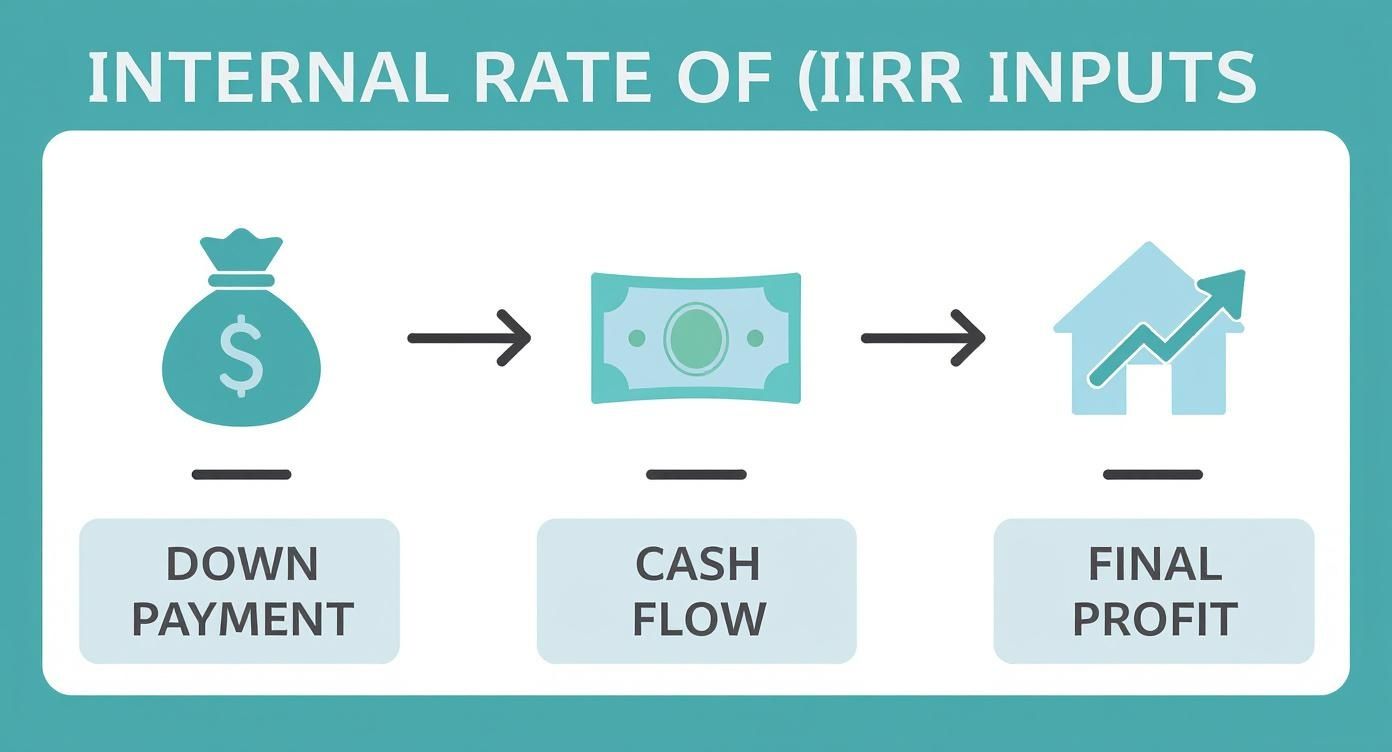
As you can see, a reliable IRR depends on carefully tracking the money coming in and going out at the beginning, during, and at the very end of your investment. While IRR is a powerful metric, it’s also useful to learn how to calculate return on investment property for a simpler, more direct look at your returns.
Stage 3: Use a Spreadsheet to Find the IRR
Once you’ve got all your cash flows mapped out, the final step is a breeze. Just open up Excel or Google Sheets and list your cash flows in a single column, making sure they’re in chronological order.
Here’s what our Bishop Arts example would look like in a spreadsheet:
- Year 0: -$90,000
- Year 1: $6,000
- Year 2: $6,500
- Year 3: $7,000
- Year 4: $7,500
- Year 5: $158,000 (this is the final year’s rent plus the profit from the sale)
Now, just click on an empty cell, type the formula =IRR(, and then select the cells with your cash flow numbers. Close the parenthesis ) and hit Enter.
Just like that, the spreadsheet spits out the IRR. It’s a single, powerful percentage that represents the project’s true annualized rate of return. For our Bishop Arts deal, the formula gives us an IRR of 15.6%—a solid, clear number we can use to judge the quality of this investment.
Putting IRR to Work in Dallas Scenarios

Theory is great, but seeing how the Internal Rate of Return actually plays out in the real world is what really matters. When you’re looking at properties in Dallas, you need a way to cut through the noise and see what an investment is truly worth.
Let’s walk through a couple of classic Dallas investment strategies to see how IRR helps make sense of them.
Imagine you’re weighing two very different opportunities. The first is a short-term rental—a condo near the Kay Bailey Hutchison Convention Center. It has the potential for huge cash flow during big events, but you know it’ll be a lot of work and have higher running costs.
The second option is a classic long-term rental, a residential property in a quiet Richardson neighborhood. This promises steady, predictable income, but it won’t be a cash cow overnight. It’s also a lot less hands-on. So, how do you decide?
Comparing Two Dallas Deals
This is where IRR shines. By running the numbers for each, we get a single percentage that lets us compare them directly, even though they have completely different timelines and cash flow patterns. IRR is powerful because it understands that when you get your money matters just as much as how much you get.
For that downtown condo, the IRR calculation would include the big upfront renovation cost, the lumpy (but hopefully high) income over five years, and the final sale price.
For the Richardson property, the IRR would be based on a smaller down payment, consistent annual rental income, and a sale ten years down the road. You end up with one number for each, giving you a true apples-to-apples comparison.
A higher IRR points to a more profitable investment for every dollar you put in. It’s basically telling you how hard your money is working for you, year after year. That’s crucial when you’re deciding between a high-effort, high-reward project and a slow-and-steady asset.
Why The IRR Result Matters
There’s a reason high-stakes finance professionals live and breathe by this metric. It’s the same tool private equity firms use to judge performance, and it’s a tough world out there.
Studies on historical private equity IRR distributions show that roughly 15–20% of funds actually end up with a zero or negative IRR. It’s a sobering reminder that even the pros don’t always win.
So, for our Dallas deals, what might the numbers look like?
That high-octane convention center property might boast an impressive IRR of 19% thanks to its quick, hefty returns. Meanwhile, the steady Richardson rental might produce a solid, but less flashy, IRR of 12%.
This doesn’t automatically mean the downtown condo is the “better” investment. It just means it generates returns at a faster rate. The 12% IRR property might be perfect for an investor who wants less risk and a more passive role. The 19% IRR is for someone willing to put in the work for a bigger, faster payoff.
Ultimately, IRR gives you the clarity to match an investment to your own financial goals and stomach for risk. That’s why getting a handle on it is non-negotiable for any serious Dallas investor.
Weighing the Pros and Cons of IRR in Real Estate
No single number can ever tell you the whole story of a Dallas real estate deal, and the Internal Rate of Return is no exception. It’s an incredibly powerful tool for sizing up potential investments, but you have to know what it does well—and where its blind spots are—to make smart financial decisions.
Think of IRR as a universal translator for investment performance. Its greatest strength is boiling everything down to a single, easy-to-compare percentage. This lets you weigh completely different opportunities, like a quick flip in Knox-Henderson versus a long-term rental in Lake Highlands, on a level playing field.
That standardized approach is a massive advantage. It helps you quickly sift through potential deals and zero in on the ones that actually deserve your time and capital.
The Major Strengths of Using IRR
For Dallas investors trying to find clarity in a crowded market, IRR offers a few clear benefits. It takes complex, multi-year cash flow projections and simplifies them into a number you can actually use.
Here’s where it really shines:
- Time Value of Money: IRR gets it—a dollar in your pocket today is worth more than a dollar you might get next year. It automatically factors in the timing of your cash flows, giving more weight to profits you earn sooner rather than later.
- All-Inclusive Metric: Unlike simpler calculations that only look at one piece of the puzzle, IRR considers the entire investment lifecycle. It accounts for everything from your initial down payment to the final check you get when you sell the property.
- Comparative Power: This is the big one. IRR allows for a direct, apples-to-apples comparison between properties with totally different timelines and cash flow patterns.
These strengths make IRR an essential tool for your first-pass analysis. But if you rely on it exclusively, you’re walking into a trap.
The real challenge with IRR isn’t getting the calculation right; it’s knowing when not to trust it completely. Smart investors use it as a powerful guide, never as a blind rule.
Understanding the Weaknesses of IRR
The biggest, most overlooked flaw of IRR is something called the reinvestment assumption. The formula silently assumes that you can take every dollar of cash flow you receive—like monthly rent—and immediately reinvest it somewhere else to earn the exact same rate as the project’s IRR.
Let’s be realistic. That almost never happens.
Imagine you pull off a fantastic flip in an up-and-coming Dallas neighborhood and hit a 30% IRR. The math behind that number assumes you can instantly find another deal and put that cash to work to earn another 30%. Finding those kinds of opportunities back-to-back is next to impossible.
This limitation gets glossed over all the time. You might see big firms advertising headline gross IRRs as high as 26% or even 39%, but this can create a misleading picture. That’s because the reinvestment assumption is rarely, if ever, met in the real world. For a deeper dive into this, you can check out this in-depth analysis of private market returns and how IRR can sometimes distort performance.
But that’s not the only issue. IRR has a few other significant drawbacks:
- It Ignores Scale: An investment of $10,000 that brings back $20,000 in a year has a jaw-dropping 100% IRR. Meanwhile, a $1,000,000 investment that returns $1,200,000 has a “lower” 20% IRR. Which would you rather have? The second deal creates far more actual wealth ($200,000 vs. $10,000), but IRR alone doesn’t show that.
- Multiple IRRs are Possible: For more complex deals with unusual cash flows (say, a major renovation partway through the hold period), it’s mathematically possible to get more than one IRR result. This can cause a lot of confusion and make the metric unreliable.
To give you a clearer picture, let’s break down how IRR stacks up for evaluating Dallas properties.
IRR Strengths vs. Weaknesses for Dallas Property Analysis
| Strengths of IRR | Weaknesses of IRR |
|---|---|
| Standardized Comparison: Great for quickly comparing a Bishop Arts duplex to a Far North Dallas rental. | Unrealistic Reinvestment Assumption: Assumes you can reinvest rental income at the same high rate. |
| Accounts for Timing: Properly values getting cash flow sooner, a key factor in fast-moving Dallas markets. | Ignores Dollar Value: A high IRR on a small deal can look better than a good IRR on a life-changing one. |
| Holistic View: Considers the entire project timeline from purchase to sale, not just one year’s performance. | Potential for Multiple Results: Can be unreliable for projects with complex, non-standard cash flows. |
| Focus on Percentage Return: Helps you evaluate how efficiently your capital is working for you. | Sensitive to Projections: Small errors in estimating future rent or sale price can dramatically skew the IRR. |
Ultimately, while IRR is a foundational metric that every serious investor should understand, it’s just one tool in your toolbox. The key is to use it wisely, pairing it with other metrics to build a complete and honest financial picture of your next Dallas investment.
Looking Beyond IRR with Other Key Metrics

While the Internal Rate of Return is a powerhouse metric, relying on it exclusively is like trying to drive through Dallas using only a single landmark for navigation. Sure, you know where one thing is, but you’re missing the rest of the map.
Smart investors know better. They create a full financial picture by pairing IRR with other key metrics. This multi-angled approach covers IRR’s blind spots, like its failure to account for the actual scale of a project or its sometimes unrealistic assumptions about reinvesting profits. Looking at a deal from every direction is how you make truly secure and profitable investment decisions in Dallas.
Essential Companion Metrics for IRR
Think of these other metrics as your personal investment analysis toolkit. Each tool is designed to answer a different, yet equally critical, question about a property’s potential. Using them together helps you understand not just the rate of return, but the real-world cash flow, total profitability, and overall efficiency of your capital.
Here are the key metrics you should always have on hand:
- Cash-on-Cash (CoC) Return: This tells you one simple thing: “How much money am I making each year on the actual cash I put into this deal?” It’s a gut-check metric for annual performance, perfect for understanding your immediate cash flow from a rental in a neighborhood like Lakewood.
- Net Present Value (NPV): NPV answers the question, “What is the total profit from this investment worth in today’s dollars?” Instead of a percentage, NPV gives you a concrete dollar amount, making it crystal clear which deal actually creates more wealth.
- Equity Multiple (EM): This one asks, “How many times over will I get my initial investment back?” It’s a straightforward measure of your total return, cutting through the complexities of time to show you exactly how much your capital has multiplied from start to finish.
Bringing this trio of metrics together with IRR gives you a 360-degree view. You’ll see the annualized return (IRR), the yearly cash flow (CoC), the total wealth created in today’s terms (NPV), and the overall capital growth (EM).
History has shown that IRR can be a bit of a mirage on its own. For example, a deep dive into over 1,600 U.S. venture funds showed a median IRR of 11–14%, but performance was all over the place. Top funds soared past 20%, but a huge number of laggards dragged the average down. It’s a stark reminder that a single percentage rarely paints the full picture of an investment class. When you use all these metrics together, you’re not just guessing—you’re building a data-driven strategy for your Dallas investments.
Common IRR Questions for Dallas Investors
Even after you get the hang of the Internal Rate of return, you’ll find that real-world questions pop up the moment you start looking at actual Dallas properties. It’s a powerful metric, for sure, but its quirks can easily make or break an investment decision. Let’s tackle some of these common questions head-on so you can use IRR effectively and sidestep the usual traps.
Getting clear answers is the key to moving from theory to confidently making offers. Here’s what Dallas real estate investors ask most often about IRR.
What Is a Good IRR for a Dallas Real Estate Investment?
There’s no single magic number. What’s considered a “good” IRR in Dallas really boils down to your personal strategy and how much risk you’re comfortable with. That said, most local investors I talk to are aiming for a range between 12% and 20%.
For a stable, lower-risk rental in a well-established neighborhood like Preston Hollow, you might be perfectly happy with an IRR toward the lower end of that spectrum. But if you’re taking on a value-add project in an up-and-coming area like East Dallas—something that needs real work and carries more risk—you should be shooting for the higher end to make the extra effort worthwhile.
How Does a Longer Holding Period Affect a Property’s IRR?
This is one of the most important things to grasp about what the internal rate of return really is: a longer hold almost always lowers the IRR, even if your total profit is much, much higher. The metric is incredibly sensitive to time and heavily favors quick returns.
Think about it this way: a quick flip in Uptown that doubles your money in a year will have a sky-high IRR. A rental property in Plano that also doubles your money, but over ten years, will have a much lower IRR. This is exactly why you can’t look at IRR in a vacuum. You have to pair it with other metrics, like the Equity Multiple, which simply tells you your total return on investment without being biased by time.
Always remember IRR’s bias for speed. A lower IRR on a long-term hold isn’t necessarily a bad sign; it just reflects a different strategy—one focused on steady, long-term wealth creation instead of a quick cash grab.
Can I Trust an IRR Calculation from a Seller or Broker?
Treat any IRR you’re handed by a seller or broker as a starting point, never the final word. It is absolutely essential to run your own numbers. A projected IRR is only as good as the assumptions used to build it, and those include everything from future rent growth and vacancy rates to appreciation and the final sale price.
You have to scrutinize every one of those assumptions. Do their rent growth projections seem realistic for that specific part of Dallas? Is their estimated sale price grounded in solid, recent comps? Vetting these inputs yourself isn’t just a good idea; it’s a non-negotiable part of your due diligence.
If Two Dallas Properties Have the Same IRR, Which Is Better?
This is a great question. If you’re looking at two Dallas deals with the exact same IRR, the “better” one is the investment that creates more actual wealth and fits your goals. The first thing I’d check is the Net Present Value (NPV). The project with the higher NPV is the one that adds more value to your portfolio in today’s dollars.
Beyond that, think about scale. An 18% IRR on a $50,000 investment is a world away from an 18% IRR on a $500,000 investment. The percentage alone doesn’t tell you anything about the deal’s size, the potential headaches involved, or whether it truly helps you hit your financial targets.
Navigating the Dallas market requires expert guidance. If you’re ready to analyze investment opportunities with a professional who understands these critical metrics, reach out to Dustin Pitts REALTOR Dallas Real Estate Agent. Let’s build your real estate portfolio together. Find your next property at https://dustinpitts.com.