
When you’re buying a home in Dallas, you’ll hear the terms “appraisal” and “inspection” thrown around a lot. It’s easy to get them mixed up, but they’re two completely different—and equally critical—parts of the process.

Let’s cut through the jargon. The simple difference is this: an appraisal tells the bank what the house is worth, while an inspection tells you what condition it’s in. The appraisal protects the lender’s money, and the inspection protects you from buying a money pit.
Appraisal Vs. Inspection: A Dallas Homebuyer’s Quick Guide
Navigating the fast-paced Dallas real estate market means understanding the milestones that safeguard your purchase. While both the appraisal and inspection involve a professional walking through your potential new home, they’re looking for entirely different things. One is all about the numbers, and the other is about the nuts and bolts.
The appraisal is almost always a requirement from your mortgage lender. They won’t lend you more money than the home is actually worth, so they need an unbiased, professional opinion on its fair market value.
On the other hand, the home inspection is for your peace of mind. While usually optional, I can’t stress enough how important it is. This is your chance to get a top-to-bottom report on the home’s health before you’re locked in.
At-a-Glance Appraisal vs. Inspection in Dallas
To make it even clearer, here’s a quick breakdown of how these two crucial steps stack up in the Dallas-Fort Worth area.
| Key Aspect | Home Appraisal | Home Inspection |
|---|---|---|
| Primary Purpose | To determine the property’s fair market value. | To assess the property’s physical condition and identify defects. |
| Who It’s For | Primarily for the mortgage lender. | Primarily for the homebuyer. |
| Main Focus | Financial value, comparable sales, and general property characteristics. | Structural integrity, major systems (HVAC, plumbing), and potential safety issues. |
| Who Orders It | The lender orders it through a third-party company. | The buyer chooses and hires the inspector directly. |
As you can see, there’s very little overlap. The appraiser is concerned with market data and overall features, while the inspector is getting into the attic and checking the foundation for potential problems.
This infographic gives you a great visual summary of who each report is for and what it focuses on.
It really highlights that while both are evaluations, they answer fundamentally different questions for two different parties in the transaction.
If you want to dive deeper into what an appraiser looks for, you can learn more about the specifics of the real estate appraisal process in our detailed guide. And for those curious about how technology is changing the real estate landscape, this ultimate real estate chatbot guide offers some fascinating insights.
Why You Absolutely Need Both an Appraisal and an Inspection in Dallas
When you’re caught up in the excitement of buying a home in Dallas, it’s easy to see the appraisal and inspection as just two more boxes to check before closing. But trust me, they’re far from simple formalities. Each one plays a distinct, critical role in protecting your financial future. One is all about the money, and the other is all about the house itself.
The home appraisal is really for your mortgage lender. It’s their way of making sure the massive loan they’re about to give you is a sound investment. Before a bank puts hundreds of thousands of dollars on the line for a Dallas property, they need solid proof that the house is actually worth what you’ve agreed to pay.
The Appraisal Is for the Bank’s Protection
Think of the appraisal as the lender’s safety net. An appraiser dives deep into recent sales of similar homes in specific Dallas neighborhoods—whether it’s a historic home in Lakewood or a sprawling estate in Preston Hollow. They’ll also look at the property’s overall condition and unique features to land on one powerful number: the fair market value. For your loan to get the green light, that number has to be at or above the sales price.
An appraisal protects the bank’s investment. An inspection protects your investment. This is the single most important distinction to remember.
This division of labor isn’t new. Home appraisals became standard practice back in the 1930s when new federal mortgage programs needed a reliable way to minimize risk. Home inspections, on the other hand, became popular much later as part of a larger consumer protection movement, giving buyers the power of information. You can dig into some of this history over at LendingTree.com.
The Inspection Is for Your Protection
Now, the inspection—that’s all about you. This process has zero to do with the home’s market value and everything to do with its physical condition. A licensed inspector is your advocate, your detective, hunting for hidden problems that could turn into massive, wallet-draining headaches down the road.
This is especially true here in North Texas, where our homes face some unique challenges. A good inspector knows exactly what to look for, including:
- Foundation Issues: Dallas is famous for its expansive clay soil, which can cause foundations to shift and crack. This is a non-negotiable check.
- Aging HVAC Systems: Can that air conditioner handle a brutal Texas summer? An inspector will put it to the test.
- Roof Integrity: Hail is a fact of life in the DFW area, and an inspector will climb up to check for damage you can’t see from the street.
- Outdated Electrical and Plumbing: They’ll identify old systems that might be a safety risk or simply on their last legs.
Armed with the inspection report, you’re in the driver’s seat. It gives you the evidence you need to go back to the seller and negotiate for repairs, ask for a credit at closing, or—if the problems are just too big—walk away from the deal with your earnest money intact during your option period.
What Happens on Site? A Tale of Two Visits
When a professional shows up at a Dallas property, what they do depends entirely on whether they’re an appraiser or an inspector. Their on-site activities couldn’t be more different, and understanding what each person is looking for really clears up the confusion between the two roles.
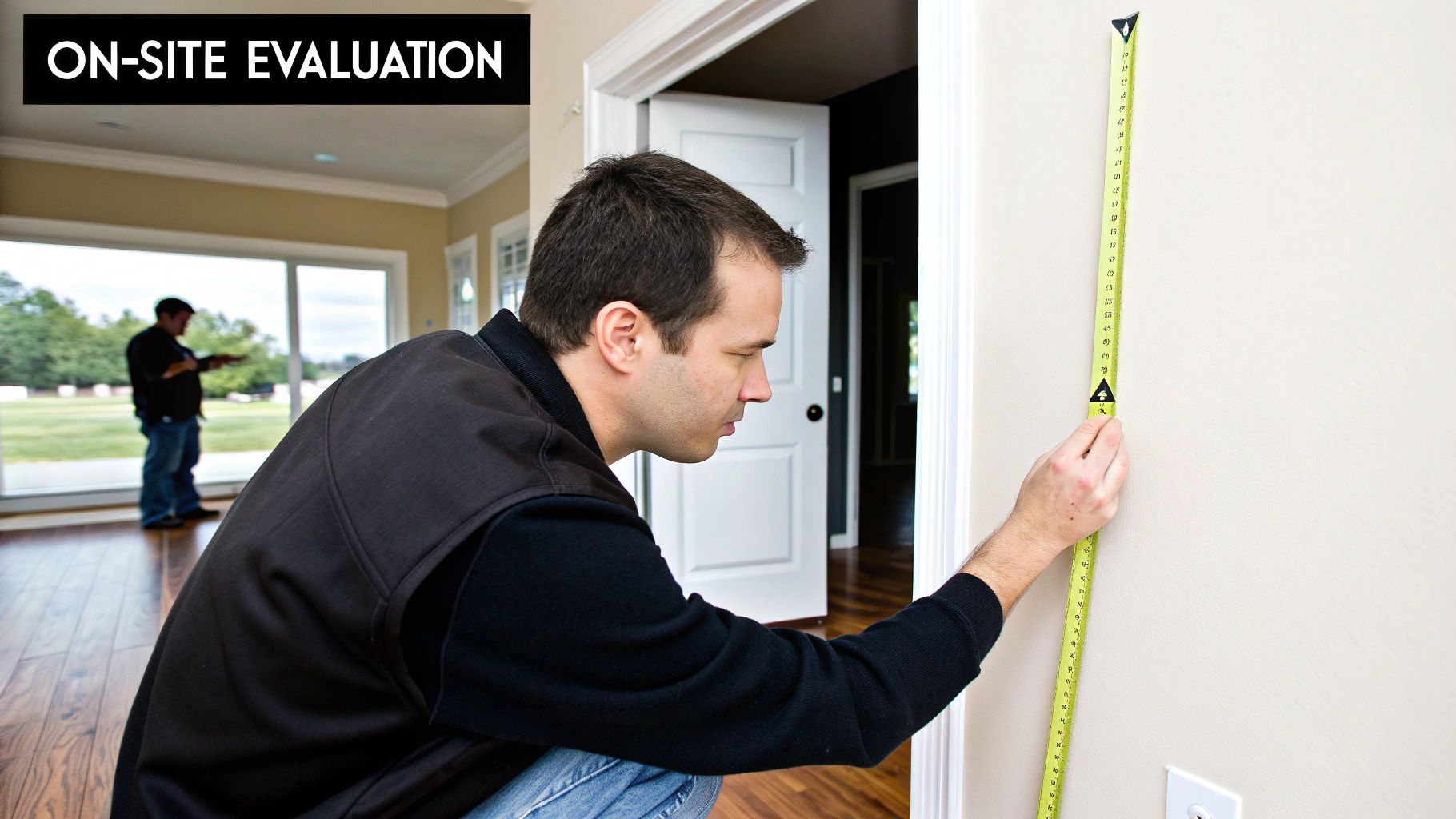
The home appraiser’s visit is all about one thing: determining the property’s market value. Their approach is methodical and driven by data, focusing on the features that directly influence what a home is worth in the current Dallas market.
Think of an appraiser’s on-site evaluation not as a deep dive into the home’s condition, but as a verification mission. They’re there to quickly but thoroughly confirm the property’s characteristics and note its overall state.
The Appraiser’s Walkthrough: A Focus on Value
A licensed Dallas appraiser’s visit is usually pretty brief. They’re there to document the property methodically. Here’s what you can expect them to do:
- Measure and Verify: They’ll pull out a tape measure and walk the exterior to confirm the home’s gross living area (GLA), or square footage.
- Document Key Features: They’ll count bedrooms and bathrooms, take note of the general layout, and document any significant upgrades—things like a recently renovated kitchen or a new swimming pool.
- Assess Overall Condition: An appraiser assigns a condition rating, typically on a scale from C1 (new construction) to C6 (needs major repairs), based on a visual once-over.
- Analyze the Neighborhood: They also size up the location, considering its proximity to desirable Dallas amenities and how it stacks up against neighboring homes.
Believe it or not, the most important part of their job often happens back at the office. That’s where they crunch the numbers, analyzing recent sales of comparable homes (the “comps”) to nail down a final valuation.
The Inspector’s Examination: A Focus on Condition
A home inspector’s visit, on the other hand, is a completely different ballgame. It’s a comprehensive, hands-on examination of the property’s physical health. A TREC-licensed inspector in Dallas will spend several hours meticulously combing through the home’s structure and systems. Having an ultimate building inspection checklist can help you follow along.
An appraiser’s goal is to produce a number for the lender. An inspector’s goal is to produce a detailed report for the buyer, identifying potential problems and future expenses.
Their investigation is far more invasive and detailed than an appraiser’s quick walkthrough. It’s a good idea to review some home inspection tips for buyers so you know what to watch for during the process.
A Dallas inspector knows exactly what to look for in our area, paying close attention to issues common in North Texas:
- Foundation Integrity: They’re on the hunt for any signs of stress or shifting, a common problem thanks to our region’s expansive clay soil.
- HVAC Performance: That AC unit will be put through its paces to make sure it can handle a brutal Texas summer.
- Roof and Attic: They’ll look for evidence of hail damage, old leaks, and poor insulation that could lead to sky-high energy bills.
- Plumbing and Electrical: The age and condition of pipes and wiring are checked to flag any safety hazards or systems on their last legs.
When you see them in action, the difference between a home appraisal vs. inspection becomes crystal clear. One professional is gathering data for a financial calculation; the other is performing a deep diagnostic to protect your investment.
Making Sense of the Final Reports
After the professionals have walked through the property, you’ll get two very different documents in your inbox. These reports are the culmination of the appraisal and inspection processes, and knowing how to read them is crucial for making smart decisions in your Dallas real-estate journey.

The appraisal report is all business—a structured, data-driven document written for your lender. It’s less of a story and more of a financial breakdown that lands on one critical number: the home’s value.
The Appraisal Report: Just the Facts
You’ll most likely receive a Uniform Residential Appraisal Report (URAR). This is the industry-standard form, and it’s designed to present a clear, fact-based case for the property’s worth.
Here’s a quick look at what’s inside:
- Property Details: This section confirms the basics, like square footage, the number of rooms, and other key features of the Dallas home.
- Comparable Sales Data: Here’s the core of the analysis, showing at least three similar homes in the neighborhood that sold recently.
- Market Analysis: A quick summary of current real estate trends in the Dallas area.
- Final Appraised Value: The appraiser’s official estimate of the home’s fair market value.
That final number is the one the lender is looking for. For your loan to proceed without a hitch, the appraised value needs to be at least as high as the price you agreed to pay. To get a better feel for what goes into this calculation, it’s worth learning more about how to determine fair market value in a competitive market.
The Inspection Report: Your Home’s Owner’s Manual
The home inspection report, on the other hand, is a completely different beast. It’s written for you, the buyer, and it reads like a detailed story about the house. Expect a long document, often 50 pages or more, packed with photos and notes written in plain English.
The entire point of this report is to give you a clear picture of the home’s condition and highlight any problems, big or small.
Think of it this way: an appraisal report gives you a value; an inspection report gives you a to-do list.
This report becomes your guide for negotiating repairs and planning for future maintenance. It’s usually organized by system (roofing, plumbing, electrical, foundation) and flags issues by importance—from minor cosmetic fixes to major safety hazards. For any Dallas homebuyer, this document is your best tool for understanding exactly what you’re buying, giving you the power to move forward confidently or head back to the negotiating table.
Navigating Costs and Timelines in the DFW Market
When you’re buying a home, especially in a fast-paced market like Dallas-Fort Worth, you’re not just managing a purchase—you’re managing a budget and a ticking clock. The practical differences between an appraisal and an inspection really hit home when you look at the costs and timelines, as both can directly affect your financial planning and your ability to meet critical deadlines.

One of the first things you’ll notice is how you pay for them. The home inspection is an upfront, out-of-pocket expense that you, the buyer, pay directly. The appraisal fee, on the other hand, is usually rolled into your closing costs and paid to the lender when you finalize the deal.
Comparing Typical Costs in Dallas
Costs can definitely vary. A sprawling home in Preston Hollow is going to have a higher price tag for these services than a condo in Uptown, simply due to size and complexity. But for budgeting purposes, here’s a solid estimate for the DFW area.
- Home Inspection Cost: You can generally expect to pay somewhere between $400 and $600. This is due when you book the service.
- Home Appraisal Cost: This fee typically lands in the $500 to $750 range and is often settled at the closing table.
It’s helpful to think of these as investments, not just line-item expenses. A good inspection protects you from surprise repair bills down the road. The appraisal protects both you and the bank from the risk of overpaying for a property.
It’s also interesting to see how DFW trends align with the bigger picture. In Texas, a significant majority of mortgage loans require an appraisal to confirm the home’s market value. Yet, a notable percentage of buyers still consider waiving an inspection, despite it being one of the best tools for discovering hidden problems. You can dig deeper into this in the home appraisal vs. inspection comparison on Bankrate.com.
Understanding the DFW Timelines
Time is absolutely of the essence, especially during your option period. Getting the inspection done quickly is crucial because it gives you the leverage and time to negotiate any needed repairs with the seller before you’re locked in.
Inspection Timeline (Typically 3-5 days):
- Scheduling: It’s usually possible to get an inspector to the property within 1-2 business days.
- On-Site: The actual inspection takes about 2-4 hours.
- Report Delivery: You’ll almost always have the full report in your inbox within 24 hours.
Appraisal Timeline (Typically 1-2 weeks):
- Ordering: The lender kicks this off after they start processing your loan application.
- Scheduling & On-Site: It can take anywhere from a few days to a week to get the appraiser out there.
- Report Delivery: The final report is typically finished 3-5 business days after the appraiser’s visit.
For any homebuyer in Dallas, the takeaway is simple: get your inspection on the calendar the moment your offer is accepted. This gives you the maximum amount of breathing room to review the findings and make smart decisions.
Using Report Outcomes to Your Advantage
Getting the appraisal and inspection reports back isn’t the finish line—it’s where your real leverage as a buyer kicks in. Think of these documents less as final verdicts and more as powerful negotiation tools. What you do with the information inside can completely reshape the final terms of your Dallas real estate deal, saving you money and preventing future headaches.
It’s important to remember that the conversations sparked by a home appraisal versus an inspection are entirely different. An inspection report gives you a clear, physical punch list to take directly to the seller, while an appraisal primarily affects your standing with your lender.
Responding to a Low Appraisal
In hot Dallas neighborhoods, it’s not uncommon for a bidding war to drive a home’s sale price higher than what an appraiser deems its fair market value. When that happens, you’re left with an “appraisal gap” that has to be closed before your lender will sign off on the loan.
This is a make-or-break moment in the transaction, and you’ve got a few ways to handle it:
- Negotiate a Price Reduction: The most straightforward approach. Your agent takes the appraisal directly to the seller to request they lower the price to the appraised value.
- Meet in the Middle: A common compromise where the seller drops the price part-way, and you bring a little extra cash to closing to cover the rest of the gap.
- Cover the Gap: If you have the savings and are determined to get the house, you can simply pay the difference out of pocket.
- Walk Away: This is exactly what an appraisal contingency is for. If the gap is too wide and no one will budge, you can cancel the contract and get your earnest money back.
Leveraging the Inspection Findings
The inspection report becomes your best friend during the option period here in Texas. When an inspector uncovers something major—maybe tell-tale signs of foundation shifting in an East Dallas bungalow or an old HVAC unit on its last legs—you’re suddenly in a much stronger bargaining position.
With the inspection report in hand, you hold the power to renegotiate. This isn’t about nitpicking minor flaws; it’s about addressing significant defects that affect the home’s safety, function, and value.
Your real estate agent will be your guide in using these findings to your advantage. Typically, you’ll:
- Request Specific Repairs: You can provide a list of items you want the seller to have fixed by a professional before you close on the house.
- Ask for Seller Credits: Often a better and more common solution. Instead of repairs, you can ask for a credit at closing, which lowers your closing costs and gives you the cash to hire your own contractors after you move in.
- Terminate the Contract: If the home’s issues are just too big or the seller refuses to negotiate, your option period gives you the unrestricted right to walk away from the deal, penalty-free.
Frequently Asked Questions About Dallas Appraisals and Inspections
Even when you understand the difference between a home appraisal and an inspection, you’ll probably still have questions as you navigate the fast-paced Dallas real estate market. Getting clear answers to these common questions can help you move forward with confidence.
Can a Bad Inspection Report Lower My Home’s Appraisal Value?
That’s a great question, but the short answer is no. Think of these as two completely separate lanes of traffic. The appraiser’s job is to figure out the home’s market value for your lender, mostly by looking at what similar homes have sold for and giving the property a general once-over.
Your inspection report, on the other hand, is for your eyes only. It’s your deep-dive into the home’s condition, giving you the ammo you need to negotiate repairs or a credit from the seller. While an appraiser might spot a major issue that was also in your inspection report (like a failing roof), you can’t simply hand them the report and expect the value to change.
An appraisal is all about the numbers for the bank. An inspection is all about the nitty-gritty details for you, the buyer. They don’t cross-pollinate.
Is It a Good Idea to Waive the Inspection in Dallas?
In a hot Dallas market, it can be tempting to waive the inspection to make your offer stand out. I’ll be blunt: this is a huge gamble. Properties here in North Texas have their own unique set of potential problems, from foundation issues caused by our infamous clay soil to HVAC systems that have been pushed to their limits by our brutal summers.
Unless you happen to be a contractor or have a serious cash reserve for unexpected, major repairs, I strongly advise getting an inspection. It’s your best defense against discovering a money pit after you’ve already signed on the dotted line.
Who Actually Picks the Appraiser and the Inspector?
This is a critical distinction because it tells you exactly who each person is working for.
- The Appraiser: Your lender calls this shot. They’ll order the appraisal and assign a state-licensed appraiser from their own trusted list. It’s all about keeping the process impartial to protect their investment in your loan.
- The Inspector: This choice is all yours. As the buyer, you get to hire any TREC-licensed home inspector you want. It’s really important to do your homework here—find a well-regarded inspector who will give you an unbiased and thorough look at the property.
Navigating the ins and outs of appraisals and inspections in Dallas is a lot easier with a local expert on your side. As a top-selling agent with years of experience in the DFW market, Dustin Pitts REALTOR Dallas Real Estate Agent can help you through every step. Visit my website at https://dustinpitts.com to make sure your home purchase is a smart one.