A rental property ROI calculator is one of the most powerful tools in an investor’s kit. It cuts through the noise and turns a mountain of financial data into a few clear, actionable numbers. By calculating metrics like Cap Rate and Cash-on-Cash Return, it gives you a snapshot of a property’s real-world performance before you ever sign on the dotted line.

Understanding Your Dallas Investment Metrics

Before you start punching numbers into a calculator, you have to know what those numbers actually mean. Just plugging in figures without understanding the metrics is like trying to navigate Dallas traffic blindfolded—you’ll eventually end up somewhere, but probably not where you intended.
For anyone serious about investing in the Dallas-Fort Worth area, getting a handle on a few key financial metrics is essential. These aren’t just buzzwords; they’re the vital signs of a property’s financial health. I’ve seen too many new investors fixate on a single metric, which gives them a completely warped view. The pros look at several metrics together to get a complete, 360-degree picture of the deal.
The Core Three ROI Metrics
When you’re sizing up a rental property, whether it’s a sleek condo in Uptown or a single-unit dwelling out in Irving, there are three numbers that tell most of the story.
- Capitalization Rate (Cap Rate): Think of this as the property’s raw, unleveraged return. You find it by dividing the Net Operating Income (NOI) by the purchase price. It’s a fantastic way to compare the earning potential of different Dallas properties on an apples-to-apples basis, completely ignoring financing. To dig deeper, check out our guide on https://dustinpitts.com/uncategorized/what-is-capitalization-rate/.
- Cash-on-Cash Return: This is the one that hits closest to home. It measures your annual pre-tax cash flow against the actual cash you put into the deal—down payment, closing costs, and upfront repairs. It directly answers the most important question: “For every dollar I take out of my pocket, how much am I getting back each year?”
- Total ROI: This is the big-picture metric. It doesn’t just look at cash flow; it also factors in the equity you build as you pay down the loan and the appreciation of the property itself. This metric reveals the true, long-term wealth-building power of your Dallas investment.
A huge mistake I see is investors confusing these metrics. A property might have a fantastic Cap Rate, but if you have expensive financing, your actual Cash-on-Cash return could be terrible. Understanding how these numbers play together is what separates successful investors from the rest in a hot market like Dallas.
To help clarify these crucial figures, here’s a quick breakdown of what each one tells you about a potential Dallas investment.
Key ROI Metrics at a Glance for Dallas Investors
| Metric | Simple Formula | What It Tells You |
|---|---|---|
| Cap Rate | Net Operating Income / Purchase Price | The property’s unleveraged, raw earning potential. Great for comparing Dallas deals. |
| Cash-on-Cash Return | Annual Cash Flow / Total Cash Invested | The direct return on your out-of-pocket cash investment. |
| Total ROI | (Cash Flow + Equity + Appreciation) / Total Cash Invested | The complete financial picture, including long-term wealth growth in the Dallas market. |
Looking at these three together gives you a balanced and realistic forecast of a property’s financial future.
What Is a Good ROI in Dallas?
As a general rule of thumb, a solid target for rental property ROI in Dallas is somewhere between 8% and 12%. This range typically balances healthy cash flow with the potential for long-term appreciation. A good rental property ROI calculator to maximize your investments will always force you to account for all operating costs—not just the mortgage, but property management, taxes, insurance, and maintenance reserves.
Ultimately, though, what’s “good” comes down to your personal strategy. An investor chasing rapid growth might accept lower initial cash flow on a property in a booming Dallas suburb like Frisco, betting on appreciation. On the other hand, an investor who needs steady monthly income might prioritize a higher cash-on-cash return in a well-established Dallas neighborhood like Lakewood. Your goals define the deal.
Getting Your Numbers Right for the Calculator
Any ROI calculator is powerful, but it has one big weakness: it’s only as good as the numbers you plug into it. This is a classic case of “garbage in, garbage out.” If your inputs are based on wishful thinking or generic national averages, your ROI figures will be a financial fantasy—not a real projection for a Dallas investment.
To build an analysis you can actually trust, you have to dig for real, local numbers. This goes way beyond just the purchase price and your down payment. As any seasoned investor in the DFW market will tell you, the small details are what make or break a deal. The specific costs tied to a neighborhood in Dallas versus a suburb in Collin County can be worlds apart.
Sourcing Your Core Financial Inputs
Before you can even think about projecting expenses, you have to nail down your initial investment costs. These numbers are the bedrock of your entire calculation.
- Purchase Price and Closing Costs: The list price is just where the math starts. In the Dallas area, closing costs typically run between 2% and 5% of the purchase price. For a $400,000 property, that’s another $8,000 to $20,000 you have to bring to the table. Don’t forget it.
- Initial Repair and Renovation Budget: Does the place need some love before it’s rent-ready? Get real quotes from local Dallas contractors. Whether it’s a kitchen update for a duplex in the Bishop Arts District or a new HVAC unit for a rental in Plano, you need hard numbers, not a ballpark guess.
Once you have these foundational figures locked in, it’s time to figure out what the property can actually earn. That requires a laser focus on the specific Dallas submarket you’re in.
Running a Dallas-Specific Rental Market Analysis
Setting the right rent is a balancing act. Aim too high, and you’ll be sitting on a vacant property for months. Go too low, and you’re just giving away money. A quick, targeted rental market analysis is absolutely essential for any Dallas property.
Start by looking at what comparable properties are renting for right now, right in that neighborhood. I’m talking same bed/bath count, similar square footage, and equivalent amenities. Sites like Zillow and Rentometer are great for this. If you’re analyzing a property in the M Streets, your comps need to be from the M Streets—not Richardson or Garland. This hyper-local approach is the only way to make sure your Gross Rental Income projection is based in Dallas reality. For more on this, check out our guide on how to find investment properties.
Here’s a pro tip: Don’t just look at active listings. Pay close attention to pending or recently rented properties in the Dallas area. This shows you what tenants are actually paying right now, which is way more valuable than an optimistic asking price that’s been on the market for 60 days.
Uncovering the True Local Expenses
This is where so many new Dallas investors get burned. They’ll use a generic percentage for expenses and then get blindsided by the actual costs of owning a property here in North Texas. To avoid that painful surprise, you need to hunt down the hard numbers for these key items:
- Property Taxes: This is a huge one in Texas. Never use the seller’s current tax bill for your projections. Counties like Dallas and Collin will reassess the property’s value based on what you paid for it, which almost always means a higher tax bill. Go directly to the Dallas Central Appraisal District (DCAD) or Collin CAD website and use their tax estimators with your purchase price.
- Homeowner’s Insurance: Rates can swing wildly based on the property’s age, location in Dallas, and even its proximity to a fire hydrant. Make the call. Get an actual quote from a local insurance agent and be sure to tell them it’s a rental—landlord policies are different.
- HOA Fees: If the property is in a community with an HOA, this is non-negotiable. Find the exact monthly or annual fee. Don’t guess; get the official number from the association documents.
- Utilities: Figure out which utilities the tenant will cover and which ones are on you. In some Dallas-area communities, landlords are responsible for water or trash service, so you need to know what’s standard for that specific property and municipality.
Getting Real About Operating Expenses in Dallas
Underestimating your operating expenses is probably the fastest way to kill the returns on a Dallas rental property. Your ROI calculator is only as good as the numbers you feed it, and that means getting hyper-local and realistic with your cost projections. Forget the generic “50% rule” you might have heard about—that’s a dangerously blunt instrument in a market like Dallas, with its own unique cost profile.
To get an accurate picture, you have to move beyond rules of thumb and build your expense forecast line by line. This means digging into everything from professional fees to the inevitable costs of dealing with Texas weather. A detailed expense list is what separates a wild guess from a reliable financial projection for a Dallas property.
Property Management and Professional Fees
For a lot of investors, hiring a property manager is the first and biggest operating cost they’ll encounter. Across the Dallas-Fort Worth metroplex, you can expect management fees to run between 8% and 10% of the monthly rent you actually collect. So, for a house renting at $2,500 a month, you’re looking at a direct cost of $200 to $250 right off the top. That has to go into your calculator.
Don’t stop there, though. You’ll likely need other professional services from time to time. Think about an accountant for tax advice or an attorney to look over your lease agreement. While these aren’t monthly bills, budgeting a small amount for them ensures you aren’t caught off guard. We’re seeing massive growth in the global property management market, largely driven by tech that makes things like tenant screening and maintenance coordination more efficient—which can ultimately help you control costs. You can dive deeper into these rental property trends for 2025 on Rentredi.com.
Budgeting for Maintenance and Repairs
Maintenance isn’t a possibility; it’s a certainty. And in North Texas, you’re budgeting for a lot more than just a leaky faucet. The brutal summer heat puts a massive strain on HVAC systems, and a surprise hailstorm can do a number on a roof in minutes.
A good starting point is to budget between 5% and 10% of your annual gross rental income for general maintenance. If your property brings in $30,000 a year, that means setting aside $1,500 to $3,000 annually for routine repairs, pest control, lawn care, and all the other little things that keep the property in good shape and your tenants happy.
One of the biggest mistakes I see new Dallas investors make is mixing their maintenance funds with their personal accounts. You absolutely have to create a separate, dedicated bank account for these reserves. This bit of financial discipline is what keeps you from “borrowing” from your property’s future needs to pay for today’s wants.
Planning for the Big Stuff: Capital Expenditures (CapEx)
While maintenance covers the small, ongoing stuff, Capital Expenditures (or CapEx) are for the big-ticket items. We’re talking about the major systems and components that have a long but very finite lifespan. Ignoring CapEx isn’t a question of if it will torpedo your returns, but when.
To build a solid CapEx budget for a Dallas property, just list out the major components of the property, their likely replacement cost, and how long they’re expected to last.
Here’s a quick breakdown for a typical Dallas property:
- Roof Replacement: A new roof in this area can easily cost $10,000 – $20,000 and should last 20-25 years. That means you should be saving $400 – $800 every year for its eventual replacement.
- HVAC System: This is a big one. A new system will run $7,000 – $15,000 and lasts about 15 years. You’ll need to set aside $470 – $1,000 per year.
- Water Heater: Cheaper, but still significant. At $1,500 – $2,500 every 10-12 years, you should budget $125 – $250 annually.
- Exterior Painting: The Texas sun is unforgiving. Plan on spending $4,000 – $7,000 for a full exterior paint job every 7-10 years, which breaks down to about $400 – $1,000 per year.
Add those up, and you get a realistic annual savings goal for CapEx. Without this fund, a single major failure can wipe out years of your hard-earned cash flow.
Factoring in Vacancy and Other Costs
No property stays rented 100% of the time. It’s just not realistic. For a good property in a stable Dallas submarket, a 5% vacancy rate is a conservative and safe bet. If you’re investing in a more transitional neighborhood or an area with a ton of new construction, it might be smarter to budget 8-10%. This gives you a buffer for the time it takes to clean up, make repairs, and find a new, qualified tenant.
Finally, don’t guess on property taxes. You can find the exact figures you need for any Dallas-area property. The Dallas Central Appraisal District’s website, for example, has a search tool to find property owner information.
This tool lets you plug in an owner’s name or address to find the precise assessed value and tax history—critical data for making your ROI calculator as accurate as possible.
A Practical Dallas ROI Calculation Walkthrough
Alright, let’s get our hands dirty and run the numbers on a real-world Dallas-area rental property. Theory is one thing, but seeing how the formulas actually play out with local market data is where the real learning happens. I’ll walk you through the exact process I use to analyze potential deals in DFW.
For this example, we’ll look at a single-unit dwelling in Richardson. It’s a great Dallas suburb—solid schools, always in demand with renters. This makes it a perfect, realistic test case.
Setting The Scene: A Richardson Rental
First, we need to establish the basic numbers for our property. These are pretty typical for a well-kept, investor-grade property in a desirable North Dallas neighborhood right now.
- Purchase Price: $425,000
- Down Payment (20%): $85,000
- Closing Costs (3%): $12,750
- Initial Repairs (New paint & flooring): $7,250
- Total Cash Invested: $105,000 (This is your real “skin in the game” number)
- Loan Amount: $340,000 (at a 6.5% interest rate)
- Gross Monthly Rent: $3,000
With these foundational figures plugged in, we’re ready to start dissecting the property’s performance, starting with income versus expenses.
Calculating Net Operating Income (NOI)
The first real metric we need to find is the Net Operating Income, or NOI. Think of it as your property’s profit before you’ve paid the bank. It’s your gross rent minus all the costs of keeping the place running. For a deeper dive into this, you can check out how to calculate cash flow on rental property.
Here’s a realistic breakdown of the monthly expenses for our Richardson property:
- Property Taxes: (~2.2% of purchase price annually) $779/month
- Homeowner’s Insurance: $150/month
- Vacancy Fund (5% of rent): $150/month (Never skip this!)
- Maintenance Fund (8% of rent): $240/month (For the small stuff)
- CapEx Fund (7% of rent): $210/month (For the big-ticket items like a new roof)
- Property Management (8% of rent): $240/month
Add it all up, and your Total Monthly Operating Expenses come to $1,769.
Now, let’s figure out the NOI:
$3,000 (Gross Rent) – $1,769 (Expenses) = $1,231 (Monthly NOI)
$1,231 x 12 = $14,772 (Annual NOI)
This infographic really nails the three buckets of expenses you absolutely have to account for in your Dallas analysis.
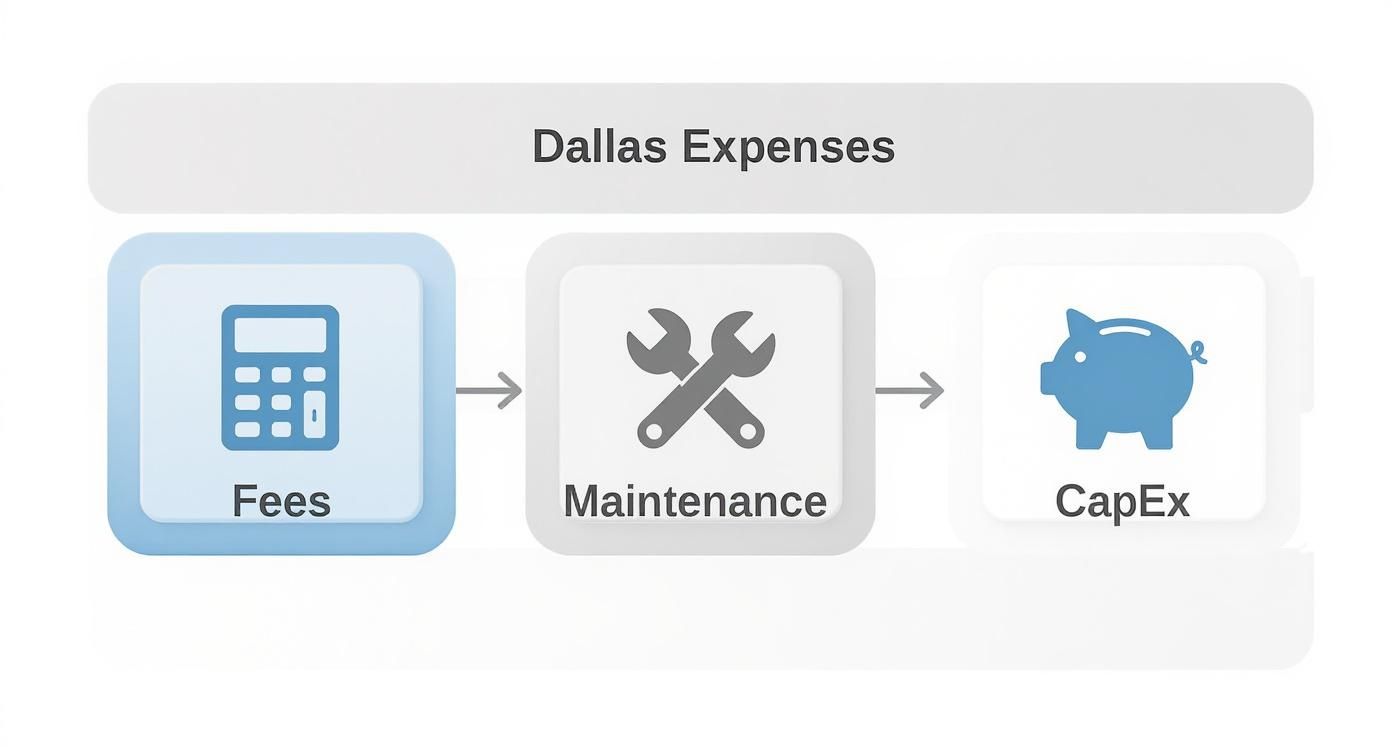
Getting this part right is everything. You have to forecast the management fees, the day-to-day upkeep, and the major replacement costs separately to get an accurate picture.
Finding Your Cash Flow And Key Metrics
Okay, we have our NOI. Now it’s time to pay the mortgage (what the pros call “debt service”) and see what’s actually left over. A $340,000 loan at 6.5% over 30 years gives you a principal and interest payment of about $2,149 a month.
$1,231 (Monthly NOI) – $2,149 (Mortgage) = -$918 (Monthly Cash Flow)
Seeing that negative number might make your stomach drop, but hang on. In high-value markets like Dallas, especially with today’s interest rates, this is an increasingly common scenario. This is exactly why we don’t rely on just one metric to judge a deal.
Investor Insight: Negative cash flow doesn’t automatically kill a deal in Dallas. Many investors in high-appreciation markets will accept break-even or slightly negative cash flow because they’re building wealth in other ways—namely, their tenant is paying down their loan and the property value is climbing. The ROI calculator is what tells you this full story.
Let’s run our key formulas to see what I mean:
- Cap Rate: $14,772 (Annual NOI) / $425,000 (Price) = 3.48%
A cap rate this low is typical for a stable, in-demand Dallas market. It tells you the property is expensive relative to its income. - Cash-on-Cash Return: -$11,016 (Annual Cash Flow) / $105,000 (Cash Invested) = -10.49%
This metric is brutally honest—it shows you that, from an income perspective, you’re losing money each year. This is critical information if you’re an investor who needs immediate cash flow. For a more general overview, there’s a comprehensive guide on calculating Return on Investment that covers the basics well.
As you can see, a good ROI calculator isn’t about getting a single “thumbs up” number. It’s about building a financial model that reveals the entire truth of an investment, warts and all.
Advanced Analysis and Common Dallas Pitfalls
https://www.youtube.com/embed/GnLRI4wty4A
Getting that first number from your ROI calculator feels good, but it’s just the beginning. The spreadsheet gives you a clean answer, but as any seasoned Dallas investor knows, real estate is messy. The initial calculation is your baseline—the real work starts when you begin poking holes in your own assumptions.
This is where you shift gears from being a number-cruncher to a strategic analyst. It’s all about asking the tough “what if” questions to see just how durable your potential Dallas investment really is. A deal that only works in a perfect world is a deal waiting to fail.
Stress-Testing Your Numbers with Sensitivity Analysis
“Sensitivity analysis” sounds complex, but it’s really just a simple, powerful habit for analyzing Dallas properties. You take one variable in your calculator, change it, and see how badly it hurts your bottom line. It’s how you find the breaking point of your investment before you ever sign the closing papers.
Start asking yourself—and your spreadsheet—these kinds of questions:
- What if the property sits empty longer than I expect? You might have used a 5% vacancy rate, which is a solid starting point. But what happens to your cash flow if a slow leasing market in Dallas pushes that to 10%? Or a major repair keeps it vacant for two months, bumping it to 15% for the year?
- What if a big-ticket item fails? Imagine the HVAC system gives out in the middle of a Texas summer. That’s an unexpected $10,000 hit. How does that one expense demolish your cash-on-cash return for that year?
- What if the tax man comes knocking? Property taxes in Texas rarely go down. A 10% jump in your annual tax bill might not sound catastrophic, but it’s a direct hit to your net operating income that compounds over time.
Running these scenarios shows you how much breathing room—or lack thereof—your deal has. If a small hiccup turns your cash flow negative, that’s a serious red flag.
Investor Takeaway: A solid Dallas investment should be able to take a few punches. If your deal completely unravels because one assumption is slightly off, it’s too fragile. The goal is to find properties that still perform even when things don’t go perfectly to plan.
Avoiding Common North Texas Investment Traps
Every market has its quirks, and Dallas is no exception. Beyond the universal risks, there are a few local gotchas that frequently trip up new or out-of-state investors. Ignoring these can turn a great-looking ROI into a money pit.
The Property Tax Surprise
This is, without a doubt, the number one mistake I see investors make in Dallas. You simply cannot use the seller’s current property tax bill in your calculations. Once that property sells, the county appraisal district will reassess its value based on your higher purchase price, and your tax bill will follow. It’s almost guaranteed. We’re talking a potential jump of 20-30% or more in the first year alone, which can instantly erase your projected cash flow. Always, always calculate your taxes based on your purchase price.
Dallas Foundation Issues
The soil here is no joke. North Texas is famous for its expansive clay soil, which swells when wet and shrinks when dry, wreaking havoc on foundations. This constant movement can lead to cracks, uneven floors, and doors that stick. Fixing a foundation isn’t like patching drywall; it can easily run you $15,000 to $25,000, sometimes more. A thorough inspection by a structural engineer before you buy is absolutely non-negotiable in the Dallas area. I also recommend padding your maintenance and CapEx reserves a bit higher specifically for this risk.
Over-Relying on Appreciation
Dallas has had a great run with appreciation, but banking on it to make a bad deal look good is speculating, not investing. A strong rental property should stand on its own two feet, generating positive cash flow from day one. In 2025, market forecasts suggest that while rents remain strong, the rapid price growth we’ve seen is leveling off. This is a crucial reminder that cash flow is king. As the global real estate outlook from Aberdeen points out, relying on rental income is the most durable strategy. Your analysis needs to prove the property works now. Appreciation should be the icing on the cake, not the cake itself.
Answering Your Top Questions About Dallas Rental ROI
When you’re trying to figure out if a Dallas rental property is a good deal, a few key questions always come up. Let’s tackle the big ones I hear from investors all the time.
What’s a Good ROI for a Rental Property in Dallas?
This is the million-dollar question, isn’t it? The truth is, “good” depends entirely on your game plan. While many Dallas investors I work with look for a cash-on-cash return of 8% to 12%, what works for you hinges on your personal goals and how much risk you’re comfortable with.
The Dallas-Fort Worth metroplex is huge and diverse. A property in a high-growth suburb like Frisco might only yield a 4-6% cash-on-cash return. An investor buying there is playing the long game, betting on that property’s value to skyrocket over time. They’re trading immediate cash flow for future wealth.
On the flip side, someone who needs reliable monthly income might target a 10% or higher cash-on-cash return in a Dallas neighborhood like Mesquite, where the numbers often pencil out for stronger cash flow from day one.
A good ROI isn’t just a number; it’s the right number for your investment strategy. Your calculator should let you model both scenarios: one for immediate cash return and another that projects your total return over five or ten years.
How Do Dallas Property Taxes Affect My ROI?
I can’t stress this enough: property taxes in Dallas will make or break your deal. They have a massive impact on your bottom line, more so than in many other markets. Texas has some of the highest property tax rates in the U.S., typically falling between 2% and 3% of the property’s value each year. That’s a huge expense that can eat away at your Net Operating Income (NOI).
Here’s the biggest rookie mistake I see Dallas investors make: using the seller’s current tax bill in your calculations. Don’t fall into that trap. Once you buy the property, counties like Dallas and Collin will reassess its value based on your new, higher purchase price. This almost always leads to a significant tax hike.
If you don’t account for this, your ROI calculator is giving you garbage data. You have to project your future tax bill using your purchase price to get a real sense of your annual costs. A sudden 25% jump in property taxes can turn a profitable rental into a money pit overnight.
Should My Calculator Include Appreciation?
Yes and no. It’s critical to use the right metric for the right analysis. When you’re just trying to see if a Dallas deal makes sense on paper and can support itself financially, stick to the income-based numbers.
These are your bread-and-butter metrics for immediate health:
- Cap Rate: Tells you the property’s raw, unleveraged income potential.
- Cash-on-Cash Return: Shows you the direct return on the actual money you put into the deal.
Neither of these should ever include appreciation. This is how you ensure you’re buying a property that stands on its own two feet from day one, based purely on the rent it generates.
However, when you want to look down the road and estimate your Total ROI over, say, five years, that’s when you bring in a conservative appreciation estimate. And I mean conservative—base it on historical Dallas market data, not wishful thinking. By running both types of calculations, your calculator gives you the full picture: how the property performs today and its potential to build wealth over time.
Ready to find a Dallas investment property that meets your specific ROI goals? The team at Dustin Pitts REALTOR Dallas Real Estate Agent has the local expertise and analytical tools to help you identify and acquire properties that align with your financial strategy. Contact us today to start your search.