
A 1031 exchange flips the usual tax script. Instead of selling a Dallas investment property, paying capital gains, and then buying again, you reinvest every dollar of your sale into a new, similar asset—postponing the tax hit. Rooted in Section 1031 of the Internal Revenue Code, it’s a favorite move for Dallas investors who want to keep their money working.

Understanding The 1031 Exchange In Dallas
Think of a 1031 exchange as swapping Dallas properties without stopping at a toll booth. You sell your old investment property, then immediately roll that full value into your next acquisition. No tax detour.
In Dallas, that might look like selling a well-loved rental in Bishop Arts and using those proceeds to grab a larger commercial loft in the Design District. You sidestep a hefty IRS bill and expand your portfolio in one smooth transaction.
The Three Pillars Of A Successful Exchange
Pulling off a 1031 exchange means following some ironclad IRS requirements. Dallas investors lean on three core rules to keep the deal on track:
- The Like-Kind Rule: The replacement property must be “like-kind” to what you sold. Thanks to broad real estate definitions, you could swap a Dallas duplex for a warehouse or raw land for an office building.
- The 45-Day Identification Window: From the day you close on your sold property, you’ve got 45 days to list potential replacements in writing.
- The 180-Day Exchange Period: You must seal the deal on your new property within 180 days of the original sale.
The Three Core Rules Of A 1031 Exchange
Here’s a quick-reference table every Dallas investor should keep close at hand before starting an exchange.
| Rule | Requirement | Timeframe |
|---|---|---|
| The Like-Kind Rule | Replacement must be similar in nature and use to the one you sold | Throughout the exchange |
| 45-Day Identification Window | Identify up to three potential properties in writing | 45 days from sale |
| 180-Day Exchange Period | Close on your chosen replacement and complete the exchange | 180 days from sale |
Keeping these rules front and center will help you seize opportunities in the Dallas market and steer clear of IRS pitfalls.
The Wikipedia snippet reminds us that a 1031 exchange defers gains on property held for productive use in a trade, business, or for investment. Tapping into insights into selling commercial property can spark new ideas when you’re exchanging business-use assets in Dallas. And brushing up on real estate investment tax benefits is a must before you dive into your next deal.
The Surprising History of Like-Kind Exchanges
You might think of the 1031 exchange as a clever modern tax “hack,” but its origins actually stretch back over a century. For Dallas investors, understanding this history isn’t just trivia; it’s the key to using this tool effectively.
The whole concept first took shape in the Revenue Act of 1921. The goal back then was simple: encourage people to keep their money invested in the economy rather than cashing out. It allowed investors to swap similar types of properties without having to immediately pay capital gains taxes. You can dive deeper into this evolution on the Accruit blog.
It wasn’t long before savvy investors in the 1930s figured out a crucial workaround for delayed sales. They started using a third party—what we now call a Qualified Intermediary—to hold their cash. This prevented them from taking “constructive receipt” of the funds, which would have triggered the tax bill. A few decades later, the Internal Revenue Code of 1954 officially named the provision Section 1031, and the name stuck.
Here’s a quick rundown of the early milestones:
- 1921: The Revenue Act creates the initial rule for like-kind exchanges.
- 1924: An amendment tightens the rules, removing non-like-kind property from the deal.
- 1930s: The concept of using a Qualified Intermediary is born.
- 1954: The provision is officially codified as Section 1031.
How The Early Rules Shaped Modern Investing
By refining what counted as “like-kind,” Congress was trying to prevent abuse while still keeping the spirit of the law intact. This forced investors to stick to swapping assets meant for business or investment, not just any old property. For Dallas real estate pros, this was a huge win. It meant they could roll their profits from one local investment directly into another without the IRS taking a cut right away.
You could see it happening across the city. Landlords in Oak Lawn and Deep Ellum started swapping their rental properties for small warehouses or trendy office lofts. It was like trading in your trusty sedan for a heavy-duty truck—you’re just switching to a different vehicle to get the job done, not cashing out of the transportation business entirely.
“The history reminds us that these rules have always been a balancing act between encouraging investment and maintaining the integrity of the tax system,” notes one IRS historian.
Court Cases Lock in the Deadlines
For decades, the process was a bit loose. But a landmark court case in 1984 changed everything. The ruling officially allowed for delayed exchanges, which prompted Congress to step in and set some firm ground rules. This is where our modern, non-negotiable deadlines come from.
Now, investors have just 45 days from the sale of their property to formally identify potential replacements. After that, they have a total of 180 days to close on one of those properties.
This shift was a game-changer. It meant Dallas investors could no longer play it by ear. Meticulous planning and a close relationship with a Qualified Intermediary became mandatory. Miss one of those deadlines by even a day, and the whole exchange fails, leaving you with an unexpected and often massive tax bill.
This visual timeline gives you a snapshot of how the rules have taken shape over the years.
As you can see, the journey has been one of gradual refinement, moving from a broad concept to the highly specific process we follow today.
What This History Means for Dallas Investors
Why does any of this old history matter? Because it shows you that every rule, every deadline, and every procedural step exists for a reason. Understanding the “why” behind the 45-day and 180-day rules helps you respect them and avoid costly mistakes.
So, when you ask, “what is a 1031 exchange?” remember it’s more than just a tax loophole. It’s the result of a century of legislative and judicial fine-tuning designed to keep capital flowing while protecting the tax base.
For investors here in Dallas, this history is a practical roadmap. It underscores the need for strategic planning and careful execution. Each refinement over the decades serves as a lesson—a warning about a potential pitfall someone else already discovered. Ignoring a deadline, for instance, isn’t just a simple mistake; it’s a financial landmine that can cost you tens of thousands in taxes you thought you were deferring.
By appreciating this long journey, Dallas investors can navigate the strict requirements of a 1031 exchange with confidence and make this powerful, time-tested tool work for them.
How a 1031 Exchange Builds Wealth in Dallas
The most obvious perk of a 1031 exchange is putting off a tax bill, but its real power is how that tax deferral fuels your portfolio’s growth in Dallas. It’s really about compounding your gains by keeping every single dollar working for you, rather than slicing off a huge chunk for the IRS every time you sell.
This strategy opens up a world of opportunities across the Dallas-Fort Worth metroplex. Instead of a slow, one-step-at-a-time climb up the property ladder, a 1031 exchange is like an elevator, letting you jump to the next level of investment much, much faster.
The Power of Reinvesting Pre-Tax Capital
Let’s ground this with a real-world Dallas example. Imagine you sell a duplex in Oak Lawn and clear a $200,000 capital gain. In a normal sale, you could be looking at a federal tax bill of nearly $40,000.
That $40,000 is gone—poof—right out of your investment capital. But if you use a 1031 exchange, you can roll that entire $200,000 gain, plus your original investment, straight into your next Dallas deal.
This chart from a recent industry report shows just how much this strategy has exploded in popularity, with investors recognizing its power.
The massive jump in deal equity, especially for multifamily properties, really drives home the economic muscle you gain by reinvesting pre-tax dollars to buy bigger and better assets in markets like Dallas.
A Dallas Scenario Unlocking Growth
So, instead of writing that big check to the IRS, our Oak Lawn investor uses their full sale proceeds as a down payment on a small apartment complex over in East Dallas. This single move hits several home runs:
- Preserves Equity: Every dollar of their hard-earned gain stays in the game, working to build more wealth.
- Increases Buying Power: That extra $40,000 in capital helps them qualify for a larger loan, giving them access to higher-value Dallas properties they couldn’t touch otherwise.
- Boosts Cash Flow: Jumping from a single duplex to a multi-unit apartment building can seriously pump up their monthly rental income and overall return.
A 1031 exchange flips a tax event into a growth opportunity. It lets you leverage your entire asset base to scale up, diversify, or reposition your portfolio in a hot market like Dallas, all without the immediate drag of capital gains tax.
The ripple effect of these deals is huge. The total equity involved in 1031 exchanges skyrocketed from $170 million in 2010 to a staggering $5.5 billion by 2021. In 2021 alone, these exchanges were estimated to support 568,000 jobs and add $55.3 billion to the U.S. economy, proving they’re a major catalyst for economic activity. You can dig deeper into the economic footprint of 1031 exchanges on irei.com.
Accelerating Your Dallas Portfolio Strategy
This compounding effect is the secret sauce that accelerates wealth building. Our investor can keep this cycle going—swapping the East Dallas complex for a commercial building in the Cedars, and maybe later for a bundle of rental properties across Richardson and Plano. Each time, they defer the tax and use the full value of their asset to level up.
Of course, to pull this off, you need to have your financing lined up and ready to go. Partnering with a lender who gets the nuances of these deals is non-negotiable. Getting that part right is critical, and finding the right investment property mortgage lender can make all the difference. This strategic approach allows Dallas investors to diversify their holdings and pivot with market trends far more nimbly than the old sell-and-repurchase model ever could.
Getting the 1031 Exchange Rules and Timeline Right
If you want to pull off a successful 1031 exchange, you have to play by the IRS’s rules. For Dallas real estate investors, this isn’t just a suggestion—it’s the only way to make sure your tax deferral actually works. The whole process is incredibly precise, with deadlines that are non-negotiable.
Your Most Important Partner: The Qualified Intermediary
First things first, you’ll need a Qualified Intermediary (QI). This is an independent third party, and using one is mandatory. When you sell your Dallas property, the money doesn’t go to you. It goes directly to the QI, who holds it in an escrow account until you’re ready to buy the next property.
Why the middleman? This step is absolutely crucial to avoid what the IRS calls “constructive receipt.” If those sale proceeds hit your personal or business bank account, even for a second, the entire exchange is blown. You’ll be looking at a hefty tax bill. Your QI is the firewall that keeps your transaction compliant.
The Two Unbreakable Deadlines
The moment you close the sale on your old property (the “relinquished” property), two clocks start ticking. Miss either of these deadlines by a single day, and the whole deal is off.
- The 45-Day Identification Period: You get exactly 45 calendar days from the closing date to officially identify potential replacement properties. This isn’t a casual list; it must be in writing and delivered to your QI, clearly detailing the properties you plan to buy.
- The 180-Day Closing Period: You have a total of 180 calendar days from the original sale date to close on one or more of the properties you identified. Remember, this 180-day clock starts on the day you sell, running concurrently with the 45-day window. It doesn’t start after the 45 days are up.
This timeline is the engine that allows an investor to trade up from a smaller property to a larger one, using deferred tax dollars to fuel serious portfolio growth in Dallas.
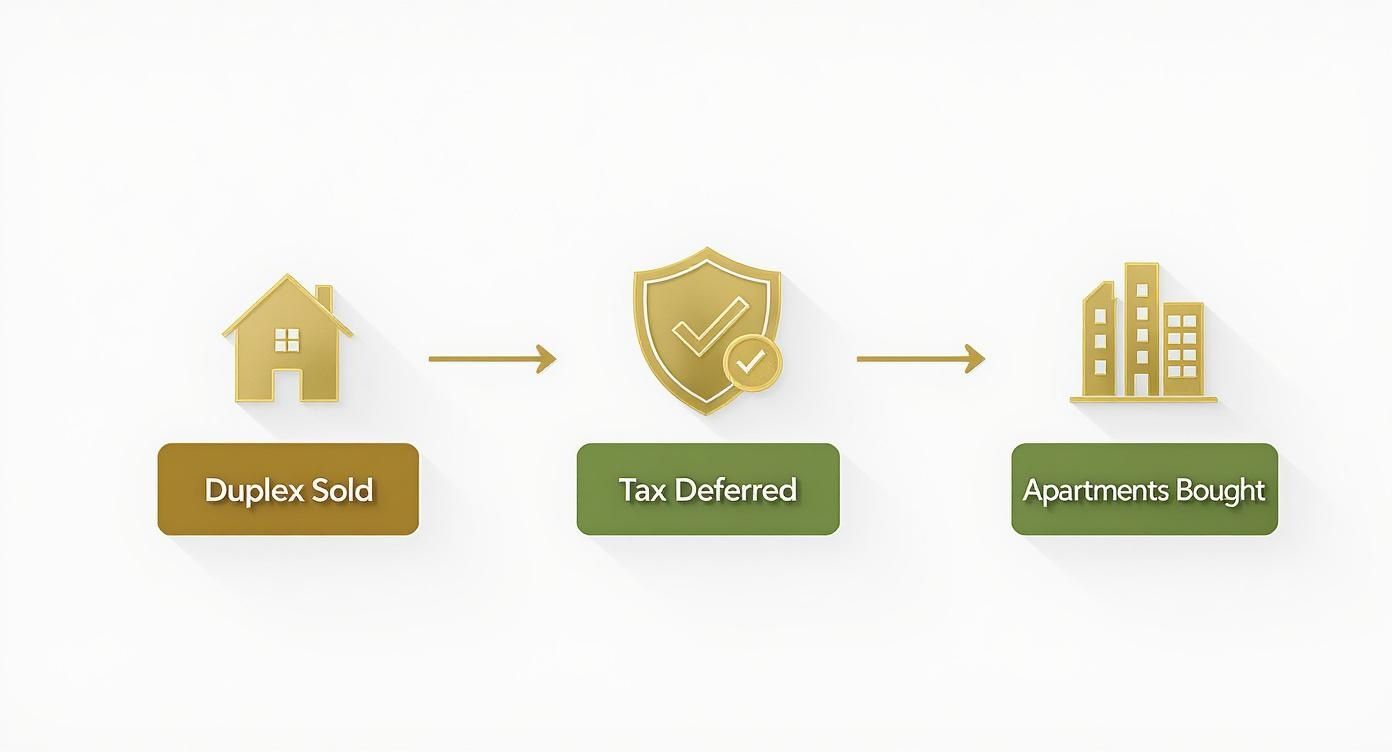
As you can see, the strategy is all about rolling the full value from selling a duplex into a larger apartment building, all while keeping that tax liability on the sidelines.
What “Like-Kind Property” Actually Means
One of the best parts of a 1031 exchange is the flexibility of the “like-kind” rule. When it comes to real estate, the IRS definition is surprisingly broad. It’s about the nature of the investment, not the physical form of the property. The only major requirement is that both the old and new properties are held for business or investment purposes.
The term ‘like-kind’ gives you an incredible amount of freedom. You could exchange a warehouse in the Dallas industrial district for a rental condo in Uptown, or trade raw land near Plano for a bustling office building in Las Colinas. The critical detail is that they are all investment assets, not your primary residence.
The “Equal or Greater Value” Rule
To put off paying 100% of your capital gains tax, the math is simple: the property you buy must have an equal or greater value than the one you sold. You also have to reinvest all of the cash proceeds from the sale.
If you buy a less expensive property or decide to pocket some of the cash, that leftover portion is called “boot,” and it’s taxed immediately.
For example, let’s say you sell a Dallas property for $800,000 and buy a replacement for $750,000. That $50,000 difference is boot, and you’ll owe capital gains tax on it. Getting a firm grip on these financial details is vital, and you can dive deeper into the specifics of capital gains tax on a property sale in our guide.
Mastering these rules isn’t just academic—it’s the foundation of a profitable 1031 exchange strategy in the fast-paced Dallas market.
Choosing The Right Exchange Structure In Dallas
https://www.youtube.com/embed/DmF5Qv8GVnY
Knowing the basics of a 1031 exchange gets you in the door, but picking the right type of exchange is what truly unlocks its power for your Dallas investments. Think of it less like a one-size-fits-all rule and more like a toolkit. The right tool depends entirely on your goals, your timeline, and the specific deal you have in front of you.
Let’s break down the most common structures you’ll encounter in the Dallas area.
The Delayed Exchange: The Go-To Standard
For most investors in the DFW area, the Delayed Exchange is the default. It’s the most common and straightforward path, which is why it’s also called a “Forward Exchange.”
Here’s the simple, linear process: you sell your property, a Qualified Intermediary (QI) holds your proceeds in escrow, and you buy your next property within the 180-day window. It’s clean and predictable.
Imagine you just sold a duplex in Lower Greenville. With a delayed exchange, you have the flexibility to take your time—up to 45 days to identify and 180 days to close—to find that perfect replacement, maybe a small retail space in the Bishop Arts District. It’s perfect when you have a plan but need the breathing room to execute it without rushing.
The Reverse Exchange: Seize The Opportunity
What happens when you find a dream property before you’ve even listed your current one? In a hot market like Dallas, this isn’t just a possibility; it’s a regular occurrence. This is exactly where the Reverse Exchange shines.
As the name suggests, it flips the script. You acquire the new property first. A special entity called an Exchange Accommodation Titleholder (EAT) buys the new property on your behalf and “parks” it while you race to sell your old one. Once your original property sells, the funds are used to complete the exchange.
A Reverse Exchange is a power play for proactive investors. It allows you to jump on a prime opportunity—like a below-market property in Uptown—before anyone else can. Just be aware that it comes with higher fees and more complex financing hurdles than a standard exchange.
The Delaware Statutory Trust (DST): The Hands-Off Approach
If you’re tired of the “3 T’s” (tenants, toilets, and trash) but still want the tax benefits of real estate ownership, the Delaware Statutory Trust (DST) is an elegant solution.
A DST lets you use your 1031 exchange proceeds to purchase a fractional interest in a massive, institutional-grade property. Instead of buying another rental property, you could own a piece of a high-rise in Downtown Dallas or a sprawling apartment complex in Plano.
This is the ideal path for investors looking to step back from active management. You get the potential for steady, passive income without the landlord headaches. It’s a fantastic way to transition into a new phase of your investment journey, which aligns with many of the real estate investment exit strategies we discuss in our detailed guide.
Comparing 1031 Exchange Structures For Dallas Investors
To find the best fit, let’s compare these structures side-by-side. This table breaks down the features, benefits, and ideal scenarios for each type of exchange in the Dallas market.
| Exchange Type | Key Features | Ideal Use Case |
|---|---|---|
| Delayed Exchange | Sell first, then buy. Funds held by a Qualified Intermediary. Simple, linear process. | The most common scenario where an investor has time to find a replacement property after closing their sale. |
| Reverse Exchange | Buy first, then sell. Involves an Exchange Accommodation Titleholder (EAT). More complex and costly. | When a must-have replacement property becomes available before the original property can be sold. Essential for competitive markets. |
| Delaware Statutory Trust (DST) | Purchase a fractional interest in a large, professionally managed property. Passive investment. | For investors looking to exit active property management while deferring taxes and still receiving potential income. |
Ultimately, the right structure aligns with your immediate opportunity and long-term vision. Whether you need flexibility, speed, or a passive role, there’s a 1031 exchange strategy that can work for you in Dallas.
Don’t underestimate how vital these exchanges are to the market. This chart from the National Association of REALTORS® drives home just how common they are in commercial real estate.
This isn’t just a niche strategy for the ultra-wealthy. Research shows that from 2010 to 2020, between 10% and 20% of all commercial real estate deals were structured as like-kind exchanges.
Interestingly, the median sale price for these deals was around $1.1 million, confirming that it’s primarily individual investors—not massive corporations—driving this activity. And it’s not a permanent tax loophole; up to 88% of these exchanges eventually end in a fully taxable sale. This provision is a critical engine for market liquidity, encouraging investors to keep capital moving and reinvesting in new opportunities in cities like Dallas. You can dive deeper into the economic impact of 1031s on nar.realtor.
Costly 1031 Exchange Mistakes and How to Avoid Them

A 1031 exchange can be an incredible tool for building wealth in the Dallas real estate market. Get it right, and you can defer massive tax bills. Get it wrong, and you could face a devastating financial setback that wipes out all your intended savings.
The difference between success and failure often comes down to avoiding a few common, but very costly, mistakes.
One of the easiest ways to blow up an exchange is by missing the 45-day identification deadline. I’ve seen it happen. The clock starts ticking the second your old property closes, and in a fast-paced market like Dallas, that window slams shut before you know it. If you don’t provide a clear, written list of potential replacement properties to your Qualified Intermediary (QI) within that time, the deal is dead on arrival.
Another fatal error is accidentally taking control of the sales proceeds. This is known in IRS terms as “constructive receipt,” and it’s an instant disqualifier. If even one dollar from the sale of your property lands in your personal or business bank account, even for a minute, the exchange is voided. This is exactly why a reputable QI isn’t just a good idea—they’re the essential gatekeeper who holds the funds and keeps your exchange valid.
Navigating Property and Financing Traps
The pressure of the deadline can lead to another set of problems. Some Dallas investors get so focused on the timeline that they skimp on due diligence. They identify properties with major underlying issues that don’t become apparent until it’s too late, trapping them into either buying a lemon or watching their exchange fail.
Financing can also be a minefield. A critical rule is that the mortgage on your new property must be equal to or greater than the mortgage you paid off on the old one. If you buy a new property with less debt, the IRS sees that difference as a gain and it becomes taxable “boot.” It’s a nasty surprise for anyone who isn’t prepared.
A successful 1031 exchange is less about finding a loophole and more about following a very specific road map. Deviating from the path, even slightly, can lead you right back to a taxable event.
To keep your exchange on track and protect your capital, a little proactive planning goes a long way. Here’s a quick checklist to run through before you start the process here in Dallas:
- Select a Veteran QI Early: Don’t scramble to find one at the last minute. Do your homework and pick a Qualified Intermediary with a solid track record, strong security, and deep experience in the Dallas market.
- Plan Your Identification Strategy: In a competitive market like Dallas, you need a plan. Have your list of target properties—plus a few backups—researched and ready to go before your sale closes. That 45-day window moves fast.
- Understand the ‘Boot’: Get clear on what’s taxable. Any cash you take out or any reduction in debt is considered boot. You must structure the deal to reinvest 100% of the equity and replace all the debt.
- Confirm Title and Vesting: This is a simple but crucial detail. The same taxpayer who sold the original property must be the one who acquires the new one. The name on the title has to be identical.
By getting ahead of these common mistakes, Dallas investors can sidestep the pitfalls and truly harness the power of a 1031 exchange to grow their portfolios.
Answering Your Top 1031 Exchange Questions
When you’re dealing with something as powerful as a 1031 exchange, it’s natural to have questions. This is especially true in a fast-paced market like Dallas. Let’s break down some of the most common questions we hear from investors just like you.
Can I Use a 1031 Exchange on My Primary Residence in Dallas?
That’s a common point of confusion, but the answer is a clear no. A 1031 exchange is designed exclusively for investment or business properties. So, that beautiful home you live in, whether it’s in Preston Hollow or Lakewood, doesn’t qualify under IRS rules.
There is a potential workaround, though. If you move out and convert your former home into a full-time rental property, it can eventually become eligible. You just need to hold it as a true investment asset for a sufficient period to satisfy the “held for investment” requirement.
What Happens If I Can’t Find a Replacement Property in 45 Days?
This is where the rubber really meets the road. The 45-day identification window is one of the most unforgiving deadlines in the entire tax code. If you don’t provide your Qualified Intermediary (QI) with a written list of potential replacement properties within that timeframe, the exchange is over. It fails.
Once that deadline passes without a proper identification, your QI has no choice but to release the sale proceeds back to you. The moment that happens, the transaction is no longer a tax-deferred exchange—it’s just a regular sale, and you’ll be on the hook for the full capital gains tax.
Do I Have to Reinvest All the Cash to Defer All the Tax?
Yes, if you’re aiming for 100% tax deferral, you need to follow the rules precisely. There are two main financial hurdles to clear. First, the total value of the new property (or properties) you buy must be equal to or greater than the one you sold.
Second, all of the cash proceeds from the sale must be reinvested. If you pocket any cash from the deal, the IRS calls that “cash boot,” and it becomes taxable income in the year of the sale.
Can I Exchange One Dallas Property for Multiple Properties?
Absolutely! In fact, this is a fantastic strategy many Dallas investors use to diversify their portfolios and spread their risk. You could sell one large commercial building downtown and use the proceeds to acquire several single-unit rental properties in growing suburbs like East Dallas or Richardson.
The key is to follow one of the IRS identification rules. The most straightforward is the “Three-Property Rule,” which lets you formally identify up to three potential replacement properties, regardless of their combined value.
Ready to see how a 1031 exchange can elevate your Dallas real estate investment strategy? The experts at Dustin Pitts REALTOR Dallas Real Estate Agent have the local knowledge and professional network to guide you through every step. Contact us today to start planning your next move.