So, what exactly is a home equity line of credit, or HELOC? Think of it as a flexible financial tool that lets you tap into the value you've painstakingly built up in your Dallas home. It works a lot like a credit card, but instead of being unsecured, it's backed by your property, which usually means much better interest rates.

This setup gives you a revolving line of credit you can draw from whenever you need it, making it a go-to option for local homeowners planning for big-ticket expenses.
How Your Dallas Home Equity Works for You
Imagine the equity in your home as a savings account you've been contributing to for years. Every mortgage payment you've made and every bump in your property's value—a familiar story in hot Dallas neighborhoods from Preston Hollow to Lakewood—has added to that account.
A HELOC is basically the key that unlocks those funds.
Instead of getting a single check like you would with a traditional loan, a HELOC opens up a line of credit. You can pull money from it as needed, pay it back, and then borrow again. This is perfect for ongoing projects where costs pop up over time. A homeowner in the M Streets, for example, could use a HELOC to fund a kitchen remodel in phases without having to apply for a new loan every time a contractor needs a payment.
Given the steady rise in Dallas property values, this has become an incredibly powerful way for homeowners to put their equity to work.
To give you a clearer picture, here’s a quick rundown of what makes a HELOC tick.
Key HELOC Features for Dallas Homeowners
| Feature | Description |
|---|---|
| Revolving Credit | You can borrow money, repay it, and then borrow again up to your approved credit limit. |
| Variable Interest Rates | Rates are typically tied to a benchmark index, so your monthly payment can fluctuate. |
| Secured by Your Home | Your property acts as collateral, which helps secure a lower interest rate than unsecured debt. |
| Defined Draw Period | There's a set timeframe, usually 10 years, during which you can actively draw funds. |
This structure gives you a ton of flexibility that you just don't get with other types of loans.
A HELOC isn't a one-and-done loan; it's a living, breathing financial resource. It’s built for people who need cash on demand, giving you total control over when you borrow and how much you take out.
Ultimately, this powerful option is tied directly to the wealth you've accumulated in your property. To really make the most of it, it helps to first understand the basics. You can learn more about how to build equity in your home and see why it’s such a big deal in the competitive Dallas real estate market. That knowledge is the foundation for using your home as the valuable financial asset it truly is.
How a HELOC Works for Dallas Homeowners
A Home Equity Line of Credit isn't like a traditional loan where you get a single lump sum of cash. Instead, it works in two distinct stages, giving Dallas homeowners a ton of flexibility. The key is understanding how these two phases—the draw period and the repayment period—work together.
This simple visual breaks down how you can turn your home's value into cash you can actually use.
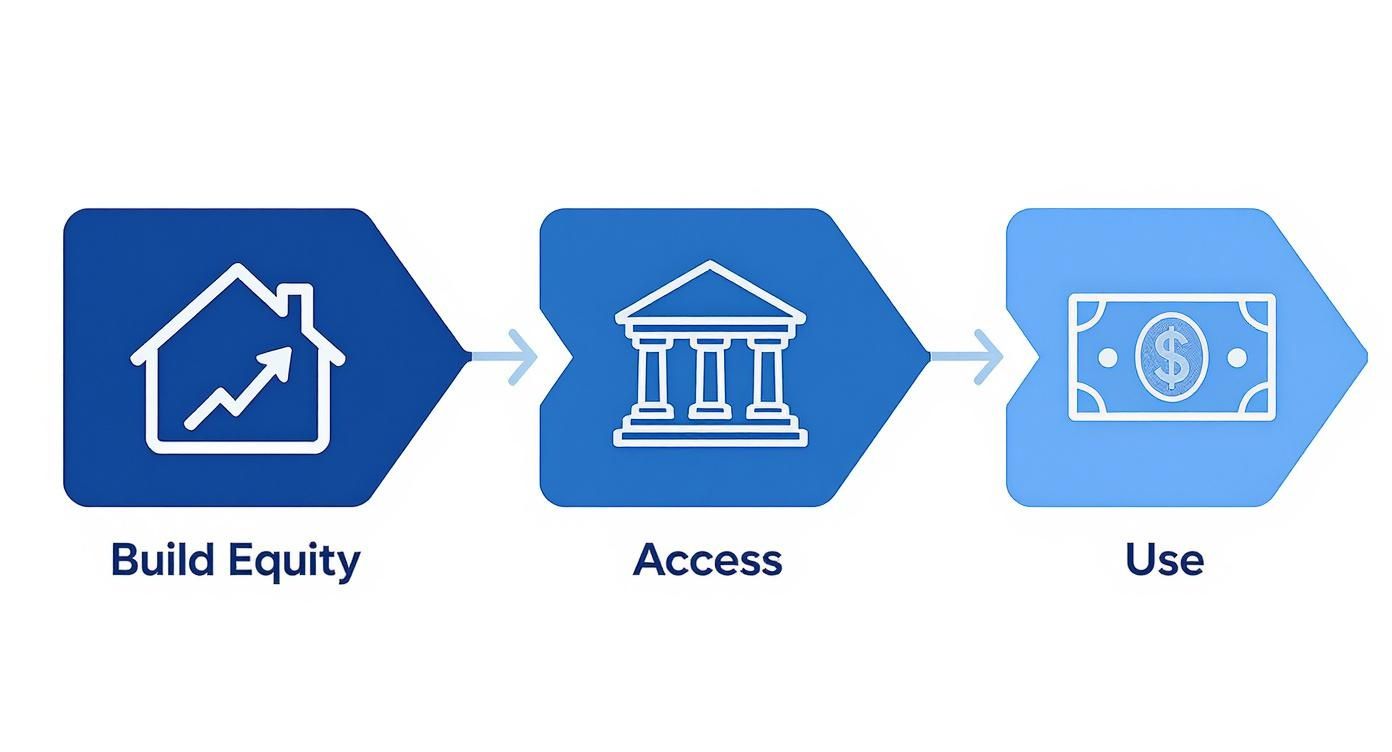
As your Dallas property value climbs, so does your equity. A HELOC is simply a way for lenders to let you tap into that value to fund your financial goals.
The Draw Period
Think of the draw period like a credit card, but with a much better interest rate and secured by your home. For a set timeframe, usually 10 years, you have a line of credit you can borrow from whenever you need to, right up to your approved limit. The best part? You only pay interest on the money you've actually drawn.
Let's say a homeowner in the Dallas M Streets gets a $100,000 HELOC for a big kitchen remodel.
- In the first month, they pull $25,000 to pay the contractor for demolition and framing. Their monthly payment is based only on that $25,000, not the full credit line.
- Six months later, they need another $40,000 for cabinets, countertops, and appliances. Their payments will now be calculated on the new total balance of $65,000.
- During this time, if they pay back some of the principal, that amount becomes available to borrow again—just like paying down a credit card.
This pay-as-you-go model is perfect for projects with staggered costs, like a home renovation. It stops you from paying interest on a huge chunk of cash that’s just sitting in your bank account, giving you more control and cutting down on unnecessary costs.
This kind of financial flexibility is a big reason why home equity lending has become so popular. The global market, currently valued at $29.23 billion, is expected to swell to $36.18 billion soon, thanks in large part to rising property values just like we're seeing all over the Dallas area. You can dive deeper into this trend by reading about the home equity lending market growth on The Business Research Company.
The Repayment Period
Once the draw period closes, your HELOC shifts into the repayment period. This phase can last up to 20 years, and your ability to borrow from the line of credit is now shut off. The focus moves entirely from accessing funds to paying down what you owe.
From this point on, your monthly payments will be larger because they'll include both principal and interest, not just the interest-only payments you might have been making. It's a change you need to be ready for. The mission is simple: systematically pay down your balance to zero over the repayment term, clearing the debt that was secured by your Dallas home.
Weighing the Benefits and Risks in Dallas
Tapping into your home's equity is a big financial step, and like any major decision, it's smart to look at it from all angles. A Home Equity Line of Credit (HELOC) can be a fantastic tool, but it's just as important to be clear-eyed about the potential downsides. The key is to weigh the incredible flexibility it offers against the very real responsibility of putting your home on the line.
For many Dallas homeowners, the biggest draw is the flexibility. Think about it: unlike a typical loan where you get a big pile of cash and start paying interest on all of it immediately, a HELOC lets you pull out only what you need, when you need it. This gives you amazing control over how much you borrow and how much interest you actually pay.
The Upside of a Dallas HELOC
But the benefits don't stop there. When you dig into what a HELOC can do, you'll see a few perks that are especially handy here in the Dallas market.
- Lower Interest Rates: Because your home secures the loan, lenders see it as less risky. That usually means you get a much better interest rate than you would with a credit card or a personal loan, which can save you a serious amount of money.
- Potential Tax Advantages: This is a big one. If you use the money to buy, build, or make significant improvements to your Dallas home, the interest you pay might be tax-deductible. Always chat with a tax professional to see how this applies to you.
- Revolving Credit Access: During what's called the "draw period," any money you pay back toward the principal is freed up for you to use again. It's like having a financial safety net for emergencies or new projects, all without having to reapply for another loan.
Think of a HELOC as your own private financial reservoir, ready and waiting. For a Dallas resident who spots a great investment property in a hot neighborhood like Bishop Arts, that quick access to cash can mean the difference between snagging the deal and watching it slip away.
Understanding the Potential Risks
Now, let's talk about the other side of the coin. This isn't free money, and the biggest risk is a serious one: your Dallas home is the collateral. If you can't make the payments, the lender could foreclose. That’s the fundamental trade-off for getting those lower rates and flexible terms.
Beyond that primary concern, there are a few other things to keep a close watch on.
- The Temptation to Overspend: It can be easy to get carried away when you have a large credit line at your fingertips. It’s absolutely critical to have a firm budget and a clear plan for how you'll use the funds.
- Variable Rate Uncertainty: Most HELOCs have variable interest rates, meaning they can go up or down with the market. If the Prime Rate goes up, so will your monthly payment, which could put a real squeeze on your budget if you're not prepared.
- Market Fluctuations: The Dallas real estate market has been on a great run, but things can change. If property values dip, you could find yourself "underwater"—owing more on your mortgage and HELOC combined than your home is actually worth.
Qualifying for a HELOC in the Dallas Market
Getting a Home Equity Line of Credit isn't a given. Dallas lenders are looking for specific things to make sure you're in a solid financial spot to handle the new line of credit. Knowing what they’re looking for ahead of time can make the whole process smoother and set you up for success. Think of it as a financial health check for both you and your property.

First and foremost, it all comes down to your home’s equity. This is the entire foundation of a HELOC, and it's what gives the lender the confidence to lend you money. They need to see that you have a significant ownership stake in your home, which serves as their collateral.
Your Equity and Loan-to-Value Ratio
Lenders measure your equity using something called the loan-to-value (LTV) ratio. In the Dallas area, most lenders will let your total home-related debt—that’s your main mortgage plus the new HELOC—go up to 85% of your home's current appraised value. This means you’ll need to keep at least 15% equity in your home even after you open the credit line.
Let's walk through an example. Say your Dallas home is appraised at $600,000, and you still owe $350,000 on your mortgage. Your current LTV is roughly 58%. Since a lender might let your total debt climb to $510,000 (which is 85% of $600,000), you could potentially qualify for a credit line of up to $160,000.
This 85% cap is a safeguard for everyone. It protects you and the lender if the housing market takes a dip. The great news for Dallas homeowners is that equity levels are at an all-time high. U.S. mortgage holders have a staggering $17.6 trillion in home equity, and about $11.5 trillion of that is considered "tappable," or available to borrow against. You can dive deeper into these record levels of home equity on ICE Mortgage Technology's website.
Credit Score and Financial Stability
Beyond equity, lenders need to see that your personal finances are in good shape. They'll take a close look at your credit history and income to get a clear picture of your ability to repay the loan.
Here are the key things they'll check:
- A Strong Credit Score: Generally, you'll need a credit score of at least 680. For the very best rates and terms, lenders often want to see a score above 700. A high score shows you have a history of managing debt responsibly.
- Verifiable Income: You have to prove you have a steady, reliable income that can easily cover your current debts and the new payments from the HELOC.
- Low Debt-to-Income (DTI) Ratio: Your DTI is a simple calculation: your total monthly debt payments divided by your gross monthly income. Most lenders want this number to be 43% or lower.
Your credit score is one of the most significant factors in the approval process. It’s a direct reflection of your financial habits and tells lenders how likely you are to repay your debts on time.
If your score isn't quite there yet, don't worry. Taking some time to improve it before applying is a really smart move. Our guide on how to improve your credit score is packed with practical tips to help you get on the right track. When you can check all these boxes, you’ll be in a fantastic position to get approved.
Understanding HELOC Rates and Terms
When you're looking at a HELOC, the interest rate is probably the first thing you'll check. But it's not as straightforward as the fixed rate on your primary mortgage. Most HELOCs have variable interest rates, which is a crucial detail to understand.
Your rate isn't set in stone. Instead, it’s tied to a major financial benchmark, usually the Prime Rate. If that index moves up or down, your HELOC rate and your monthly payment will likely follow. This can be great when rates are dropping, but it also adds a layer of uncertainty you need to be ready for.
For any Dallas homeowner planning a big project, this is a big deal. A sudden rate hike could throw your entire budget off track. Before you commit, it's smart to understand all the factors that increase your total loan balance so you can manage the debt without any surprises.
Fixed-Rate Conversion Options
Feeling a bit nervous about that variable rate? Some lenders offer a fantastic feature to give you some peace of mind: a fixed-rate conversion option. This lets you lock in a specific portion of what you’ve borrowed at a fixed interest rate.
Let's say you draw $50,000 from your HELOC for that kitchen remodel in your East Dallas home. You could choose to convert that $50,000 into a fixed-rate loan. Now, your payments on that chunk are predictable and won't change, no matter what the market does. The rest of your credit line stays open and variable, ready for whenever you need it.
This hybrid approach really gives you the best of both worlds—the on-demand cash of a HELOC and the payment stability of a traditional loan.
Navigating the Terms
When you start shopping around with different lenders in the Dallas area, don't just fixate on the interest rate. The devil is in the details, and you need to look at the entire loan agreement to avoid getting tripped up later.
Be sure to ask about these key terms:
- Draw Period: How long do you have to actually use the money?
- Repayment Period: Once the draw period ends, how long do you get to pay it all back?
- Annual Fees: Is there a yearly cost just to keep the account open?
- Closing Costs: Will you have to pay upfront fees, similar to a mortgage?
HELOC rates can be all over the map. Nationally, the average might be around 7.82%, but in Dallas, you could see offers anywhere from 6.15% to over 8.65%. Your final rate will depend on your credit score and your home's equity. Speaking of equity, knowing your home's loan-to-value ratio is non-negotiable; you can get up to speed by reading our guide on what is a loan-to-value ratio.
Smart Ways Dallas Homeowners Use a HELOC
Knowing what a HELOC is in theory is great, but seeing how people actually use one is where it all starts to make sense. For homeowners here in Dallas, a HELOC is more than just a loan; it's a flexible tool that can help you hit some major life goals.

From boosting a home's value to getting a handle on personal finances, here are some of the smartest ways Dallas locals are putting their home equity to work.
Strategic Home Renovations
One of the most popular and powerful ways to use a HELOC is to fund a home renovation—the kind that improves your life and your property value. In a hot market like Dallas, the right upgrades can pay for themselves and then some.
Think about using a HELOC to finally gut that dated kitchen in your Oak Cliff bungalow or to pop the top and add a second story to your M Streets home. These aren't just expenses. They're smart investments that build even more equity down the road.
By tapping into the equity you already have, you're funding projects that grow your home's value. This creates a powerful cycle: the renovation increases your home's worth, which in turn builds the very equity you can tap into again later.
Of course, before you start knocking down walls, you need a solid plan. A HELOC can provide the funds, but a good budget is essential. This practical guide to budgeting for a home renovation is a fantastic resource to get you started.
Financial Consolidation and Other Goals
A HELOC isn't just for home improvements. It can be a cornerstone of a much broader financial strategy. Since the interest rates are often much lower than what you'd find with credit cards or personal loans, it’s a brilliant tool for getting your finances in order.
Here are a few other common uses:
- Paying Down High-Interest Debt: Got a few credit cards with sky-high interest rates? You can roll all those balances into a single HELOC payment. The lower rate can save you a ton of money on interest and make your monthly payments much more manageable.
- Funding Educational Pursuits: A HELOC can cover big educational bills without requiring you to cash out other investments.
- Creating an Emergency Fund: Sometimes, just having the line of credit open and available is the goal. It can act as a powerful emergency fund for life's big, unexpected curveballs, giving you incredible peace of mind.
Frequently Asked Questions About Dallas HELOCs
Getting into the weeds of a home equity line of credit naturally brings up a lot of questions. For homeowners here in Dallas, a little local context can make all the difference in feeling confident about your decision. Let's tackle some of the most common things people ask.
How Much Can I Borrow with a HELOC on My Dallas Home?
Most Dallas-area lenders will let you tap into up to 80-85% of your home's appraised value, minus what you still owe on your mortgage. This is what's known in the industry as the combined loan-to-value (CLTV) ratio, and it's the most important number in this whole equation.
Let's make that real. Say your home in a neighborhood like Preston Hollow is valued at $500,000, and you have a $250,000 mortgage balance. If a lender uses an 85% CLTV, they'd be willing to lend a total of $425,000 against your home. Just subtract your current mortgage balance, and you're left with a potential credit line of up to $175,000.
Are HELOC Interest Payments Tax-Deductible in Texas?
Good news—yes, they can be. Since Texas follows federal tax law on this, you can deduct HELOC interest as long as the money is used to "buy, build, or substantially improve" the home that's securing the loan.
So, if you put that HELOC money toward a major kitchen remodel for your Dallas home, the interest you pay is likely deductible. But if you use it to pay off credit card debt or buy a new boat, that interest won't qualify for a deduction.
Always a good idea to chat with a tax professional first. They can give you advice based on your specific financial picture before you bank on any deductions.
What Happens if Dallas Property Values Decline?
This is a smart question to ask. If the Dallas property market takes a dip after you've opened a HELOC, you could find yourself owing more on your home (your first mortgage plus the HELOC) than it's actually worth. This is often called being "underwater."
A market downturn won't usually change the payment terms of the HELOC you already have. The real challenge comes if you try to sell or refinance. In a worst-case scenario where values are falling fast, a lender might decide to freeze or reduce your credit line to manage their risk, which ultimately protects both you and them.
Navigating the Dallas real estate market requires an expert guide. Whether you're thinking about a HELOC to boost your property's value or planning your next big move, Dustin Pitts REALTOR Dallas Real Estate Agent is here to help. Explore your options and see what your home is truly capable of at https://dustinpitts.com.