
Think of the chain of title as the official story of your Dallas property. It’s the complete, unbroken historical record that traces ownership all the way from its very first owner to the person selling it today. Each “link” in this chain is a legal document, most often a deed, that officially passes ownership from one person to the next.

What Is The Chain Of Title For A Dallas Property?
When you buy a property in a competitive Dallas neighborhood like Uptown or Lakewood, you’re not just buying the land and the building. You’re buying the legal rights to own it, and the chain of title is the paper trail that proves the seller actually has the right to sell those rights to you. It’s a chronological sequence of all the property’s historical transfers, all officially filed with Dallas County.
Imagine the property’s ownership history as an actual chain. If even one link is weak, missing, or was created through fraud, the entire chain is compromised. This is what we in the real estate world call a “cloud” on the title, and it can bring a Dallas transaction to a screeching halt.
The Foundation Of Clear Ownership
A clean, clear chain of title isn’t just a nice-to-have; it’s the bedrock of a secure real estate investment in Dallas. Without it, you could be setting yourself up for nasty legal surprises and ownership challenges long after you’ve settled in. These problems often stem from issues buried deep in a property’s past.
Here’s what a solid title history looks like:
- A clear starting point: The record begins with the very first private owner, which often traces back to an original land grant.
- Consecutive transfers: Every single sale, inheritance, or other transfer is documented with a legally sound and properly recorded deed.
- No unresolved claims: The record confirms that all previous mortgages, liens, or court judgments against the property have been fully paid and officially released.
A complete and unbroken chain of title is non-negotiable for a Dallas property. It’s what gives a lender the confidence to issue a mortgage and allows a title company to insure your ownership rights against any defects from the past.
This visual timeline helps illustrate how ownership moves from an original grant, through various deeds, all the way to the current owner.
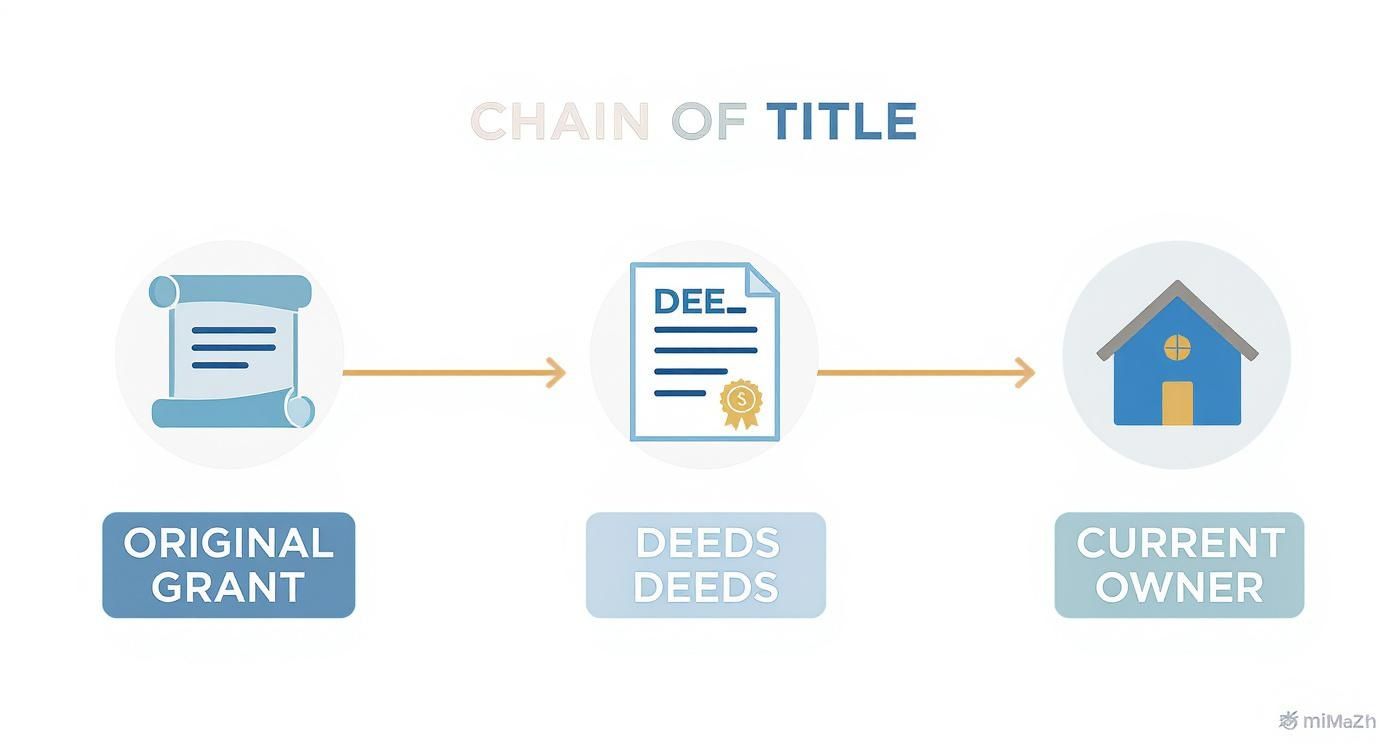
The diagram simplifies the concept, showing that each deed is a crucial link that must be secure for your ownership to be valid and defensible.
To get a clearer picture, it helps to break down the specific documents that make up this historical record.
Core Components of a Dallas Property’s Chain of Title
| Component | Its Role in Dallas Real Estate |
|---|---|
| Grant Deed / General Warranty Deed | This is the most common type of deed, transferring ownership and guaranteeing the seller has the legal right to sell the property. |
| Quitclaim Deed | Often used in divorces or between individuals, this deed passes any ownership interest without any guarantees or warranties about the title. |
| Mortgages & Deeds of Trust | These documents show when the property was used as collateral for a loan. A “release of lien” must be filed when the loan is paid off. |
| Tax Liens & Mechanic’s Liens | These are claims against the property for unpaid taxes or unpaid work done by contractors. They must be cleared to have a clean title. |
| Wills & Probate Records | When a property is inherited, these court documents prove the legal transfer from the deceased owner to their heirs. |
| Easements & Covenants | These records grant rights to others (like utility companies) or place restrictions on how the property can be used. |
Each of these components is a piece of the puzzle. A Dallas title company’s job is to assemble them all to ensure the picture is complete and nothing is missing.
Verifying A Property’s Past
Before you close on a Dallas property, a title company performs a meticulous review of this history, known as a title search. This isn’t just a quick look at recent sales. A professional title examiner will trace the chain of ownership back decades, sometimes 50 to over 100 years, depending on the property’s age and history.
This deep dive into Dallas County’s public records is crucial for uncovering any hidden issues. Understanding how to research property history yourself can give you a real appreciation for the detailed work that goes into protecting your Dallas investment. A thorough search validates the seller’s ownership claim and ensures you won’t inherit their old problems.
Why a Clear Title Is Crucial for Dallas Investors
In the fast-paced Dallas real estate market, a clean chain of title isn’t just a piece of paper—it’s your armor. Ignoring it opens you up to serious financial and legal headaches that can turn a great investment sour.
Think about it. You find the perfect property in a prime Dallas neighborhood like Preston Hollow, you close the deal, and you start making plans. Then, out of the blue, a previously unknown heir comes forward with a legitimate claim. Or maybe you discover an old contractor’s lien from a decade ago is now your problem to solve. These aren’t just scare tactics; they’re the real-world risks of a “clouded” title in Dallas.
These clouds, or title defects, can stop a deal in its tracks or drag you into expensive legal fights long after you’ve moved in. Your entire investment is on the line.
The Non-Negotiable Requirement for Financing
Let’s be blunt: if you need a loan in Dallas, you need a clear title. It’s a deal-breaker for lenders. They won’t finance a property with a clouded title because it puts their money at risk. They have to know, without a doubt, that their loan is secured by a property with undisputed ownership.
The same goes for title insurance companies in Texas. They won’t issue a policy to cover a property that already has known, unresolved issues. Without that insurance, your ownership rights are completely exposed to claims from the past that you had nothing to do with.
A clean title is the green light for the entire Dallas transaction. It assures lenders that the property is a secure asset and allows insurers to protect you from financial loss due to undiscovered historical issues.
Verifying the chain of title is the most important due diligence you can do. It’s what protects your investment, secures your ownership, and makes sure you can sell the property later without any costly surprises. The whole point is to find and fix problems before they ever become yours.
Protecting Your Dallas Investment from the Past
At its core, a title search confirms one simple but critical thing: that the person selling you the Dallas property actually has the legal right to do so. Any gap or question mark in the property’s history can create an opening for someone else to challenge your ownership down the road.
A thorough title search can dig up all sorts of things, like:
- Outstanding Liens: Unpaid property taxes or old bills from contractors (mechanic’s liens) that are still attached to the property.
- Undisclosed Heirs: Someone with a valid inheritance claim from a long-dead owner could pop up years after you buy.
- Errors in Public Records: You’d be surprised how often simple typos or filing mistakes with Dallas County can create massive ownership headaches.
- Forgeries and Fraud: A forged signature on a deed from 30 years ago could invalidate the seller’s claim to the property today.
These defects are more common than you might think. Data shows that about 1 in 500 real estate deals in the U.S. run into title problems during the search, often leading to thousands in legal fees and major closing delays. You can find more chain of title data on HelloData.ai.
Ultimately, a clear title gives you something invaluable: peace of mind. It’s the confirmation that you’re buying a clean asset, free from the legal and financial baggage of its past, so you can move forward with your Dallas investment with confidence.
How Professionals Uncover a Property’s History in Dallas
When you’re buying property in Dallas, figuring out its history isn’t something you do on a weekend. It’s a serious investigation handled by trained experts. Title companies, real estate attorneys, and specialists called abstractors are the ones who dig into a property’s past using a formal process known as a title search.

This isn’t just a quick Google search. It’s a deep dive into public records, tracing ownership back in time, one owner to the next. The official home for all this information is the Dallas County Clerk’s Office, where every property transaction in the county is recorded.
The Detectives of Real Estate: Title Officers and Abstractors
Think of a title officer or abstractor as a property detective. Their entire job is to comb through Dallas public records to build a precise, complete timeline of the property’s life. They have a trained eye for spotting the kind of inconsistencies and red flags that most people would never notice.
These professionals go way beyond just looking at who sold the property to whom. Their search is incredibly thorough, focusing on a specific set of documents that paint the full picture of the property’s legal health.
Here’s what they’re looking for during a Dallas title search:
- Deeds: They review every recorded deed (General Warranty, Quitclaim, etc.) to make sure each transfer was done by the book.
- Mortgages and Liens: They hunt for any outstanding mortgages, contractor liens (mechanic’s liens), or liens for unpaid taxes.
- Judgments: Any court judgments against a past owner that could still be attached to the property are flagged.
- Probate Records: If a property was inherited, they check these records to verify the legal transfer to the heirs was legitimate.
This exhaustive review is what allows a title company to issue a title report, which is basically a summary of their investigation. Learning how to read a title report is a game-changer for any serious Dallas property buyer, as it lays out everything the search uncovered.
Following the Paper Trail Backward
The process is methodical. Professionals start with the current owner and work their way backward, link by link. They verify that each seller (grantor) actually had the legal authority to transfer the property to the buyer (grantee). Even a single forged signature or a misfiled document from 50 years ago could put every later transaction in jeopardy.
Given the sheer volume of paperwork involved, many legal pros now use sophisticated AI legal document review tools to help manage and analyze these extensive records more efficiently. It just goes to show how much information has to be sifted through to confirm you’re getting a clean title.
A professional title search is the only surefire way to know a Dallas property’s true legal standing. It’s a specialized craft that blends legal expertise, investigative grit, and an intimate knowledge of how Dallas County records work.
The chain of title is one of the most vital parts of any real estate deal. A comprehensive search can take a title company anywhere from 40-60 hours of focused work to complete. That significant time commitment is exactly why this job is best left to the pros who know Texas property law inside and out—their work is what protects your investment.
Common Title Defects Found in Dallas Real Estate
Even in a market as hot as Dallas, a property’s history isn’t always squeaky clean. A professional title search is designed to dig up any historical hiccups, often called “clouds” or defects, that could put your investment at risk. These aren’t just minor legal details; they are real-world problems that can slow down, or even kill, a deal if they aren’t handled correctly.
The best way to appreciate a good title search is to understand what can go wrong. Think of these defects as unresolved issues from the property’s past that cast doubt on who truly has the right to sell it. Finding them before you sign on the dotted line is absolutely essential to protecting your future ownership.
Unresolved Liens and Judgments
One of the most common issues we see in Dallas properties is an unresolved lien. Simply put, a lien is a legal claim a creditor has on a property because of an unpaid debt. This gives them the power to force a sale of the property to get the money they’re owed.
Several types of liens can pop up and cloud a title:
- Mechanic’s Liens: Let’s say a previous owner remodeled their kitchen in a Highland Park home but never paid the contractor’s final invoice. That contractor can file a mechanic’s lien. The tricky part? The claim is attached to the property, not the owner, meaning it could easily become your headache.
- Tax Liens: If a former owner neglected to pay their property taxes to Dallas County or even owed back income taxes to the IRS, a tax lien can be slapped on the property. These absolutely have to be paid off before the title can be cleanly transferred to you.
- Judgment Liens: If someone loses a lawsuit and has a court judgment against them for a sum of money, that judgment can be attached to their real estate.
Every one of these liens has to be paid in full and officially released before or at the closing table. If they slip through the cracks, you could end up inheriting someone else’s debts right along with your new property.
Errors and Forgery in Public Records
The Dallas County Clerk’s office manages an incredible amount of paperwork, and let’s be honest, mistakes can happen. A simple clerical error—a name spelled wrong, an incorrect legal description—can create major title problems that require time and legal muscle to fix.
Even more troubling is the potential for forgery or fraud. Picture this: a deed was signed 20 years ago by someone pretending to be the owner, or a signature was forged to transfer the property illegally. A fraudulent transfer like that creates a massive break in the chain of title and could potentially void every sale that came after it—including yours.
A fraudulent deed lurking in a property’s past can render the entire chain of title void. This is a severe defect that highlights why both a professional title search and a comprehensive owner’s title insurance policy are non-negotiable in Dallas.
Undisclosed Heirs and Boundary Disputes
Other common title issues we see in Dallas are less about the paperwork and more about people and property lines. These can be particularly difficult to uncover without a seasoned expert on your side.
An undisclosed heir, for example, can throw a serious wrench in the works. This happens when a property owner passes away, and their known relatives sell the property. But then, months or years later, a previously unknown heir emerges with a legitimate legal claim to a piece of the pie. This can ignite a complex legal fight over who really owns the property.
Finally, boundary disputes are surprisingly common, especially in older, established Dallas neighborhoods like the M Streets or Lakewood, where lots have been bought and sold for generations. Your new neighbor’s fence might be encroaching onto your land by a few feet, or an old survey could be out of date and inaccurate. These disputes can limit how you use your property and need to be sorted out so you know you’re getting exactly the land you paid for.
Title problems can feel overwhelming, but understanding these potential pitfalls is the first step toward a smooth and secure closing. Let’s take a closer look at some of these issues and how they’re typically resolved.
Common Dallas Title Defects and Potential Resolutions
Here’s a look at frequent title issues in Dallas real estate, their impact on a buyer, and the standard methods used to resolve them.
| Title Defect Example | Potential Buyer Impact | Common Resolution Method |
|---|---|---|
| Unpaid Contractor (Mechanic’s Lien) | You could be responsible for the previous owner’s unpaid construction bill. | The seller must pay the outstanding debt from their closing proceeds, and the contractor files a “release of lien.” |
| Federal Tax Lien | The IRS’s claim takes priority and must be paid before you can receive a clear title. | The lien is paid off at closing, and the IRS issues a Certificate of Discharge for the property. |
| Clerical Error on Deed | A misspelled name or wrong lot number can create confusion over legal ownership and stall financing. | A “correction deed” is drafted and filed with Dallas County to amend the public record. |
| Missing Heir | An unknown relative of a deceased former owner could surface and claim an ownership stake in your property. | Title insurance protects you from financial loss. Resolving the claim may require a “quiet title” lawsuit. |
| Boundary Encroachment | Your neighbor’s fence or shed is partially on your property, limiting your use of the land. | The issue may be resolved with a new survey and a boundary line agreement filed with the county. |
| Forgery | A past deed was fraudulently signed, making the entire chain of title invalid. | Owner’s title insurance is your primary defense against financial ruin from such a severe, hidden defect. |
Each of these defects has a solution, whether it’s as simple as paying off a debt or as complex as a “quiet title action” where a court has to step in and make a final ruling on ownership. This is exactly why a professional title search isn’t just a box to check—it’s your most important line of defense in a Dallas property transaction.
How Title Insurance Becomes Your Ultimate Safeguard
Finding a snag in a property’s chain of title can feel like hitting a brick wall, but honestly, it happens more often in Dallas real estate than you might think. The good news? Most of these issues are completely fixable. We tackle them with a two-part strategy: first, we actively “cure” any defects we find during the title search, and second, we protect your investment with a powerful safety net called title insurance.

Think of it as both offense and defense. We clear the field of any problems we can see, then put up an iron-clad shield to guard against the ones we can’t.
The Art of Curing Title Defects
When a Dallas title search turns up a “cloud” on the title, the goal is to get it resolved before you sign on the dotted line at closing. This process, known in the business as curing the title, involves taking the right legal and financial steps to wipe the issue clean from the public record. It’s all about making sure ownership can transfer to you without any leftover baggage.
Let’s say an old contractor’s lien pops up from a long-forgotten project. The seller is usually on the hook to pay that outstanding debt out of their sale proceeds at closing. Once they do, the contractor files a “release of lien” with Dallas County, and just like that, the claim is officially gone. Or, if a boundary line is in dispute, the problem is often solved by hiring a surveyor for a fresh look and getting both property owners to sign a legally binding boundary agreement.
These proactive steps are essential for known problems. But what about the risks that are lurking beneath the surface—the ones even a meticulous title search can’t dig up?
Your Financial Shield: Owner’s Title Insurance
This is precisely where owner’s title insurance proves its worth. It’s not your typical insurance policy that protects against future mishaps like a fire or flood. Instead, it’s a unique kind of protection that shields your ownership rights from past events—hidden defects that could surface and threaten your claim to the property years after you’ve moved in.
You pay a one-time premium at closing, and in return, you get lasting peace of mind. It’s become so fundamental to a secure transaction that over 90% of real estate deals in Texas now include title insurance. That figure alone tells you how critical it is for protecting your investment.
This policy defends you against a whole host of potentially devastating issues, including:
- Forgery and Fraud: If a signature on a past deed was faked, you’re covered.
- Undisclosed Heirs: Protects you financially if a forgotten relative of a past owner makes a valid claim to your property.
- Filing Errors: Shields you from problems caused by simple clerical mistakes in Dallas County’s public records.
- Unreleased Liens: Defends your title against old debts that were paid but never properly cleared from the record.
If one of these claims ever comes to light, the title insurance company steps in to handle the legal fight and cover the costs, keeping your hard-earned equity safe.
Owner’s Policy vs. Lender’s Policy: A Critical Distinction
It is absolutely crucial for Dallas buyers to understand that there are two different kinds of title insurance. They protect different people for different reasons.
An owner’s policy protects you, the property owner. A lender’s policy protects the bank. They are not the same, and only an owner’s policy truly secures your investment.
A lender’s policy is almost always required by the bank when you get a mortgage. It protects their financial stake in the property, but only for the loan amount. It offers absolutely zero protection for your down payment or the equity you build over time.
An owner’s policy, on the other hand, is for you. It protects your full investment in the property for as long as you and your heirs own it. You can dive deeper into this topic in our guide on what is title insurance. While it’s technically optional in Texas, buying a property without it is a huge and unnecessary gamble for any serious Dallas property buyer.
Navigating Your Dallas Real estate Closing with Confidence
So, you’ve done your homework on the chain of title and understand what it takes to clear up potential defects. Now we’re at the finish line: the closing. This is where all that research and due diligence really pays off, turning what can be a stressful event into a smooth, predictable path to getting your keys.
The whole process kicks into gear the second your offer on a Dallas property is accepted. At that point, either your real estate agent or your lender will order a title search from a local Dallas title company. This is the official start of the deep dive into the property’s history, and it all leads to a critical document called the title commitment.
From Title Commitment to Closing Table
Think of the title commitment as the title company’s promise to you. It’s their pledge to issue an insurance policy once certain conditions are met. This document is your roadmap, laying out everything you need to know: who currently owns the property, what needs to be fixed before closing (like paying off an old loan), and any exceptions that won’t be covered by your insurance, such as a utility easement.
As a buyer in Dallas, reviewing the title commitment with your agent is non-negotiable. It’s your golden opportunity to flag any issues or ask questions about exceptions before you’re locked in. This is how you avoid surprises down the road.
If you’re the seller, being prepared is your ticket to a quick and easy closing. Get all your documents in order ahead of time—things like mortgage payoff statements, your property survey, and any proof that old liens have been satisfied. Handing this information over to the title company early on helps them clear issues without causing eleventh-hour delays.
Key Milestones in the Closing Process
The path to closing can feel like a lot of moving parts, but it really follows a straightforward timeline. Here’s a quick look at the title-related steps you’ll encounter on your way to closing day in Dallas.
- Order the Title Search: This happens right after the contract is signed, officially launching the investigation into the property’s history.
- Receive and Review the Title Commitment: Expect this report in about one to two weeks. It details all the findings and lists the requirements to close.
- Resolve Any Title Issues: The title company will work with the seller to fix any problems, whether it’s paying off a contractor’s lien or filing a deed to correct an old error.
- Finalize Closing Documents: Once the title is clear, all the legal paperwork—like the closing disclosure and the new deed—is prepared for you to sign.
- Receive Your Owner’s Policy: After you’ve signed on the dotted line and the funds have been transferred, you’ll get your owner’s title insurance policy. This is your ultimate protection.
So, what does this cost? In Dallas, the all-in price for a title search and insurance policy typically runs between $700 to $2,000, which varies based on the property’s value and how complicated its history is. You can learn more about the value of a clear chain of title on HelloData.ai. It’s a one-time fee that buys you peace of mind and secures your ownership for as long as you have the property.
A Few Common Questions About Chain of Title
When you’re buying or selling property in Dallas, the nitty-gritty details of the chain of title can bring up some important questions. I get asked these all the time, so let’s clear up a few of the most common ones.
What Happens If a Break Is Found in the Chain of Title?
Finding a “gap” or a break in the chain of title is a major red flag. It instantly creates what’s known as a “cloud” on the title, which basically means the seller’s right to own and sell the property is in doubt. A Dallas deal can’t move forward until that cloud is cleared.
Often, fixing it requires a legal action called a quiet title lawsuit. This is where you have to go to court to get a judge to officially declare the rightful owner, effectively patching the hole in the historical record. This is exactly why you get owner’s title insurance—it’s built to shield you from the financial nightmare of a surprise break in the property’s past.
Is Title Insurance Required in Dallas, Texas?
Here’s a common point of confusion: Texas law doesn’t force a buyer to get an owner’s title insurance policy. But in my book, it’s absolutely essential. Think of it as a non-negotiable step to protect your life savings.
However, if you’re taking out a mortgage in Dallas, your lender will absolutely require you to buy a lender’s title insurance policy. Don’t get the two mixed up—the lender’s policy only protects the bank. Your down payment and your equity are only safe from old title problems if you have your own owner’s policy.
How Long Does a Title Search Take in Dallas County?
For a typical property in Dallas County, you can expect the title search to take about 5 to 10 business days. That gives the title company enough time to do a deep dive into the public records.
Of course, that timeline can stretch out. If a property has a messy history—think multiple liens, old inheritance disputes, or arguments over property lines—it’s going to take longer. The title company has to hunt down and verify every single detail to make sure you’re getting a clean title before you sign on the dotted line.
Even though the records are public, I strongly advise against trying to do your own title search. Misinterpreting a single legal document could cost you a fortune and drag you into court.
Can I Do My Own Title Search on a Dallas Property?
Technically, yes, you can walk into the Dallas County Clerk’s office and pull the records yourself. But honestly, it’s a terrible idea. Title professionals have years of training to read dense legal documents, spot the subtle warning signs, and access databases you can’t.
They know Texas property law inside and out. The risk of you missing a fraudulent signature from 30 years ago or an old lien that was never properly removed is just too high. There’s a reason every secure real estate deal relies on a professional title company—their expertise is your best shield against inheriting someone else’s expensive problems.
Making sense of a property’s history isn’t something you should have to do alone. For expert help with your next Dallas real estate deal, get in touch with Dustin Pitts, REALTOR® Dallas Real Estate Agent. Let’s make sure your investment is secure from day one. Visit https://dustinpitts.com to get started.