

When you're buying or selling a property, you expect your real estate agent to be completely on your side, right? Well, that's where the concept of dual agency comes in and shakes things up. In simple terms, dual agency is when a single real estate agent or brokerage represents both the buyer and the seller in the same deal. It's legal here in Texas, but it's a tricky situation that has major consequences for everyone involved.

What Dual Agency Means for Dallas Real Estate
In a fast-moving market like Dallas, you need to know the ins and outs of every part of the process, and dual agency is a big one. At its heart, the idea is to have one person at the center of the transaction. Instead of thinking of your agent as a dedicated lawyer fighting just for you, picture them more like a neutral mediator trying to get two sides to agree.
While that might sound streamlined, it completely changes the agent's job. Their role shifts from being your champion to being an impartial go-between. In Texas, the official term for this is "Intermediary," and it's a status that the Texas Real Estate Commission (TREC) watches very closely to make sure strict rules are followed.
The Core Conflict
The fundamental problem with dual agency is the built-in conflict of interest. A real estate agent's primary job, their fiduciary duty, is to get the best possible deal for their client. If you're selling a property in a sought-after Dallas neighborhood like Preston Hollow, "best deal" means the highest price. If you're a buyer eyeing a place in Lower Greenville, it means paying the lowest price.
See the problem? When one agent is working for both parties, those two goals are in direct opposition. The agent simply can't offer undivided loyalty to either person.
An agent acting as an Intermediary cannot advise the buyer to offer less, nor can they advise the seller to accept less. Their role shifts from strategic counsel to a neutral manager of the transaction process.
This mandatory neutrality is precisely why you need to grasp what dual agency entails before you sign anything. It directly affects your negotiating power, what confidential information can be shared, and the type of advice you'll get.
To help clarify these distinctions, here’s a quick-reference table summarizing the key concepts of dual agency specifically for Dallas real estate transactions.
Dual Agency at a Glance Key Concepts for Dallas Transactions
This table breaks down the fundamental aspects of dual agency to provide a simple overview for Dallas buyers and sellers.
| Concept | Simple Explanation | Key Implication in Dallas |
|---|---|---|
| Dual Agency | One agent or brokerage represents both the buyer and the seller in the same transaction. | Your agent can't advocate for your interests alone; they must remain neutral. |
| Intermediary | The legal term in Texas for a broker who facilitates a transaction between a buyer and a seller they represent. | This is a regulated status with specific rules set by the Texas Real Estate Commission (TREC). |
| Conflict of Interest | The agent is caught between the seller's goal (highest price) and the buyer's goal (lowest price). | The agent is legally barred from giving you strategic advice on price or negotiation tactics. |
| Fiduciary Duty | An agent's traditional duty to act in the absolute best interest of their client. | This duty is limited under an Intermediary relationship; loyalty is owed to the transaction, not one party. |
Understanding these points is crucial because they change the entire dynamic of the deal.
For more on topics that add context to agency relationships and other industry practices, you can find a wealth of related real estate insights and discussions. Knowing the rules of engagement for a Dallas property deal is the first and most important step in protecting your financial interests, whether you're buying your first loft in Uptown or selling a commercial property.
How a Dual Agency Deal Actually Works in Texas
So, what does dual agency actually look like on the ground here in Dallas? It's one thing to know the definition, but it's another to see it in action. In Texas, we have our own way of handling things, and the Texas Real Estate Commission (TREC) has a specific legal term for it: “Intermediary.” This isn't just industry slang; it’s a formal, regulated relationship with some very strict rules.
The whole process starts with paperwork. Long before a deal can move forward, both the buyer and the seller have to give their explicit, written consent. We're not talking about a quick verbal "okay"—this is a legally required step. You'll typically see this clause when you first sign on with an agent, whether it's in a buyer's representation agreement or the initial listing agreement.
The Two Paths of an Intermediary
Once everyone has agreed to the possibility in writing, an Intermediary deal in Texas can go one of two ways. The path taken makes a huge difference in how the transaction feels.
- One Agent Intermediary: This is where a single agent represents both the buyer and the seller. In this scenario, the agent has to be completely neutral—almost like a referee. Their job is to simply shuttle information back and forth without giving advice or opinions to either side.
- Intermediary with Appointments: This is the more common—and frankly, better—option. The broker appoints two different agents from within the same brokerage. One agent is appointed to the seller, and the other to the buyer. This way, each party still gets advice and guidance from their dedicated agent.
The "Intermediary with Appointments" model was created to give clients a much better experience while still keeping the transaction under one brokerage roof.
When you have an Intermediary with Appointments, the individual agents can still advise and advocate for you. The broker overseeing them, however, must remain completely neutral. This setup brings back a lot of the dedicated representation that gets lost when a single agent tries to handle both sides.
This infographic breaks down how a single agent has to juggle both sides of the deal.
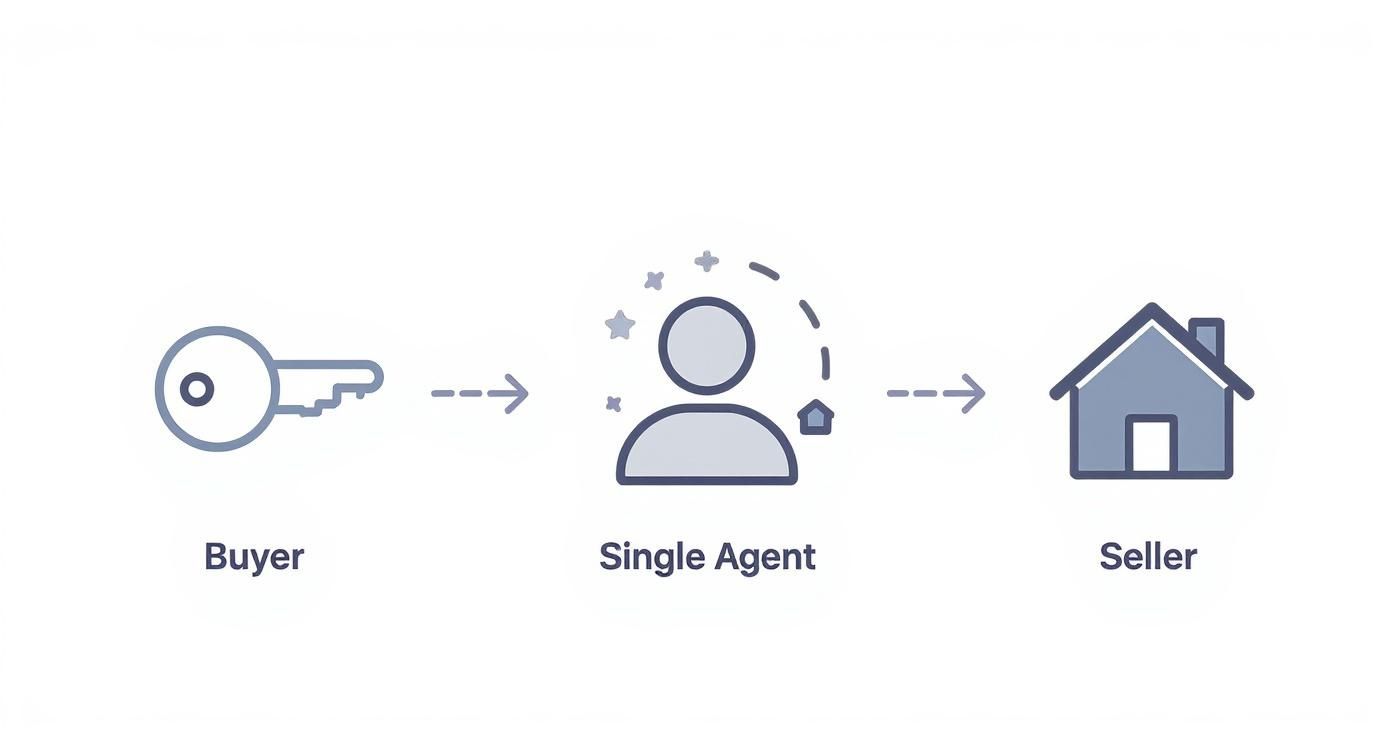
As you can see, the agent is stuck in the middle. They become more of a transaction manager than an advocate, unable to push for a better outcome for either the buyer or the seller.
A Dallas Deal in Action
Let's make this real. Picture a desirable property hitting the market in Dallas's hot Uptown neighborhood. A potential buyer, who happens to be working with another agent from the same brokerage, falls in love with it and wants to write an offer.
Because both the buyer and seller gave their written consent upfront, the broker can officially set up an "Intermediary with Appointments" transaction.
The agent appointed to the seller gets to work helping them analyze the offer and strategize on a response. At the same time, the buyer's appointed agent is advising their client on negotiation tactics and a potential counter-offer. Even though they share an office and a boss, they are operating as separate advocates for their respective clients.
This structure allows the negotiations to flow professionally, avoiding the built-in conflict of interest that comes with a single agent trying to serve two masters with opposing goals. All across Texas, dual agency is only legal when everyone involved knows what’s happening and signs off on it. The whole point of these disclosures is to protect consumers from hidden conflicts, ensuring the deal is handled with clarity and support for everyone at the table.
Look, I know dual agency gets a bad rap, and frankly, a lot of the criticism is justified. But let's be real—if it were all bad, it wouldn't exist. There are specific situations, especially in a cutthroat market like Dallas, where it can actually work to everyone's advantage.
The biggest, most undeniable benefit is streamlined communication. Think about it. Instead of playing a game of telephone between two different agents at two different brokerages, everything flows through one person. Every question, every offer, every little detail—it's all handled by a single point of contact. This can drastically cut down on the back-and-forth that bogs down so many deals.
A Faster Path to Closing
In a hot Dallas market, speed is everything. A great property can get multiple offers in a day, and delays can kill a deal. This is where a dual agent can be a huge asset. They have the full picture—they know exactly what the seller wants, what the buyer can afford, and where the potential sticking points are for both parties.
This unique insight lets them find common ground and smooth over bumps in the road much faster than two separate agents ever could. It’s not just a theory, either. A study on real estate deals showed that properties sold with a dual agent or intermediary closed about seven percent faster. That’s almost a full week shaved off the closing timeline. You can dig into the data yourself by reading the full study on real estate transaction efficiency if you're curious.
Dallas Scenario: Picture this: A buyer falls in love with a condo in Victory Park and knows another offer is coming in the next 24 hours. With a dual agent, the buyer and seller can hash out the terms and get the place under contract that same afternoon, locking down the deal before a bidding war even begins.
Potential Financial Perks
Then there's the money. Since one agent (and their brokerage) is collecting the entire commission instead of splitting it, there's suddenly some wiggle room for negotiation.
In some cases, an agent might be willing to reduce their total commission. This means more money in the seller's pocket, which could then translate into a slightly lower sale price or better terms for the buyer. It can become a win-win. To see how the numbers usually break down, it’s worth understanding the typical structure of real estate agent commission rates in our area.
Now, a discount is never guaranteed. But the possibility is often enough to make both sides consider it. Just remember, you have to carefully weigh these potential savings against the very real risk of not having someone fighting exclusively for your best interests.
Understanding the Risks and Conflicts of Interest

While the idea of a single point of contact might seem simpler, it’s crucial to understand what you’re giving up. The central problem with dual agency—what we call "Intermediary" here in Texas—is a massive, unavoidable conflict of interest. This isn't just a small wrinkle; it completely redefines your agent's legal responsibilities to you.
Normally, your agent owes you a fiduciary duty. That’s a legal term, but it simply means they have to put your best interests first, no matter what. They are your champion, your advocate. But when they step into the role of an Intermediary, that loyalty gets watered down. Their duty shifts from fighting for you to simply facilitating the deal neutrally.
What does that mean in practice? It means they can't give you strategic advice. If you're buying a property in Dallas, your agent is now legally forbidden from telling you to offer less, even if they know the list price is inflated. If you're the seller, they can't advise you to turn down a weak offer and wait for a stronger one. They become a referee, not a coach.
The Problem of Divided Loyalty
Think about a lawyer trying to represent both sides in a divorce. It just doesn't work. How can you genuinely fight for two parties whose goals are fundamentally at odds? That’s the exact tightrope a dual agent walks.
The seller’s goal is clear: get the highest price for their Dallas property. The buyer’s goal is the polar opposite: pay the lowest price possible. An agent stuck in the middle of that tug-of-war can’t effectively pull for both sides.
The biggest casualty in a dual agency transaction is dedicated advocacy. The agent's focus inevitably shifts from securing the best possible outcome for you to just getting the deal across the finish line.
This divided loyalty can leave both the buyer and the seller in a vulnerable position. It often results in one party overpaying or the other walking away with less money than they could have.
Before we go further, it's helpful to see a direct comparison of how these representation models stack up.
Dual Agency vs Single Agency Navigating Your Dallas Real Estate Options
The table below breaks down the key differences between having an Intermediary (dual agent) and having your own exclusive agent in a Dallas real estate transaction. Notice how the agent's duties and your potential outcomes change dramatically.
| Aspect | Dual Agency (Intermediary) | Single Agency (Exclusive Representation) |
|---|---|---|
| Loyalty | Neutral to both parties. Cannot prioritize one over the other. | Undivided loyalty to you. Must act in your best interest only. |
| Advice & Opinions | Prohibited from giving strategic advice on price, terms, or negotiations. | Provides expert advice, opinions, and negotiation strategies. |
| Confidentiality | Must keep both parties' confidential information private from the other. | Must keep your information confidential, but can use info about the other party to your advantage. |
| Negotiation Role | Acts as a facilitator or messenger, relaying offers and counteroffers. | Acts as your advocate, actively negotiating to get you the best possible price and terms. |
| Primary Goal | To close the transaction impartially. | To achieve the best financial and contractual outcome for you. |
| Risk of Conflict | High. Inherent conflict of interest is the core of the arrangement. | Low. The agent's interests are aligned with yours. |
As you can see, the trade-off for the perceived simplicity of an Intermediary relationship is significant. You lose the very thing you hire an agent for: expert, biased-in-your-favor guidance.
A Dallas Inspection Scenario
Let's put this into a real-world context you'll almost certainly face in a Dallas deal: negotiating inspection repairs.
Picture this: you're under contract to buy a charming property in the M Streets. The inspection report comes back with a major red flag—the foundation needs $15,000 in repairs, a common headache in our area.
- With Your Own Agent: Your agent is your strategist. They’ll lay out your options: demand the seller cover the full cost, negotiate a price reduction, or even advise you to walk away if the seller won't budge. They'll go to bat for you.
- With a Dual Agent (Intermediary): The agent’s hands are tied. They can only act as a go-between, presenting your repair request to the seller and then relaying their response back to you. They can't advise you on what a fair compromise is or help you craft a winning negotiation strategy.
In this situation, you and the seller are left to navigate a high-stakes, emotionally charged negotiation without professional guidance. The result? Often a deal where someone feels they got the short end of the stick, potentially costing them thousands of dollars they didn't have to lose.
How to Protect Yourself in a Dual Agency Scenario

If you find yourself in a potential dual agency, or "Intermediary," situation here in Dallas, don't panic. But do get smart. While this setup has its share of risks, you can navigate it safely by taking a few proactive steps to protect your bottom line.
It all boils down to asking the right questions and demanding total transparency before you sign anything. Your first move is to sit down and have a very direct, honest conversation with the agent. You need to know exactly how they plan to handle the conflict of interest that's built right into the arrangement.
Questions to Ask a Potential Dual Agent
Before you agree to an Intermediary relationship, you need clear answers. I'd even suggest getting them in writing. Here’s what you should be asking:
- Confidentiality: "How will you guarantee my confidential information, like my top-dollar offer or bottom-line price, stays completely private from the other party?"
- Neutrality: "Walk me through a specific example. If we disagree on inspection repairs, how would you handle that while staying neutral?"
- Communication: "What is your exact process for presenting offers and counteroffers? How do you make sure we both get information at the same time and in a fair way?"
- Broker Oversight: "What role will your managing broker play in overseeing this deal? How do they ensure everything is handled correctly?"
Pay close attention to their answers. An experienced, professional agent will have solid, confident responses. If they get defensive, can't give you specifics, or seem unsure, that’s a massive red flag.
Hire a Real Estate Attorney
Even if the agent is fantastic, the single best thing you can do for yourself is to hire a real estate attorney. This isn't a slight against the agent; it's just a savvy business move. An attorney works for you and only you, stepping into that advisory role the neutral agent can't legally fill.
In a Dallas dual agency deal, your attorney becomes your personal advocate. They’ll review every document, help you map out a negotiation strategy, and make sure your legal rights are protected from the initial offer all the way to the closing table.
This gives you the expert legal and strategic advice that an Intermediary agent is explicitly forbidden from providing. The cost of hiring an attorney is a drop in the bucket compared to what you could lose in a bad deal.
Know Your Alternatives
At the end of the day, remember that you are in the driver's seat. If the situation feels off, you have other options. You can ask the broker to structure the deal as an "Intermediary with Appointments," where another agent from the same brokerage is assigned to represent you exclusively. This brings dedicated advocacy back into the picture.
And if that's not possible, or you just don't feel right about it, you can always walk away. It's far better to find an agent who can represent you without conflict than to move forward on a huge financial decision feeling unprotected. Research even shows that dual agency pops up more often in lower-priced deals, which suggests less experienced buyers might be agreeing to it without fully understanding their choices. You can dive deeper into these dual agency transaction findings to see the data.
Ultimately, your strongest defense is knowing how to choose a real estate agent who is the right fit for you from the very beginning.
Common Questions About Dual Agency in Dallas
Diving into a Dallas real estate deal can feel complex, and things get even more confusing when you hear terms like dual agency, or "Intermediary" as we call it here in Texas. Let's clear the air and tackle some of the most frequent questions I get from both buyers and sellers in the DFW area.
Can an Agent Represent Both a Buyer and a Seller?
Yes, they can, but it comes with some major strings attached. In Texas, a single agent or brokerage can legally represent both the buyer and the seller in the same deal. This specific setup is called an "Intermediary" relationship.
But here’s the crucial part: it's only allowed if both parties know exactly what they're getting into and provide their explicit, written consent ahead of time. You'll typically find this clause in the seller's listing agreement or the buyer's representation agreement you sign at the very beginning. Without those signatures, an agent can't legally act as an Intermediary.
Who Pays the Commission in a Dual Agency Deal?
The commission structure doesn't really change—the seller still foots the bill. The commission is almost always a percentage of the property's final sale price, usually falling somewhere between 5% and 6% in our market.
The real difference is how that commission gets divided. In a normal transaction, the commission is split between the buyer's brokerage and the seller's brokerage. In an Intermediary deal, the entire commission stays with the one brokerage handling both sides. This is a big reason why some agents might offer a slightly lower rate; they get to keep the whole pie.
An agent who acts as an Intermediary can potentially earn a "double-ended" commission by representing both sides, which is a primary reason this practice can create a conflict of interest.
Does a Dual Agent Get Double the Commission?
Essentially, yes. Since their brokerage collects the entire commission that would otherwise be split with another company, the agent's take-home pay on an Intermediary sale is often much higher.
It's vital to understand this financial incentive. It's human nature to be influenced by a bigger payday, and that's the core conflict you need to be aware of when considering this type of arrangement.
How Does a Dual Agent Handle Negotiations?
This is where everything changes, and not necessarily for the better. An agent acting as an Intermediary has to take a step back and become completely neutral. Their role shifts from a dedicated advocate fighting for your best interests to more of a neutral facilitator.
This means they are legally prohibited from doing things they would normally do for a client. For example, they cannot:
- Advise the buyer on what price to offer.
- Tell the seller whether to accept an offer or counter with a higher price.
- Disclose any confidential information, like the seller's urgency to move or the buyer's maximum budget.
Their job boils down to shuffling paperwork and passing messages between the two parties without offering any real strategic advice. It's precisely for this reason that savvy Dallas buyers and sellers insist on having their own exclusive agent who can negotiate aggressively and single-mindedly on their behalf.
Navigating the Dallas real estate market requires expert guidance from a professional dedicated to your best interests. At Dustin Pitts REALTOR Dallas Real Estate Agent, we believe in providing undivided loyalty and expert advocacy to every client. Whether you are buying or selling, we are committed to helping you achieve the best possible outcome. Contact us today to learn how our client-first approach can make all the difference in your next real estate transaction.