

Let's talk about mortgage insurance. It’s one of those terms that can be a little confusing, but it’s a huge deal in the Dallas real estate market.

At its core, mortgage insurance is a policy that protects your lender—not you—in case you can’t make your loan payments. It’s what gives lenders the confidence to approve a home loan even when you put down less than 20%.
The Purpose of Mortgage Insurance in Dallas
Think of it as a safety net, but for the bank. When you make a small down payment, the lender is taking on a bigger gamble. If you default, and home values happen to dip, they could be out a lot of money.
That’s where mortgage insurance steps in. It’s a guarantee from a third party that if the worst happens and the home goes into foreclosure, the lender's losses will be covered. This protection is what makes it possible to buy a home in competitive areas like Frisco or Richardson without having to save up a massive 20% down payment—a massive hurdle given current Dallas-area home prices.
How It Opens Doors for Homebuyers
So, while mortgage insurance does add to your monthly housing cost, it’s also the key that unlocks the door to homeownership for many people. It bridges the gap between the down payment you have right now and the 20% benchmark lenders feel comfortable with.
By giving lenders that peace of mind, mortgage insurance allows more people to get into the Dallas housing market and start building equity years sooner than they otherwise could. It turns the dream of owning a home into a tangible reality for those who haven't had decades to save.
This isn't just a Dallas thing; it's a fundamental part of how housing finance works. North America leads the global mortgage insurance market, thanks to robust financial systems and high demand for homeownership in places like North Texas.
Now, it’s really important not to mix this up with homeowners insurance. They sound similar, but they protect different things. For a clear breakdown on the insurance that protects your actual house and belongings, this essential guide to homeowners insurance is a fantastic resource.
Mortgage Insurance at a Glance for Dallas Buyers
To boil it all down, here’s a quick summary of what this means for you as you start your home search in Dallas.
| Concept | What It Means for a Dallas Homebuyer |
|---|---|
| Purpose | Protects your lender if you default, not you or your home. |
| Trigger | Required when your down payment is less than 20% of the home's price. |
| Benefit | Helps you buy a home sooner with less cash saved up. |
| Cost | An extra fee added to your monthly mortgage payment. |
This table should give you a solid starting point. Understanding these basics is the first step to navigating your mortgage options confidently in the Dallas market.
Comparing PMI and MIP for Your Dallas Loan
So, you're diving into the Dallas real estate market and putting down less than 20%? First off, you're not alone—it's a common path to homeownership here. But it does mean you'll need to get familiar with mortgage insurance. While the name sounds simple, there are actually two main types, and they work very differently depending on your loan.
You'll either encounter Private Mortgage Insurance (PMI) or a Mortgage Insurance Premium (MIP). Think of them as two different roads to the same destination: protecting your lender. PMI is what you’ll see with conventional loans, which are the bread and butter for most homebuyers in the Dallas area. On the other hand, MIP is tied exclusively to FHA loans, a fantastic option for many first-time buyers in Dallas County.
This infographic breaks it down to the core trigger: a down payment under 20% means the lender will want some extra security.
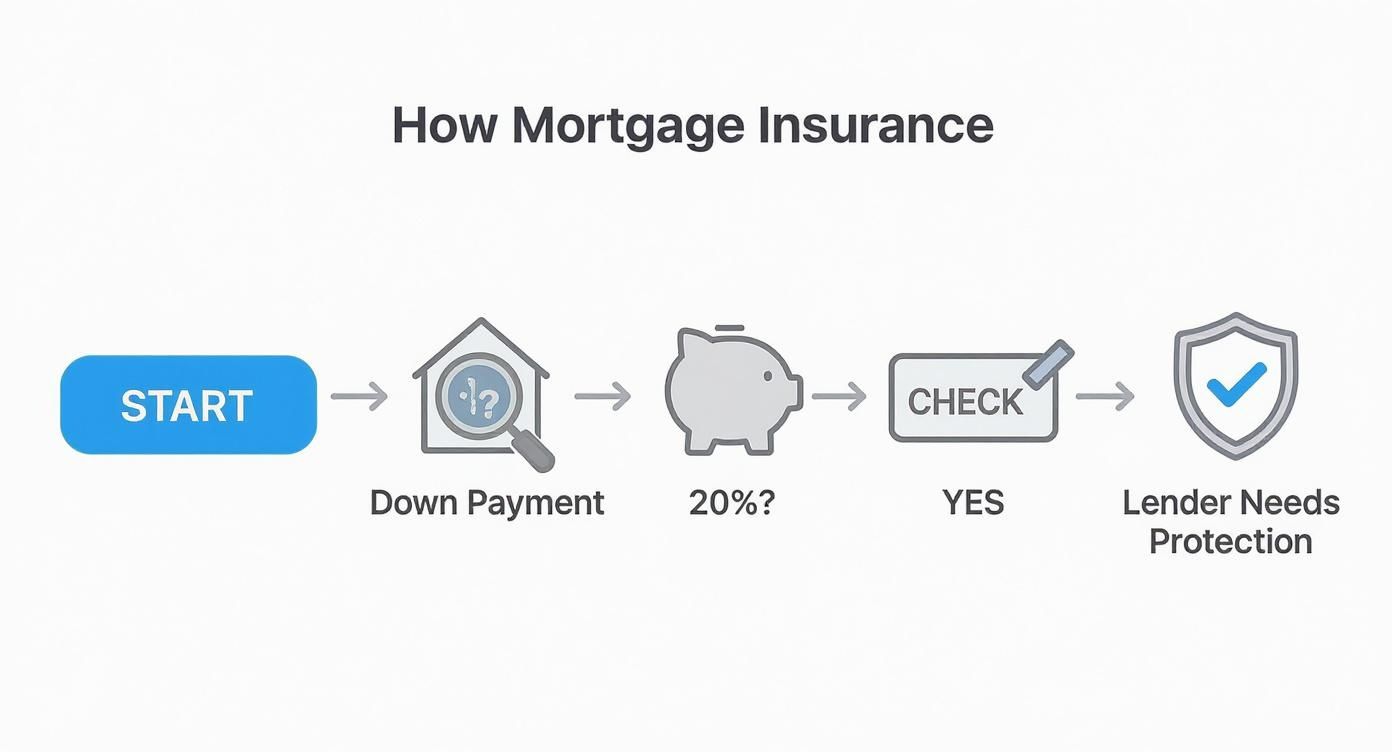
It’s really that simple. The lender sees a smaller down payment as higher risk, and this insurance is their safety net.
Let's break down the differences between these two, because the one you get can have a big impact on your monthly payment and long-term costs.
PMI vs MIP A Comparison for Dallas Home Loans
| Feature | Private Mortgage Insurance (PMI) | Mortgage Insurance Premium (MIP) |
|---|---|---|
| Associated Loan Type | Conventional Loans | FHA Loans |
| Upfront Cost | Typically none, but single-premium is an option. | 1.75% of the loan amount (UFMIP), usually rolled into the loan. |
| Monthly Cost | Varies based on credit score, down payment, and loan amount. | Based on loan term and loan-to-value (LTV) ratio; less credit-sensitive. |
| Removal | Can be requested at 80% LTV. Automatically terminates at 78% LTV. | With <10% down, it's for the life of the loan. Removal requires refinancing. |
| Flexibility | More flexible payment options (monthly, single premium, lender-paid). | Standardized structure with both upfront and annual premiums. |
As you can see, while both protect the lender, the terms are worlds apart. PMI offers a clear exit strategy as you build equity, while MIP is a much longer-term commitment unless you refinance.
Private Mortgage Insurance (PMI) in Detail
Imagine you’re buying a home in Plano with a conventional loan. This is where PMI comes into play. Its cost is calculated as a small percentage of your loan, but what you actually pay is heavily influenced by your credit score and how much you put down. A great credit score and a 15% down payment will get you a much lower PMI rate than a lower score with only 5% down. To really get into the weeds, you can learn more about what is private mortgage insurance and how the numbers shake out.
The best part about PMI? It's not forever. Once you’ve paid down your mortgage to where you have 20% equity (an 80% loan-to-value ratio), you can officially ask your lender to drop it. Even better, federal law requires them to automatically cancel it once you reach 22% equity (a 78% LTV ratio).
Understanding Mortgage Insurance Premium (MIP)
Now, let's shift gears. Say you found the perfect spot in a revitalized Dallas neighborhood like Oak Cliff and an FHA loan is your ticket in. With this loan, you'll be dealing with MIP, and it has a totally different rulebook.
MIP has a two-part structure: a hefty upfront premium (called UFMIP) of 1.75% of the loan amount that gets tacked onto your mortgage, plus an annual premium that’s broken down and paid monthly.
Here’s the critical difference that every Dallas buyer needs to understand: unlike PMI, MIP can be a lifelong commitment. If you put down less than 10% on your FHA loan, you’re stuck paying MIP for the entire loan term. The only escape hatch is to refinance into a different loan type, like a conventional mortgage, once you've built up enough equity. This is a massive factor to consider when you're weighing your loan options.
How Mortgage Insurance Costs Are Calculated

So, how do lenders actually land on a specific number for your mortgage insurance premium? It’s not a flat fee; think of it more like a sliding scale based on how much risk the lender is taking on. The more risk they see, the higher your premium will be for that Dallas property.
Several key factors get crunched to come up with your final cost. The good news is, you have some control over these. Lenders dig into these details during underwriting, which is their process for vetting your entire financial picture before approving the loan. If you want a deeper look into that critical stage, check out our guide on what is the mortgage underwriting process.
The Main Factors Influencing Your Premium
When a Dallas lender calculates your rate, they're mainly focused on a few core pieces of your financial profile.
- Your Credit Score: This one is huge. A strong credit score tells lenders you’re a reliable borrower, and they’ll reward that with a lower PMI rate.
- Your Down Payment Amount: The more you put down, the lower your loan-to-value (LTV) ratio is. A smaller LTV means less risk for the lender, which directly translates to a cheaper premium for you.
- The Loan Type: As we’ve touched on, conventional loans have PMI and FHA loans have MIP. Their rate structures are completely different. PMI rates, in particular, are very sensitive to your credit score and down payment size.
The guiding principle is pretty straightforward: the less risky you look on paper, the less you'll have to pay. Bumping up your credit score or saving for a slightly larger down payment can save you a surprising amount of money over the long run.
A Dallas Cost Scenario
Let's make this real with a Dallas-area example. Say you’re looking at a $450,000 home in Richardson. You've got a good credit score, but let's see how the down payment changes things.
- Scenario A (5% Down): You put down $22,500. This leaves you with a loan of $427,500 and a 95% LTV. Your PMI rate might be around 0.78% a year, which adds about $278 to your monthly payment.
- Scenario B (15% Down): You put down $67,500. Your loan is now $382,500, bringing your LTV down to 85%. Because you’re a lower risk, your PMI rate could drop to just 0.38%, making your monthly payment around $121.
That's a $157 difference every single month. It really shows how much your initial choices can impact your budget.
Your mortgage insurance premium is usually bundled into your total monthly house payment and paid through an escrow account. For a complete picture of your finances, it helps to have a good handle on understanding escrow accounts and how they work alongside your mortgage, taxes, and homeowners insurance.
When Is Mortgage Insurance Required in Dallas?
https://www.youtube.com/embed/BVBDabwb9CI
So, what’s the trigger for mortgage insurance? It’s not some arbitrary fee lenders tack on for fun. It all boils down to one critical factor: the size of your down payment.
Lenders have a very clear line in the sand they use to gauge their risk, and knowing where that line is can save you a lot of money.
For anyone grabbing a conventional loan to buy a home in the Dallas area, the magic number is 20%. If you put down anything less than 20% of the home's price, you can bet you’ll be paying for Private Mortgage Insurance (PMI).
Why 20%? Because a down payment that large gives the lender a serious equity cushion right from the start. Think about it from their perspective. If a borrower defaults on a loan with only 5% down, the bank stands to lose a lot more if home values have softened. A 20% stake in the game dramatically lowers that risk, making them comfortable enough to skip the insurance requirement.
The Conventional Loan Rule: The 20 Percent Threshold
Let's put this into real numbers. Say you've found a great place in Frisco for $500,000. To steer clear of PMI, you’d need to show up to closing with a $100,000 down payment. Come in with anything less than that, and your lender will require PMI to protect their investment.
This has been the industry standard for decades, and it's why so many savvy homebuyers in the competitive Dallas market work hard to hit that 20% target. But with home prices being what they are, that's a tall order for many folks. And that's exactly why mortgage insurance exists—it’s a bridge that makes homeownership possible without needing a massive pile of cash upfront.
The less you put down, the higher the lender’s perceived risk. Mortgage insurance is the tool that balances this risk, allowing loans to be approved with down payments as low as 3-5%.
FHA Loans: A Different Set of Rules
Now, while the 20% rule is king for conventional loans, FHA loans play by a completely different rulebook. If you're looking at an FHA loan for a place in Downtown Dallas or any of the surrounding suburbs, you need to know this: mortgage insurance isn't optional. It's mandatory.
With FHA loans, the Mortgage Insurance Premium (MIP) is required on all loans, no matter how much you put down. Even if you come to the table with a 10% down payment or more, you'll still be paying MIP. This is a crucial distinction to make when you're comparing your financing options.
If this is a route you're considering, getting familiar with the specific FHA loan requirements in Texas is a must. That insurance is just part of the deal—it's baked into the very structure of the FHA program.
How to Finally Stop Paying Mortgage Insurance

While mortgage insurance is a common stepping stone to homeownership in Dallas, it’s not supposed to be a permanent fixture on your monthly statement. The good news is, there are clear-cut ways to get rid of this payment and free up that cash. The right strategy for you really just depends on the kind of loan you have.
For homeowners with a conventional loan, the path to ditching Private Mortgage Insurance (PMI) is pretty straightforward. It all comes down to building enough equity in your home to hit a key milestone.
Getting Rid of PMI on a Conventional Loan
Your main objective is to build up 20% equity in your Dallas home. The moment you hit that magic number (based on your home's original value), you can officially ask your lender to cancel your PMI. This isn't something they do for you; you have to be proactive and make the request.
But what if you forget? Federal law has your back. Lenders are legally required to automatically cancel your PMI once your loan balance drops to 78% of the original home value. That’s the equivalent of having 22% equity, and it happens on its own according to your payment schedule.
For Dallas homeowners, remember that equity isn't just about paying down your mortgage. It's also about your home's value going up, and in North Texas, appreciation can be a game-changer.
Using Dallas Property Appreciation to Your Advantage
The Dallas real estate market has seen strong, steady growth, and that can seriously speed up your timeline for reaching 20% equity. If you feel like your home is worth a lot more now than when you bought it, you don't have to just sit back and wait.
Get in touch with your lender and ask for a new appraisal. If that appraisal confirms you've crossed the 20% equity threshold, you can formally request to have your PMI removed. You’ll have to cover the cost of the appraisal, but that one-time fee is often a small price to pay for shedding a recurring monthly expense.
Dealing with MIP on an FHA Loan
Removing the Mortgage Insurance Premium (MIP) from an FHA loan is a whole different ballgame. For most Dallas-area borrowers who made a down payment of less than 10%, that MIP is stuck with you for the entire life of the loan.
The most common—and often only—way to get rid of MIP is to refinance out of your FHA loan and into a conventional one. This becomes a real possibility once you have enough equity, usually right around that 20% mark. Refinancing essentially pays off your FHA mortgage and starts you fresh with a new loan that, provided you have the equity, won't require mortgage insurance.
It's worth noting that broader economic trends, like rising interest rates, can sometimes mean people stay in their loans longer, which also extends how long they pay for insurance. You can actually explore recent mortgage insurance performance data to see how these shifts play out. For many Dallas homeowners, taking control by refinancing is the smartest path forward.
Common Questions About Mortgage Insurance in Dallas
Even after you've got the basics down, a few specific questions always pop up when you're getting serious about buying a home in Dallas. Let's tackle some of the most common ones I hear from clients.
Can I Avoid Mortgage Insurance When Buying a Home in Dallas?
Yes, you absolutely can, and you've got a few ways to do it. The most well-known path is to put down 20% on a conventional loan. That’s the magic number that lets you skip mortgage insurance entirely.
Of course, with home prices what they are in the DFW metroplex, a 20% down payment isn't always realistic. Don't worry, you're not out of options.
Here are a few other strategies to discuss with your Dallas lender:
- Lender-Paid Mortgage Insurance (LPMI): Think of this as a trade-off. Instead of a separate monthly PMI payment, the lender pays for the insurance, and you take a slightly higher interest rate for the life of the loan. It simplifies your monthly payment, but you'll want to run the numbers to see which option costs less over time.
- Piggyback Loans: This is a creative approach where you get two loans. The main mortgage covers 80% of the home's price, you put down 10% in cash, and a second, smaller loan (the "piggyback") covers the remaining 10%. Since your primary mortgage is at that 80% mark, you sidestep PMI.
- Specialty Loan Programs: Some loans are designed to skip mortgage insurance. VA loans for veterans and active-duty military are a prime example in the Dallas area. Dallas's large medical sector also means "physician loans" are common, and these often waive the PMI requirement for qualified medical professionals.
Your best bet is to sit down with a local lender who understands the Dallas market. They can help you figure out which strategy, if any, is the right fit for your finances.
How Does Dallas Home Value Appreciation Affect My PMI?
This is where the hot Dallas real estate market can really work in your favor. When home values are climbing, your equity—the gap between what your home is worth and what you owe on your mortgage—grows much faster than it would from just your monthly payments.
This is a huge lever you can pull. As soon as you think you've hit the 80% loan-to-value (LTV) mark (meaning you have 20% equity), you can officially ask your lender to cancel your PMI. That equity can come from a combination of paying down your loan principal and the market appreciation in your neighborhood.
To get the ball rolling, you'll need to prove your home's new value. This almost always means paying for a new home appraisal. While that's an upfront cost, the long-term savings from dropping that monthly PMI payment usually make it a no-brainer. It pays to keep an eye on home values in your part of Dallas.
Is MIP on an FHA Loan in Texas Permanent?
This is a really important one, and the answer can be tricky: it all comes down to your down payment. The rules for the Mortgage Insurance Premium (MIP) on FHA loans changed back in 2013, making them much stickier.
Here’s the breakdown:
- If you put down less than 10%, your MIP is there for the life of the loan. It never drops off automatically.
- If you can manage a down payment of 10% or more, the MIP is only required for the first 11 years.
So what do you do if you're facing that lifetime MIP? The most common solution is to refinance. Once you've built up enough equity in your Dallas home, you can refinance out of the FHA loan and into a conventional one, leaving MIP behind for good.
Are There Dallas Programs to Help Reduce Mortgage Insurance?
Absolutely. The state of Texas and the city of Dallas have some great down payment assistance (DPA) programs designed to help homebuyers get over that initial hurdle.
These programs often come in the form of grants or low-interest loans that can be used for your down payment and closing costs. This extra cash can be exactly what you need to reduce or completely eliminate the need for mortgage insurance.
For instance, the Texas Department of Housing and Community Affairs (TDHCA) runs programs like "My First Texas Home" to help qualified buyers. By using these funds, you might be able to boost your down payment on a conventional loan to the point where your PMI is cheaper—or, if it gets you to the 20% threshold, you won't have to pay it at all. A mortgage pro who knows the ins and outs of local DPA programs is the best person to talk to about this.
Navigating the specifics of mortgage insurance and home financing in Dallas requires local expertise. If you're ready to explore your options and find the right path to your next home, contact Dustin Pitts REALTOR Dallas Real Estate Agent for expert guidance. Visit us at https://dustinpitts.com to get started.