

Determining the best time to sell a house in the dynamic Dallas real estate market is less about luck and more about strategy. While national trends provide a baseline, the Dallas-Fort Worth metroplex operates with its own unique rhythm, influenced by corporate relocations, local economic shifts, and distinct seasonal buyer behavior. Selling your property isn’t just about putting a sign in the yard; it’s about listing when buyer demand is highest, competition is manageable, and financial conditions are in your favor. This translates directly to a more profitable and efficient sale.

This guide moves beyond generic advice to provide a data-driven breakdown of the prime selling windows in Dallas. We will explore the specific months, market indicators, and personal financial considerations that can lead to more offers, a higher final sale price, and a smoother transaction. Whether you are a professional making a career move, an investor optimizing a portfolio, or a homeowner preparing for the next chapter, understanding these local nuances is the key to maximizing your return. We will cover everything from classic seasonal peaks to sophisticated strategies involving inventory levels, interest rate trends, and local job market data, giving you a comprehensive toolkit for timing your sale perfectly.
1. Peak Season Advantage: Selling in the Dallas Spring Market (March-May)
Spring in Dallas isn’t just for enjoying the Arboretum’s blooms; it is traditionally the strongest season for the real estate market. From March through May, the market experiences a significant surge in buyer activity as pleasant weather encourages house hunting and many individuals aim to close deals before the intense Texas summer arrives. This period represents the best time to sell a house for owners seeking maximum exposure, a higher number of showings, and, most critically, competitive offers.
For sellers in sought-after neighborhoods like Preston Hollow or Lakewood, this is the prime opportunity to showcase lush landscaping and vibrant curb appeal, which directly translates into higher perceived value. The increased buyer pool, including professionals and investors, creates a high-velocity environment where well-priced homes move quickly.
The Spring Selling Surge by the Numbers
Data consistently confirms the spring market’s dominance. Homes listed during this window not only sell faster but also command higher prices due to heightened competition. This is when strategic positioning and marketing yield the greatest return on investment.
To illustrate, the following infographic highlights key data points that define the Dallas spring market’s advantage.
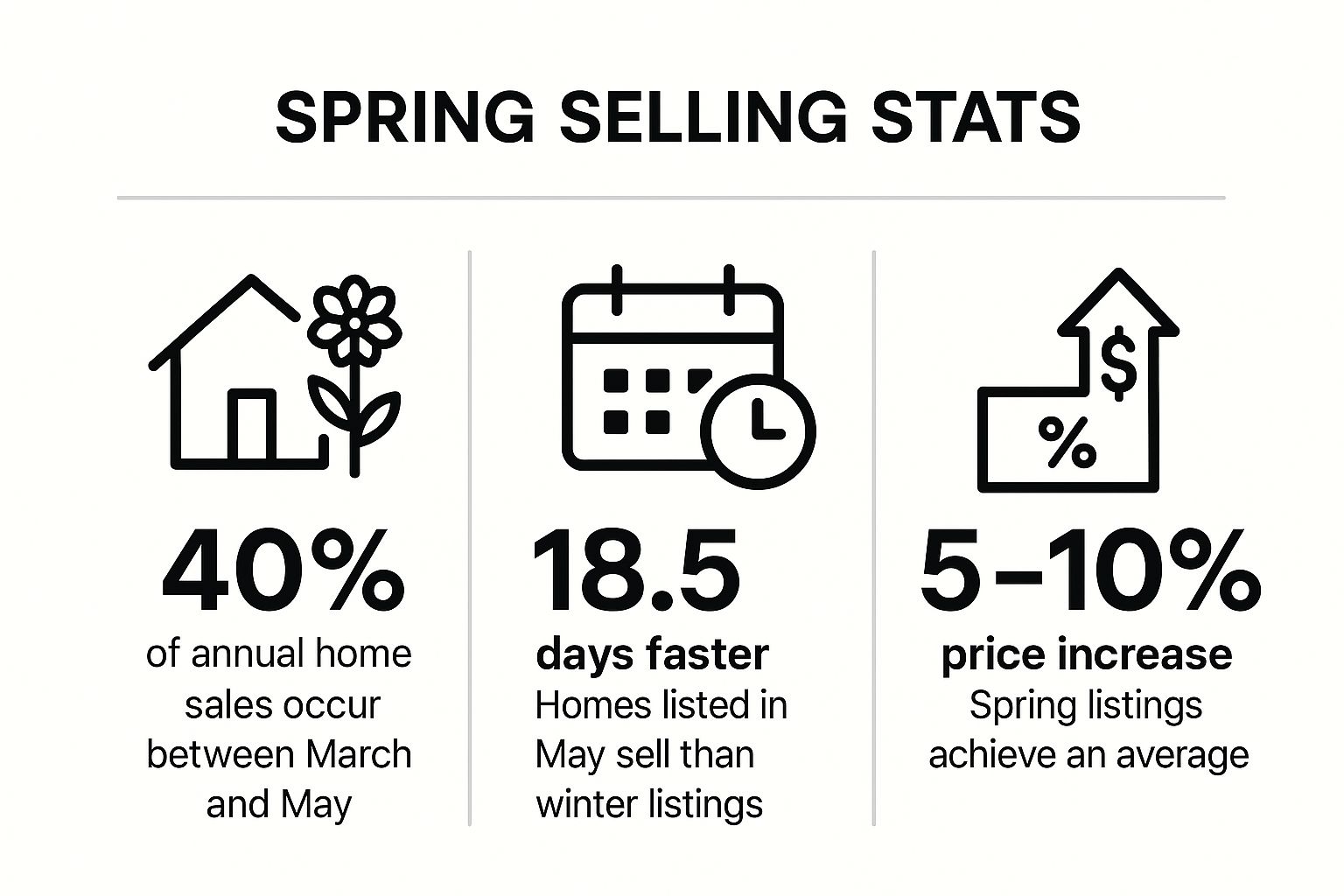
These figures clearly show that listing in spring provides a decisive edge, combining a faster sales cycle with a significant boost in final sale price. For example, data from the North Texas Real Estate Information Systems (NTREIS) consistently shows that Days on Market (DOM) are at their lowest in May, while sellers in high-demand areas like Uptown Dallas often see offer prices escalate 5-7% over list price during this peak window.
Actionable Tips for a Successful Spring Sale
To capitalize on this peak season, proactive preparation is key.
- Prepare Early: Begin preparing your home for listing in February to get ahead of the initial March rush. This includes decluttering, painting, and minor repairs.
- Invest in Photography: Use a professional photographer who can capture the vibrant spring light and your property’s pristine landscaping. A home in the M Streets, for instance, can attract 25% more showing requests with high-quality photos.
- Service Your HVAC: A functioning air conditioning system is a major selling point for Dallas buyers. Ensure it’s serviced and ready for inspection.
- Develop a Strategy: Work with an experienced agent like Dustin Pitts to create a clear plan for managing showings and navigating potential multiple-offer scenarios effectively.
2. Monitor Local Market Inventory Levels
While seasons provide a predictable rhythm, the most strategic sellers look beyond the calendar to a more powerful metric: local market inventory. The balance between housing supply (the number of homes for sale) and buyer demand is the ultimate determinant of a seller’s leverage. Understanding this dynamic is crucial for identifying the absolute best time to sell a house, regardless of the month. A seller’s market, defined by low inventory and high demand, empowers owners to command higher prices and more favorable terms.
In a seller’s market, like those seen in highly desirable Dallas neighborhoods such as the Park Cities or Bishop Arts District, there are more qualified buyers than available properties. This scarcity creates intense competition, often leading to multiple-offer situations that drive the final sale price well above the initial listing. Conversely, a buyer’s market, characterized by high inventory, requires a more calculated approach to pricing and marketing to stand out.
Timing Your Sale with Inventory Data
The National Association of Realtors considers a market with less than three months of inventory to be a strong seller’s market. Tracking this figure for your specific Dallas submarket can reveal powerful windows of opportunity that others might miss. For instance, a sudden influx of corporate relocations to the Plano or Frisco area could rapidly decrease local inventory, creating a prime selling opportunity even in an otherwise “off-peak” season.
These inventory-driven advantages allow sellers to be more assertive in negotiations, retain stronger contingencies, and dictate the closing timeline. The key is to analyze data not just for the broader DFW metroplex but for your specific neighborhood, as real estate is hyperlocal. For a deeper analysis of these trends, you can explore the current state of the Dallas housing market.
Actionable Tips for an Inventory-Driven Strategy
Leveraging inventory data requires a proactive and informed approach.
- Track Local MLS Data: Monitor the “months of supply” metric for your zip code through reports from the North Texas Real Estate Information Systems (NTREIS). A downward trend indicates strengthening seller leverage.
- Analyze Micro-Market Conditions: Conditions in Southlake can differ dramatically from those in East Dallas. Work with an agent who can provide a comparative market analysis (CMA) specific to your block.
- Monitor Pending Sales: The ratio of pending sales to active listings is a leading indicator. A rising ratio suggests that demand is outpacing supply, signaling an opportune time to list.
- Stay Flexible: Unlike seasonal selling, inventory-based opportunities can arise quickly. Have your home prepared so you can act decisively when the data reveals a favorable market shift.
3. Align with Interest Rate Trends
Beyond seasonal market cycles, the broader economic climate, specifically mortgage interest rate trends, plays a powerful role in determining the best time to sell a house. Mortgage rates directly impact a buyer’s purchasing power and overall demand. When rates are low, buyers can afford more, which fuels competition and often leads to higher sale prices and faster transactions for Dallas sellers.

For homeowners in competitive Dallas neighborhoods like University Park or Highland Park, timing a sale with favorable interest rates can be a strategic financial move. Savvy sellers monitor Federal Reserve announcements and economic forecasts to list their homes just before anticipated rate hikes, capturing a larger pool of qualified and motivated buyers. This proactive approach ensures your property enters the market when buyer affordability is at its peak.
The Impact of Interest Rates by the Numbers
Historical data provides a clear picture of how interest rates shape the Dallas real estate landscape. The period of historically low rates in 2020-2021 (sub-3%) created unprecedented buyer demand, leading to intense bidding wars and rapid price appreciation across North Texas.
Conversely, when rates began climbing toward 7% and beyond in 2022, the market cooled significantly. Each 1% increase in mortgage rates can reduce a buyer’s purchasing power by roughly 10-12%, effectively shrinking the number of individuals who can afford your home. As real estate economists have noted, this shift can reduce overall buyer activity, making a strategically timed sale crucial for achieving your financial goals.
Actionable Tips for Navigating Rate Fluctuations
To leverage interest rate trends for a successful sale, a forward-looking strategy is essential.
- Monitor the Fed: Keep an eye on the Federal Reserve’s meeting schedule and post-meeting announcements, as their policy decisions directly influence mortgage rates.
- List Preemptively: If expert forecasts predict a rate increase, aim to list your home 30-60 days beforehand to attract buyers looking to lock in a lower rate.
- Offer Incentives: In a higher-rate environment, consider offering a rate buy-down or other seller concessions to make your property more attractive and affordable for buyers.
- Consult Professionals: Partner with a knowledgeable real estate agent and a trusted mortgage professional who can provide accurate rate forecasts and help you develop a responsive selling strategy.
4. Capitalize on Life Events and Job Market Trends
Beyond seasonal cycles, the best time to sell a house often aligns with major economic and life-driven events. In a dynamic metropolis like Dallas, corporate relocations, job market expansions, and demographic shifts create predictable waves of motivated buyers. Timing your sale to coincide with these events can provide a significant competitive advantage, leading to faster sales and stronger offers, independent of the traditional spring or fall markets.
Sellers who strategically list their homes during these periods can tap into a highly focused and urgent buyer pool. For instance, when a major corporation like Toyota moves its headquarters to Plano, it injects thousands of high-income professionals into the North Texas housing market, all needing to find homes quickly. This creates a micro-market surge where well-positioned properties in areas like Frisco or Southlake can command premium prices.
The Economic Engine Driving Housing Demand
The Dallas-Fort Worth area’s robust job market is a primary driver of housing demand. Major corporate announcements or expansions act as powerful catalysts, creating seller’s markets in specific sub-regions. When a seller understands these undercurrents, they can position their property to attract these highly qualified, relocation-package-backed buyers.
For example, the expansion of the financial sector in downtown Dallas or the ongoing growth of tech hubs in Richardson’s “Telecom Corridor” generates consistent demand from incoming professionals. These buyers are often less sensitive to traditional seasonal lulls and more focused on securing a home near their new workplace. A home in the Park Cities or a modern condo in Victory Park becomes highly desirable for these individuals.
Actionable Tips for a Strategic Market-Timed Sale
To leverage these economic trends, a proactive and research-based approach is essential.
- Research Local Employers: Stay informed about major corporate relocations or expansions announced for the Dallas area. The Dallas Regional Chamber is an excellent resource for this information.
- Track University Cycles: Major institutions like SMU and UT Dallas have hiring seasons that bring new faculty and staff to the area, often creating demand in nearby neighborhoods like University Park.
- Monitor Economic News: Follow local business journals to identify industry growth sectors. Knowing which industries are booming helps you understand the type of buyer your property might attract.
- Partner with an Expert: Align with a real estate professional who has experience with corporate relocations. They often have direct connections with relocation services and an in-depth understanding of the local jobs in Dallas, Texas and how they impact housing.
5. Optimize Tax Considerations and Capital Gains
Beyond seasonal market trends, the absolute best time to sell a house can be dictated by your personal financial calendar, specifically tax implications. The financial outcome of a home sale is heavily influenced by capital gains taxes. Understanding and strategically timing your sale to leverage tax laws can save Dallas homeowners tens, or even hundreds, of thousands of dollars. This financial strategy is less about market heat and more about maximizing your net profit.
The primary tool for homeowners is the primary residence capital gains exclusion. This IRS rule allows an individual to exclude up to $250,000 of profit from their taxable income, and married couples filing jointly can exclude up to $500,000. To qualify, you must have owned the home and used it as your primary residence for at least two of the five years leading up to the sale. For high-appreciation areas like University Park or the Park Cities, this exemption is a critical financial shield.
Tax Strategy by the Numbers
Timing your sale to meet the two-year residency requirement can have a massive financial impact. A poorly timed sale could result in a substantial and unnecessary tax bill, directly reducing your net proceeds.
For example, a couple in Dallas buys a home for $300,000. Over several years, its value appreciates to $800,000, creating a $500,000 profit. By ensuring they meet the two-year residency rule before selling, they can exclude the entire $500,000 from capital gains tax, saving them approximately $75,000 (assuming a 15% federal capital gains rate). Selling even one day short of the two-year mark would nullify this benefit. Additionally, if the property was ever a rental, depreciation recapture is taxed at a different rate, which requires careful calculation.
Actionable Tips for a Tax-Optimized Sale
To leverage tax laws effectively, careful planning is non-negotiable.
- Consult a Professional: Before listing your home, consult with a tax professional and a real estate specialist. They can provide personalized advice based on your specific financial situation and help you understand regulations like IRS Publication 523.
- Track Your Residency: Keep meticulous records of your residency dates. This is especially crucial if you own multiple properties or have moved recently. The two-year rule does not need to be continuous.
- Document All Improvements: Maintain detailed records and receipts for all capital improvements made to the property. These costs can be added to your home’s basis, which reduces your total capital gain and, therefore, your potential tax liability.
- Consider Investment Implications: If your home was part of a larger investment strategy, timing the sale correctly is even more critical. Understanding the nuances of property investment is key to financial success. You can learn more about Dallas property investment insights and trends on our blog.
6. Leverage Economic Cycles and Employment Data
Beyond seasonal trends, the broader economic landscape powerfully influences the Dallas real estate market. Understanding and timing your sale with positive economic cycles can be one of the most strategic ways to determine the best time to sell a house. Strong economic indicators like low unemployment, robust GDP growth, and high consumer confidence translate directly into a more aggressive and financially capable buyer pool, creating optimal selling conditions.
For Dallas sellers, this means monitoring not just the national economy but also the specific drivers of the local Metroplex economy. When major corporations like Toyota or Charles Schwab expand their North Texas presence, the resulting job growth and influx of well-compensated professionals create a surge in housing demand. Selling during these periods of economic expansion often leads to faster sales, stronger offers, and less price negotiation, particularly in executive-centric neighborhoods like Southlake or University Park.
The Economic Impact by the Numbers
Economic data provides a clear picture of market health. For instance, the strong DFW economy in 2019, characterized by significant job creation, directly supported a 5-7% annual appreciation in home prices. Conversely, economic uncertainty, like the initial freeze during the COVID-19 pandemic, can temporarily suppress buyer activity before unique factors (like low interest rates) create a rebound.
Monitoring these trends is crucial. Watching key reports from sources like the Bureau of Labor Statistics and the Dallas Regional Chamber gives sellers a forward-looking advantage. A consistent drop in the Dallas-Fort Worth unemployment rate is a strong signal that buyer demand is likely to increase, making it a prime window to list your property.
Actionable Tips for an Economically Timed Sale
To leverage economic trends, sellers must stay informed and be prepared to act.
- Monitor Local Employment Reports: Pay close attention to the Bureau of Labor Statistics (BLS) reports on the Dallas-Fort Worth-Arlington metropolitan area. A sustained period of job growth is a green light for sellers.
- Track Corporate Relocations: Stay updated on major corporate relocations or expansions announced for the DFW area. Listing your home as these new employees begin their search can be highly profitable.
- Watch Consumer Confidence: National and local consumer confidence surveys are excellent indicators of buyer sentiment. High confidence suggests buyers are more willing to make large financial commitments.
- Consult with a Local Expert: A real estate professional with deep knowledge of the Dallas market, like Dustin Pitts, can help interpret how macroeconomic trends will specifically impact your neighborhood’s property values and selling strategy.
7. Time Personal Circumstances and Life Changes
Beyond market data and seasonal trends, the truly best time to sell a house is dictated by your own life. Personal readiness and major life events are often the most compelling reasons to list your property. Whether it’s a job relocation from Downtown Dallas to another state, a need to downsize from a large University Park home, or a change in personal finances, your individual circumstances ultimately determine the right moment to act. Selling when you are prepared, both financially and emotionally, leads to a smoother transaction and a better outcome.
Attempting to sell under duress, such as during a sudden job loss or divorce, often results in rushed decisions and accepting a lower price. Conversely, having your next housing situation secured before listing your current home removes immense pressure. This allows you to negotiate from a position of strength, unhurried by the need to find a new place to live. A well-prepared seller is a patient and strategic seller.
How Personal Readiness Impacts Your Bottom Line
Your personal situation directly translates into tangible financial results. The difference between a planned sale and a forced one can be significant. A staged, owner-occupied home, for instance, often presents better to prospective buyers and can command a higher price than a vacant property that may signal seller desperation.
According to real estate psychology experts, sellers who have their next move planned are less likely to accept lowball offers and are better equipped to wait for the right buyer. Data suggests that staged, occupied homes can sell for 6-10% more than their vacant counterparts. Furthermore, sellers navigating a major life stressor without adequate preparation can see sale prices dip significantly below market value, as the need for a quick close outweighs the desire for maximum profit.
Actionable Tips for Aligning Your Sale with Life Events
To ensure your personal circumstances support a successful sale, focus on strategic preparation.
- Secure Your Next Home First: If possible, arrange your next living situation before listing. This could mean closing on a new home in a neighborhood like the Bishop Arts District or securing a short-term rental, giving you a powerful negotiating advantage.
- Maintain the Property: If you must move out before selling, ensure the home remains in pristine, show-ready condition. An empty house should still have curb appeal, be professionally cleaned, and potentially staged to avoid looking abandoned.
- Prepare Your Finances: Account for all potential costs, including two mortgage payments if you buy before you sell, staging expenses, and moving fees. Having a clear financial buffer reduces stress.
- Seek Professional Support: For emotionally charged sales, don’t hesitate to consult with financial advisors or counselors. An experienced Dallas real estate agent, like Dustin Pitts, can also provide invaluable, objective guidance to navigate the process with clarity and confidence.
Best Timing Factors for Selling a House: 7-Point Comparison
| Strategy | Implementation Complexity 🔄 | Resource Requirements ⚡ | Expected Outcomes 📊 | Ideal Use Cases 💡 | Key Advantages ⭐ |
|---|---|---|---|---|---|
| Sell During Peak Spring Season (March-May) | Medium – coordinating timing and staging | Moderate – listing, staging, landscaping costs | High – faster sales, higher prices | Sellers targeting maximum buyer activity in optimal season | High buyer competition, strong curb appeal, motivated buyers |
| Monitor Local Market Inventory Levels | Medium – requires ongoing data tracking | Low to Moderate – MLS access, agent consultations | Variable – better timing and pricing | Sellers seeking market advantage through inventory insights | Strategic market entry, informed pricing, reduced time on market |
| Align with Interest Rate Trends | High – monitoring economic policies | Low – requires awareness and expert input | High – impacts buyer pool and sale price | Sellers sensitive to financing market conditions | Increased buyer competition at low rates, better sale terms |
| Capitalize on Life Events and Job Market Trends | High – research and timing coordination | Moderate – networking, market research | Moderate to High – motivated buyers, premium pricing | Sellers near corporate hubs or growing job markets | Targeted buyer pools, often cash-backed, motivated deadlines |
| Optimize Tax Considerations and Capital Gains | High – complex tax laws and planning | Moderate to High – professional tax advice | Financial – significant tax savings | Sellers focused on maximizing post-sale financial outcome | Large tax exemptions, flexible timing, potential tax deferral |
| Leverage Economic Cycles and Employment Data | Medium – tracking economic indicators | Low to Moderate – access to reports and analysis | Variable – timing sales with economic expansions or contractions | Sellers aiming to align with broader economic conditions | Avoid downturns, capitalize on expansions, faster sales |
| Time Personal Circumstances and Life Changes | Medium – personal planning and readiness | Moderate – logistics, financial planning | Moderate – better negotiation, smoother sales | Sellers balancing life events with market timing | Better shows with occupied homes, reduced pressure, preparedness |
Partnering for Perfect Timing: Your Next Step to a Successful Dallas Sale
Navigating the Dallas real estate market to pinpoint the absolute best time to sell a house is less about finding a single magic date and more about strategically aligning multiple powerful factors. As we’ve explored, the “perfect” moment is a unique equation for every homeowner, blending broad market dynamics with intensely personal circumstances.
The traditional wisdom of a bustling spring market holds true; the period from March to May often sees the highest buyer traffic and competitive offers. Yet, a savvy seller might find their greatest success by defying the crowds. A calculated off-season listing in winter could capture the attention of highly motivated buyers with less competition, while a fall sale can attract serious contenders aiming to settle before the year’s end.
Synthesizing Market Data with Personal Goals
The true mastery of timing lies in looking beyond the calendar. The most successful sales strategies in Dallas are built on a sophisticated understanding of a wider range of inputs. This means:
- Monitoring Inventory: Keeping a close watch on the housing supply in specific neighborhoods like Uptown or Lakewood. Low inventory creates scarcity and gives sellers significant leverage.
- Tracking Economic Indicators: Paying attention to interest rate trends and Dallas’s robust job market. A dip in rates or a major corporate relocation can create sudden surges in buyer demand.
- Analyzing Personal Finances: Aligning your sale with your own financial milestones, such as optimizing for capital gains tax or leveraging equity for your next major investment.
Key Takeaway: The optimal time to sell your Dallas home is not a passive event you wait for. It is an active strategy you build by layering market intelligence, economic awareness, and your individual financial and life objectives.
Ultimately, whether you’re selling a luxury estate in Preston Hollow or a modern townhome in the Bishop Arts District, your decision must be informed and intentional. Selling a property is one of the most significant financial transactions you will undertake. Relying on generic advice or national trends is a missed opportunity. Instead, the goal is to develop a bespoke strategy that maximizes your return by launching your home onto the market at the precise moment of peak opportunity for you.
This requires a nuanced, hyper-local perspective. A deep-seated knowledge of Dallas’s distinct micro-markets, buyer behaviors, and cyclical trends is not just an advantage; it’s essential for achieving a premium outcome. By synthesizing the data-driven insights we’ve discussed with your personal timeline, you can move forward with the confidence that your timing is not just good, but perfect.
Ready to pinpoint your perfect time to sell in the dynamic Dallas market? Partner with Dustin Pitts REALTOR Dallas Real Estate Agent to get a data-backed, personalized strategy for your property. Dustin’s deep market expertise ensures you won’t just list your home; you’ll launch it for maximum impact and profitability.