

To properly research a Dallas property’s history, you need two things to start: its address and its unique Parcel Number. These two details are the keys to unlocking everything else, from tax assessments and ownership records to deeds and permits. Getting this information right from the beginning is the foundational step that makes the rest of your investigation smooth and accurate.

Where to Start Your Dallas Property Research
Before you can start digging through old deeds or pulling building permits, you need to gather the core intelligence for the Dallas property you’re investigating. Think of it like building a case file; without this foundational info, you’ll end up chasing bad leads or hitting frustrating dead ends.
Your first stop and most powerful tool for this initial phase is the Dallas Central Appraisal District (DCAD) website. This is the official public hub for all property information in Dallas County, and thankfully, it’s quite user-friendly.
A methodical approach saves a ton of time down the road. If you’re new to this kind of work, getting familiar with the basics of a good research methodology for beginners can make the whole process much more efficient.
Gathering Core Identifiers
Every single property in Dallas has two key identifiers you’ll need to find:
- The Physical Address: This is the simple one—the street name and number you already know.
- The Parcel Number: Also known as an account number or “R-Number,” this is a unique code the county assigns for all tax and record-keeping.
Here’s a quick look at the DCAD search portal where you’ll get started.
As you can see, the interface is straightforward. You can search by the owner’s name, the property address, or the account number to pull up the main record.
Once you plug the address into the DCAD search, you get instant access to a trove of baseline information. This includes who currently owns the property, its assessed value for tax purposes, and—most importantly—its official legal description. That legal description is what you’ll see on all the official documents, like deeds and surveys, so it’s a critical piece of the puzzle.
Key Takeaway: The Parcel Number (R-Number) is often more reliable than a street address for searching official Dallas records, as address formats can change over time while the parcel number remains constant.
Before you go any further, it helps to organize what you’re looking for. Here’s a quick table to summarize the starting points for your research.
Key Dallas Property Research Starting Points
This table outlines the essential tools and information you’ll need to kick off your property history investigation in Dallas County.
| Information/Tool | What It Provides | Where to Find It |
|---|---|---|
| Physical Address | The common street address of the property. | You likely already have this. |
| Parcel Number (R-Number) | A unique county identifier for tax & records. | DCAD website. |
| Current Owner Name | The name(s) of the person or entity on title. | DCAD website. |
| Legal Description | The official property description for legal docs. | DCAD website. |
| DCAD Website | Central hub for all public property data. | dallascad.org |
Having these details organized will give you a solid foundation for the more in-depth research to come.
This initial data collection is a non-negotiable first step. It provides the accurate names, dates, and legal details you’ll need to confidently dig into title records and permit histories. For those just starting their property buying journey in Dallas, our guide to success for first-time homebuyers offers more background on the importance of due diligence.
With this foundational file built, you’re ready to start tracing the property’s story back through time.
Tracing Ownership Through Dallas Title Records
Once you have the property’s basic identifiers, it’s time to dig into its official ownership story. This history is laid out in a document called the chain of title, which is essentially a chronological log of every single person or entity that has ever owned the property. Think of it as the property’s legal biography, showing how it changed hands over the years.
This isn’t just some historical curiosity; it’s a make-or-break step for any serious buyer in Dallas. Uncovering this history lets you spot potential landmines that could derail your ownership or future plans. A clean, unbroken chain of title gives you peace of mind, but a messy one is a huge red flag.
Where to Find Dallas Title Information
The official keeper of these records is the Dallas County Clerk’s Office. You’ve got a couple of ways to get your hands on this information, and each has its own perks.
- Go Old-School at the Dallas County Records Building: For a deep dive, nothing beats a trip to the Records Building at 500 Elm Street. This gives you direct access to the complete historical archives. If you’re looking at an older Dallas property, this is often your best bet, as many older records haven’t been digitized.
- Use the Online County Clerk Portal: For more recent history, the county’s online portal is a lifesaver. You can search for deeds, liens, and other key documents right from your computer. It’s perfect for getting the ball rolling.
No matter which route you take, the goal is the same: trace the ownership backward. Start with the current owner you found on DCAD and work your way back, one deed at a time.
What to Look for in the Records
As you sift through the records, you’re looking for more than just a list of names. You’re hunting for specific document types and tiny details that, together, paint a full picture of the property’s legal and financial past.
A General Warranty Deed is what you want to see—it’s the gold standard for property transfers in Texas. But if you come across something like a Quitclaim Deed, it might signal a less-than-standard transaction, maybe a transfer between individuals or a quick fix to a title problem. A transfer like that should make you want to ask more questions.
A broken chain of title—a gap or an unexplained transfer—is one of the most serious red flags you can find. It might point to a past foreclosure, an old ownership dispute, or even a fraudulent transaction that could put your entire purchase in Dallas at risk.
Beyond the deeds, keep your eyes peeled for other documents that can affect the property’s status. These include:
- Mortgages (Deeds of Trust): These show who has lent money against the property over the years.
- Liens: These are legal claims for unpaid debts. They could be from the government for unpaid taxes or from a contractor who was never paid (mechanic’s lien). An unresolved lien could become your headache.
- Easements: This is a right given to someone else to use a part of your property. A common example is a utility company needing access to power lines. An old easement you didn’t know about could kill your plans for a new pool or addition.
Learning to spot these items is key to researching a property’s history in Dallas. Every document you find adds another piece to the puzzle, helping you build a complete profile and ensure there are no ugly surprises waiting for you after you close the deal.
Decoding Deeds and Public Land Records

When you’re digging into a Dallas property’s history, the deed is the star of the show. It’s the official story of ownership. But here’s something a lot of buyers miss: not all deeds are created equal. The type of deed used in a sale can tell you a lot about the transaction and the seller’s confidence in the title.
As you comb through Dallas County records, you’ll run into a few different kinds. Knowing how to spot them gives you an insider’s view of how the property changed hands and why.
Common Deed Types in Dallas
- General Warranty Deed: This is the gold standard in Texas. When you see one of these, it means the seller is guaranteeing a clear title for the entire history of the property. They’re on the hook for any title issues, even from long before they owned it. It’s the highest level of protection you can get.
- Special Warranty Deed: This one is a bit more limited. The seller guarantees the title is clean only for the time they owned it. They’re not making any promises about what happened before they came along. It’s common in Dallas, but it’s not as ironclad as a general warranty deed.
- Quitclaim Deed: This one offers absolutely no guarantees. A quitclaim deed simply transfers whatever interest the seller has in the property—if they even have any—to the buyer. You’ll often see these used in non-sale situations, like transfers between individuals or to fix a cloud on the title. A quitclaim deed in the chain of title is a big red flag that warrants a much closer look.
A deed is far more than a receipt for your new Dallas property. It’s a legal document that can dictate everything from where you can build a fence to whether you can run a business from home. Skimming the fine print is a gamble no savvy Dallas investor should ever take.
Beyond the deed type, the document itself is full of critical details. You need to zero in on the legal description—this isn’t the street address, but the formal description using metes and bounds or lot and block numbers that defines the exact property boundaries. Also, keep an eye out for any covenants or restrictions that could limit how you can use the land, like banning certain types of construction.
Looking Beyond the Deed: Plats and Surveys
Other public records help put the legal jargon into a real-world context. A plat map, for instance, is the master drawing of a whole Dallas subdivision, showing how all the individual lots are laid out. A survey is much more specific—it’s a detailed map of just your property, showing precise dimensions, easements, and any physical structures.
Why does this matter? Imagine you buy a Dallas lot intending to build an addition, only to discover a decades-old deed restriction that makes your project impossible. This happens. Reviewing these documents is a non-negotiable part of due diligence, especially for anyone serious about Dallas real estate investing.
Globally, the detail in property records can vary wildly. It’s interesting to note that at the end of 2022, the world’s total property value hit about $379.7 trillion. A staggering 47% of that wealth was concentrated in Europe and North America, which have only 17% of the global population. This concentration has led to incredibly rich, digitized record-keeping systems that make this kind of deep historical research possible in places like Dallas. You can explore more about global real estate wealth on Savills.com.
Analyzing Building Permits and Structural Changes
Beyond the paper trail of deeds and titles, a Dallas property’s physical story is etched into its permit history. These public records are a goldmine, telling you exactly what’s been built, repaired, or replaced over the years. This gives you an unfiltered look at the property’s structural integrity, and for anyone serious about their due diligence, it’s an absolutely essential step.
When you dig into a property’s permit history in Dallas, you’re looking for proof that past work was done legally and up to code. Finding a permit for a recent roof replacement or a slick kitchen remodel? That’s a great sign and should give you some confidence.
On the other hand, discovering that a huge back patio and outdoor kitchen were built without a single permit is a massive red flag.
Navigating the City of Dallas Permit Portal
Your primary tool for this investigation is the City of Dallas’s online permit portal. Think of this database as your window into the property’s construction and maintenance timeline.
Here’s a look at the official City of Dallas permit page where your search begins.
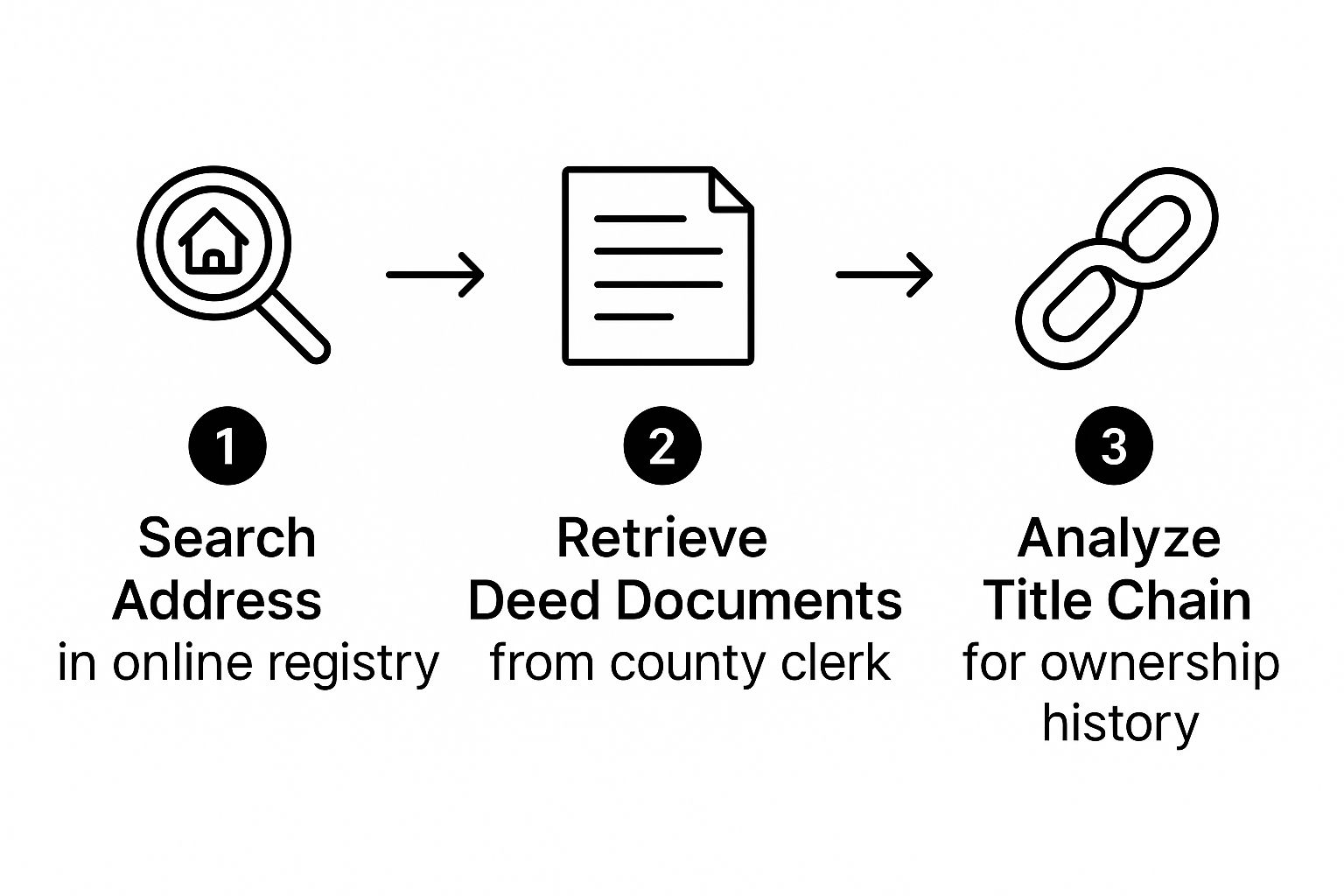
From this portal, you can search by address to pull up a chronological list of every permit ever issued for that property.
You’re not just looking for a single permit; you’re trying to build a complete timeline of the property’s life. Keep an eye out for permits related to:
- Major Renovations: Kitchen and bathroom remodels, finishing a basement, or moving walls around.
- Additions: New rooms, second stories, or expanded living areas.
- System Replacements: HVAC units, electrical panel upgrades, major plumbing work, and new roofing.
- Foundation Work: Given our clay soil in Dallas, any permits for foundation repair are especially important to scrutinize.
A solid, detailed permit history suggests the owners were diligent and maintained the property correctly. But a sparse (or non-existent) history for an older Dallas property that has obviously been updated should set off alarm bells. It’s a classic sign of unpermitted—and therefore uninspected—work.
When reviewing permits, it’s easy to get sidetracked by all the details. I’ve seen clients overlook critical warning signs because they weren’t sure what to look for. Here are some of the most common red flags I’ve encountered in Dallas and what they could mean for you as a buyer.
Dallas Permit Search Red Flags
| Red Flag | Potential Implication |
|---|---|
| No Permits for Obvious Work | Renovations were done without city oversight, meaning they may not be up to code or structurally sound. |
| “Owner-Pulled” Permits for Major Jobs | While legal, it can sometimes indicate DIY work on complex systems (electrical, plumbing) that should have been handled by a licensed pro. |
| Open or Expired Permits | The project was started but never officially completed or inspected, leaving its quality and safety in question. |
| Multiple Permits for the Same Repair | This could signal a recurring problem, like a persistent leak or electrical issue that wasn’t fixed correctly the first time. |
| Permits for Demolition Only | If a structure (like a garage or shed) was torn down but no permit was issued to rebuild, it might affect the property’s legal use. |
Seeing one of these isn’t necessarily a deal-breaker, but it means you need to ask more questions and probably bring in a specialized inspector to take a closer look.
Special Considerations for Historic Districts
If the property you’re eyeing is in one of Dallas’s beautiful historic districts—think Swiss Avenue, the M Streets, or Kessler Park—your research gets a bit more complex. Properties in these areas are subject to some pretty strict preservation rules.
You won’t just be checking the standard permit portal. For these properties, you also have to check with the Dallas Landmark Commission.
Any exterior alterations, from window replacements to paint colors, require a special document called a Certificate of Appropriateness. Verifying that all past work was approved by the commission is crucial. If you don’t, you could inherit a violation that you’ll be responsible for fixing. Unapproved work in a Dallas historic district can lead to hefty fines and being forced to reverse the changes, which is an expensive and frustrating surprise for any new owner.
Deeds tell you who owned a place, but tax records tell a completely different, and equally important, story—the financial one. This data gives you a year-by-year narrative of a property’s assessed value, offering some powerful clues about its physical evolution and the economic health of its Dallas neighborhood.
For this part of your deep dive, your best friend is again the Dallas Central Appraisal District (DCAD) database. Every single year, DCAD assigns an assessed value to each property for tax purposes. When you track this number over time, you start to see patterns that reveal a great deal about the property’s journey.
A steady, gradual climb in value, like you’d expect for a well-maintained property in Oak Lawn, usually points to market stability and consistent upkeep. No surprises there. But a sudden, dramatic spike in assessed value? That’s a major clue. It almost always means a significant, permitted renovation or addition took place, which you can then cross-reference with the building permit history you’ve already pulled.
Interpreting the Financial Footprint
Analyzing these value trends is a crucial part of researching a Dallas property’s history. An erratic valuation history—think sharp drops followed by sharp increases—could hint at periods of distress, neglect, or even damage, followed by a major overhaul. It’s a clear signal to dig deeper into what was happening during those more volatile years.
It’s also smart to understand how these local Dallas numbers fit into the bigger picture. Residential property price data can reveal market patterns stretching back decades. Institutions like the Bank for International Settlements (BIS) maintain incredibly detailed datasets covering property prices from dozens of economies, often going back to the 1970s. These records show how major economic events influenced local markets, giving you context for the value changes you’re seeing in Dallas. You can explore these global residential property price statistics on data.bis.org to get a feel for the macro trends.
Checking for Tax Liens and Delinquencies
Beyond just value trends, Dallas tax records are the go-to source for identifying any outstanding financial baggage tied to the property. The DCAD record will show if there are any delinquent taxes owed. When property taxes go unpaid, it can result in a tax lien, which is a legal claim against the property that absolutely must be settled before it can be sold with a clear title.
Crucial Insight: An unresolved tax lien is a serious complication in a Dallas real estate deal. It can delay or even completely halt a transaction. If missed during due diligence, that financial responsibility could fall squarely on you, the new owner.
Discovering a tax delinquency isn’t just about the money owed; it can also be an indicator of financial distress on the part of the current owner. For an investor, this might spell opportunity. For a typical property buyer, though, it’s a warning sign that requires careful handling by your real estate agent and title company.
To get a better handle on the specifics of local tax obligations, check out our guide on how to calculate property taxes in Dallas, Texas. This will help ensure you understand the full financial picture before moving forward.
Common Questions About Dallas Property Research
Even with a clear guide, you’re bound to have questions once you’re deep in the archives. Digging into a Dallas property’s history can feel like you’re solving a puzzle, and sometimes, a few crucial pieces just don’t want to be found. Let’s tackle some of the most common hurdles that pop up during a Dallas property investigation.
These are the real-world challenges people run into, along with some actionable advice to keep your research moving forward.
What if Records Are Missing or Incomplete?
It’s a frustrating but all-too-common scenario: you’re tracing a deed history and suddenly hit a dead end, or a key permit seems to have vanished into thin air. This happens a lot with older Dallas properties, especially when you’re looking for records that pre-date the city’s digital systems.
When you hit a wall online, don’t assume the record doesn’t exist. Your next move should be a trip to the Dallas County Records Building. So many older documents, like original plats and deeds, were never scanned into the online portals. Plus, striking up a conversation with a clerk can be invaluable—they know the quirks of the filing system better than anyone.
For properties in historic districts or older neighborhoods like Old East Dallas, you might need to broaden your search:
- Dallas Public Library: Head to the J. Erik Jonsson Central Library. Its history and archives division is a goldmine of old maps, city directories, and photos that can fill in major gaps.
- Dallas Historical Society: Their collections can provide incredible context on a neighborhood’s development and, sometimes, specific details about the property itself.
- Title Companies: These firms maintain their own private databases, often called “title plants.” They frequently have copies of records that are a real headache to find through public channels.
How Far Back Should I Realistically Go?
This is a great question. While it’s tempting to try and trace a property’s ownership back to the Republic of Texas, it’s usually overkill for standard due diligence. For most Dallas buyers, a 50-to-60-year search is more than enough. That timeframe is typically sufficient to uncover any relevant liens, easements, or restrictions that could actually impact your ownership today.
But the right answer really depends on your goal.
If you’re buying a property in a designated historic district like Swiss Avenue, you’ll want to go all the way back to its original construction. This is essential for verifying the property’s architectural history and ensuring past modifications were properly approved.
On the other hand, if you’re looking at a property in a suburban Dallas development built in the last 20 years, the chain of title will be short and sweet. A deep historical dive just isn’t necessary.
What Is the Best Way to Research Pre-Digital Properties?
Researching a Dallas property built before the 1980s is a different ballgame. Since most of its history isn’t sitting in a neat digital file, you’ll need to get comfortable with physical archives. I always recommend starting at the Dallas County Clerk’s office for deeds and then heading over to the Dallas Municipal Archives for building permits, which you might find on microfilm or in old-school physical ledgers.
It also helps to understand the bigger picture. The real estate market’s growth over time gives you clues about property valuation and ownership changes. The global market was valued at around USD 7,384.14 billion recently, with North America holding a 33.4% share. This long-term growth, driven by decades of urbanization, is mirrored in the historical property values you’ll uncover right here in Dallas. You can learn more about global real estate market trends at imarcgroup.com.
Navigating the complexities of Dallas property research takes local expertise and a keen eye for detail. The team at Dustin Pitts REALTOR Dallas Real Estate Agent has the experience to guide you through every step, ensuring you have a complete picture of your investment before you commit. To put a Dallas expert on your side, visit https://dustinpitts.com.