

Staring at a mountain of DFW property listings can feel like you’re getting nowhere. A good rental yield calculator is the tool that cuts right through that noise. It takes all those confusing numbers and spits out a clear percentage, showing you a property’s real income potential. For any serious Dallas real estate investor, it’s the essential first step before you even think about making an offer.

Your First Step to Smart Dallas Investing
When you’re looking at hot Dallas neighborhoods like Bishop Arts or Uptown, a rental yield calculator is your first line of defense against a bad investment. It gives you a standard metric to stack up different properties against each other. Suddenly, you’re moving past the nice listing photos and neighborhood hype to focus on what actually pays the bills: profitability.
The basic idea is pretty simple. A rental yield calculator divides a property’s annual rental income by its total purchase price, giving you a percentage. If you want to dive deeper into the nuts and bolts, you can find detailed guides on how a yield calculator functions. That final percentage is your potential return on investment from rent alone.
But any investor who’s been around the block in Dallas knows that not all calculations are built the same. The real story—the one that determines if you actually make money—is hidden in the local expenses that can eat away at your returns.
Gross Yield vs Net Yield
Probably the biggest rookie mistake I see is an investor getting excited over a gross yield calculation. It’s a dangerously simple number that just looks at the annual rent versus the property price, and it can paint a wildly optimistic picture. It completely ignores the real-world costs of owning a rental in Dallas County.
The net yield is where the truth comes out. This is the number that matters because it forces you to account for all those critical, and often overlooked, expenses.
A net yield calculation makes you confront the real costs of ownership—property taxes, insurance, HOA dues, and maintenance. Skipping this step is like trying to merge onto the Dallas North Tollway with your eyes closed. You’re going to hit something expensive.
Getting this difference right isn’t just a good idea; it’s non-negotiable for succeeding in the DFW market.
Gross Yield vs Net Yield: A Quick Comparison
Before you analyze any deal, it’s crucial to understand the difference between a basic gross yield and the far more realistic net yield, especially when you factor in common Dallas investor costs.
| Metric | What It Measures | Formula | Best For |
|---|---|---|---|
| Gross Yield | The raw return on investment from rent before any expenses are deducted. | (Annual Rental Income / Property Purchase Price) * 100 |
A quick, initial screening to filter a long list of properties in the Dallas market. |
| Net Yield | The actual return on investment after all operating expenses are subtracted. | (Annual Rental Income - Annual Expenses) / (Property Purchase Price + Closing Costs) * 100 |
A detailed, realistic analysis for making an actual investment decision in Dallas. |
As you can see, the net yield gives you the only true picture of your investment’s financial health. It’s the number that tells you what you’ll actually be putting in your pocket.
Finding Accurate Data for Your DFW Property Analysis

Any rental yield calculator is a fantastic tool, but it has a critical weakness: it’s only as good as the numbers you feed it. If you’re relying on generic estimates or, worse, national averages, you’re setting yourself up for a misleading result. That’s a recipe for a bad investment in the Dallas market.
To get a true picture of a property’s potential here in the Dallas-Fort Worth area, you have to roll up your sleeves and dig for local, property-specific data. This is where the real work of an investor happens, moving beyond optimistic guesswork to find figures that reflect the on-the-ground reality of owning a rental in DFW.
Sourcing Your Key Dallas-Specific Costs
Building a reliable net yield calculation means hunting down several key expense figures. These are the numbers that will ultimately separate a profitable Dallas investment from a financial headache.
Here are the data points you absolutely must track down:
- Dallas County Property Taxes: Don’t even think about using a state or national average. You need the exact tax rate for the property’s specific location, which you can find on the Dallas Central Appraisal District website. Rates can vary wildly, even between neighboring suburbs.
- North Texas Insurance Premiums: Get on the phone and request actual quotes from insurance agents. Premiums in North Texas are often higher due to our local weather events like hail and tornadoes, so a national guesstimate will leave you underfunded.
- Average HOA Fees: This is a big one. For condos or homes in planned communities, especially in dense areas like Victory Park or Las Colinas, the HOA fee is a major monthly expense. You need the precise figure from the listing agent or the HOA’s official documents.
A savvy investor knows the crucial difference between gross and net rental yield. Net yield is your reality check, subtracting all the real-world costs like maintenance, property management, taxes, and insurance. In Dallas, these expenses can easily knock your net yield down by 1-3 percentage points or more, depending on the property and local conditions.
On top of these, you need to budget realistically for maintenance—think about what it costs to service an HVAC unit to survive a brutal Texas summer. You also need to project vacancy rates by analyzing hyper-local comps, not just city-wide stats.
For a deeper dive into market specifics, understanding real estate market trends on a broader scale will sharpen your analysis and help you make a smarter decision for your Dallas portfolio.
Putting the Calculator to Work: A Dallas Case Study
Theory is one thing, but let’s make this rental yield calculator concept tangible. Seeing the numbers come to life with a real-world example is what provides true clarity. We’ll walk through a detailed scenario using a hypothetical property in a desirable Dallas neighborhood to show you exactly how the calculation works in practice.
Imagine you’re eyeing a classic bungalow in the M-Streets, an area known for its charm and strong rental demand. This walkthrough will turn a long list of expenses into a single, powerful metric.
The M-Streets Bungalow Example
First, let’s lock in our core numbers for this hypothetical property. To keep it practical, we’ll use realistic figures based on current market conditions in this sought-after Dallas location.
Initial Property & Income Data:
- Purchase Price + Closing Costs: $515,000
- Projected Monthly Rent: $3,200
- Annual Rental Income: $3,200 x 12 = $38,400
Based on these numbers alone, a quick gross yield calculation suggests a 7.45% return. While that looks tempting on paper, the figure is dangerously misleading. It completely ignores the significant operating costs of owning a rental property in Dallas. To get the real picture, we have to dig into the net yield.
Calculating the Net Rental Yield
Now for the critical part: subtracting the realistic annual expenses a Dallas investor would actually face. These are the costs that separate a good investment from a bad one.
- Dallas County Property Taxes (approx. 2.1%): $10,815
- Annual Insurance Premium: $2,800
- Vacancy Fund (4% of annual rent): $1,536
- Maintenance & Repairs (8% of annual rent): $3,072
- Property Management Fees (8% of annual rent): $3,072
Total Annual Expenses: $21,295
With our expenses tallied up, we can finally determine the net annual income:
$38,400 (Gross Income) – $21,295 (Total Expenses) = $17,105 (Net Income)
At last, we can plug this net income into the formula to find our true yield:
($17,105 / $515,000) * 100 = 3.32% Net Rental Yield
This is the number that matters.
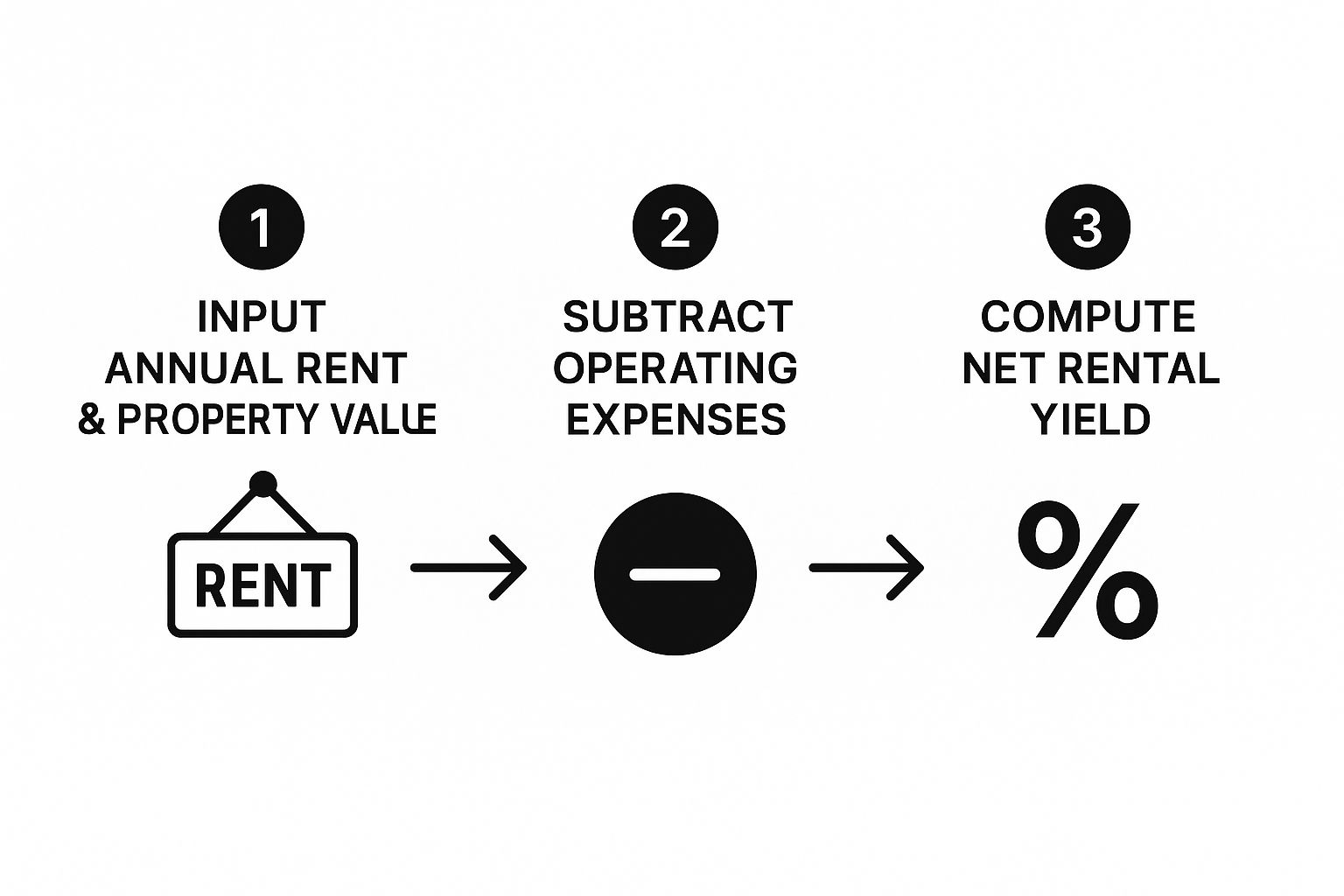
As you can see, the path from gross income to a final net yield percentage shows just how crucial it is to account for every single expense.
In our M-Streets example, the difference between the initial gross yield (7.45%) and the final net yield (3.32%) is massive. This process proves why a good rental yield calculator is so valuable—it transforms a complex jumble of data into an actionable number for smarter, more profitable Dallas investing.
What Is a Good Rental Yield in the Dallas Market?
So, you’ve plugged the numbers into a rental yield calculator and have a percentage staring back at you. Now what? That single number is where the real work begins—interpreting it is how you move from just doing math to making smart investment moves in Dallas.
First things first: there’s no magic number for a “good” rental yield. It completely depends on your personal strategy and the specific Dallas submarket you’re targeting.
For instance, in a high-octane growth suburb like Frisco, where property values are climbing fast, an investor might be perfectly happy with a net yield of 4%. In this scenario, the play isn’t just about monthly cash flow. It’s about building long-term wealth as the property’s value appreciates over time.
On the other hand, if you’re looking at more established, stable Dallas neighborhoods, you’ll likely want to see a higher yield—think 7% or more. These properties are the workhorses of a portfolio, designed to be cash flow machines that deliver steady, predictable income month after month.
The key takeaway is this: A lower yield in a high-appreciation area of Dallas can be more strategic than a high yield in a stagnant one. It all comes down to your personal investment thesis—are you playing for monthly income or long-term equity growth?
Putting Your Numbers in Context
To get a real sense of how your Dallas property stacks up, it helps to zoom out and look at the bigger picture. Some national data can provide a baseline, but local context is king. For comparison, you can explore rental yields across major U.S. markets on GlobalPropertyGuide.com, but always bring the focus back to DFW.
Ultimately, the ideal yield boils down to your financial goals and risk tolerance. There’s no one-size-fits-all answer here. A deep understanding of the Dallas-Fort Worth housing market is crucial for setting realistic expectations. The goal is to find the property whose yield and growth potential align perfectly with what you want to achieve in the Dallas area.
Actionable Strategies to Boost Your Dallas Rental Yield

Getting your property’s yield is just the first step. The real work—and where you build real wealth in Dallas real estate—is in actively improving it. The number you get from a rental yield calculator isn’t written in stone. Think of it as a baseline you can, and should, work to raise.
The path to a higher net income is always two-fold: you either increase what comes in or decrease what goes out. When it comes to revenue, targeted renovations in the Dallas market tend to pay off handsomely. It’s all about implementing proven strategies for achieving higher rental income that make a tangible difference in your bottom line.
Smart Upgrades and Expense Management
Your upgrades should solve common problems for Dallas tenants. For instance, putting in new energy-efficient windows is a massive draw for renters who are sick of sky-high summer electricity bills. A quick refresh of the kitchen or bathroom can also justify a significant bump in your rental rate.
On the flip side, don’t just passively accept your expenses. Scrutinize everything. Here are a few places I always tell my clients to look first:
- Review Your Management: Doing it yourself saves you a management fee, but it costs you something more valuable: time. A top-notch Dallas property manager can often find better tenants and slash vacancy periods, which can more than cover their fee.
- Challenge Property Taxes: Assessments from Dallas County aren’t always spot-on. You have every right to appeal your property’s valuation, and a successful appeal can lead to some serious annual savings.
- Target Different Renters: Think outside the box. If your property is near a business hub like Las Colinas or Downtown Dallas, why not market it as a corporate lease? These arrangements often command higher rents and attract tenants for longer terms.
Your job as an investor isn’t over once you close on the property. The most successful Dallas landlords are the ones who are constantly looking for ways to boost revenue and trim costs. That’s how you turn a decent investment into a high-performing asset.
By taking these steps, you gain direct control over your property’s financial performance. For more in-depth advice, our Dallas real estate investment guide provides a comprehensive look at building a successful portfolio right here in DFW.
Common Questions About DFW Rental Yield

Even with a great calculator, I find that new and even experienced investors run into the same questions when they start digging into Dallas-Fort Worth properties. Getting these nuances right is what separates a sharp, profitable investment from a costly mistake.
Let’s go through some of the most frequent questions I get from investors to clear up any lingering confusion.
How Much Do Dallas Property Taxes Really Affect Net Yield?
They have a huge impact. Forgetting to account for Dallas County’s high property tax rates is one of the biggest errors I see. It’s a deal-killer if you ignore it.
On a $400,000 property, for example, your annual tax bill can easily top $8,000. That single expense can knock a full two percentage points (or more) right off your net yield. You absolutely have to use the precise tax rate for the property’s specific location, like whether it’s inside the Dallas ISD, to get a calculation that reflects reality.
Does a Rental Yield Calculation Include Appreciation?
No, and that’s intentional. Rental yield is a laser-focused metric on one thing: cash flow. It tells you how well the property sustains itself financially based only on the rent you collect versus your initial cash outlay. It’s your monthly and yearly performance grade.
Your total Return on Investment (ROI) is a different, broader metric that does include appreciation. A strong rental yield proves your Dallas investment is solid on its own, regardless of what the overall market is doing.
What Is the Biggest Mistake When Calculating DFW Rental Yield?
Without a doubt, the most common and expensive mistake is underestimating your expenses. So many investors get excited, plug in the rent and mortgage, and call it a day. But in DFW, it’s the other costs that can quietly drain your returns.
These often-forgotten expenses include:
- High HOA fees, which are incredibly common in Dallas-area condos and master-planned communities.
- Vacancy funds, because even in a hot market like ours, you’ll have turnover between tenants.
- Capital expenditures for big-ticket items like a new HVAC system—an absolute certainty here in Texas.
Can I Improve My Yield After Buying a Property?
Absolutely. The number you get from a calculator is just your starting point, not your final score. Smart Dallas investors are always looking for ways to boost their yield.
This could mean making strategic, high-ROI renovations that allow you to charge higher rent. Or you might refinance your mortgage to lock in a better rate. I’ve even seen clients successfully appeal their property tax assessment to lower their expenses. The key is to treat your property like a business and constantly look for ways to optimize its performance in the Dallas market.
Navigating the Dallas real estate market requires local expertise and data-driven insights. If you’re ready to analyze properties with precision and make your next investment your best one, contact Dustin Pitts REALTOR Dallas Real Estate Agent to get started. Find your next opportunity at https://dustinpitts.com.