

Before you can put that “For Sale” sign in your Dallas front yard, there’s a critical document you’ll need to sign: the listing agreement.

Think of it as the official handshake between you and your real estate brokerage. It’s a legally binding contract that gives them the green light to market and sell your property. This document is the playbook for the entire sale, spelling out everything from the asking price to your agent’s commission.
Your Guide to Dallas Listing Agreements

This agreement is the very foundation of your property-selling journey. It’s far more than a simple formality; it’s the tool that ensures you and your agent are perfectly aligned from day one. In a fast-paced market like Dallas, setting clear expectations right from the start is non-negotiable.
The agreement serves a few key purposes. It grants the real estate brokerage the exclusive authority to represent you, which prevents any confusion and guarantees a focused, powerful marketing effort. It also meticulously outlines the duties and responsibilities of both you and your agent.
A well-crafted listing agreement is more than just a contract; it’s a strategic plan. It aligns the seller’s goals with the broker’s marketing efforts, creating a clear and legally protected path to a successful sale.
The Importance of a Formal Contract
Without a signed agreement, an agent has no legal authority to advertise your property, put it on the Multiple Listing Service (MLS), or negotiate offers on your behalf. This formal contract is what empowers them to pour their time, money, and expertise into getting your Dallas property sold.
These agreements have become a cornerstone of modern real estate for good reason. They formalize everything—the agent’s duties, how the commission is structured, and the timeline for the sale. The sheer scale of their importance is clear from market data; in 2023, approximately 4,090,000 existing homes were sold in the US, and nearly every single one of those deals was kicked off with a listing agreement. You can dig into more real estate market statistics to see just how vital these contracts are.
Ultimately, understanding what a listing agreement is and what’s in it is essential for anyone selling property in Dallas. It’s your safety net.
Let’s take a look at the essential components you’ll find in a typical Dallas listing agreement.
Key Components of a Dallas Listing Agreement at a Glance
This table breaks down the crucial elements of a standard Texas real estate listing agreement, so you know exactly what to look for when you review the document.
| Component | What It Means for Dallas Sellers | Why It’s Important |
|---|---|---|
| Parties Involved | Identifies you (the seller) and the brokerage (the agent’s firm). | Establishes the legal relationship and who is bound by the contract. |
| Property Description | The legal description of your property, not just the street address. | Ensures there is no ambiguity about which property is being sold. |
| Listing Price | The initial asking price for your home. | This is the public-facing price that will be used in all marketing. |
| Contract Term | The start and end dates of the agreement. Usually 3 to 6 months. | Defines the period during which the agent has the exclusive right to sell. |
| Broker’s Compensation | The commission rate (e.g., 5-6%) and terms for payment. | Clarifies exactly how and when your agent gets paid for their work. |
| Broker’s Duties | Spells out the agent’s responsibilities, like marketing and negotiations. | Sets clear expectations for the services you will receive. |
| Seller’s Duties | Outlines your obligations, like providing access for showings. | Ensures you’re holding up your end of the partnership for a smooth sale. |
| Intermediary Status | Discloses if the brokerage can represent both buyer and seller. | A key legal disclosure required in Texas to avoid conflicts of interest. |
Having a solid grasp of these components is your first step toward a transparent and successful property sale. Before we dive into the different types of listing agreements, recognizing this document as your primary tool for a smooth transaction is key.
Choosing Your Strategy with Different Agreement Types
Not all listing agreements are created equal. The type of contract you sign in Texas really defines the partnership you’ll have with your real estate agent, impacting everything from their marketing budget to how they get paid. It’s crucial to understand these differences so you can pick a sales strategy that actually fits your goals for your Dallas property.
Think of it like choosing a business model for selling your house. Do you want a dedicated project manager who gets paid for a successful sale no matter what? Or would you prefer a more open-ended approach where only the person who closes the deal gets a check? Let’s walk through the three main types you’ll come across.
The Exclusive Right to Sell Agreement
This is, by far, the most common and widely used listing agreement in the Dallas real estate scene, and for good reason. The Exclusive Right to Sell agreement gives a single brokerage the sole authority to market your home and represent you.
What does that mean in practice? Under this contract, your agent earns their commission if the property sells during the agreed-upon term, regardless of who ultimately finds the buyer. Even if your colleague hears your house is for sale and makes an offer directly to you, your agent is still entitled to their commission.
This setup gives an agent the strongest possible incentive to go all-in on marketing your property. They can confidently invest their time, money, and effort into professional photos, aggressive online ad campaigns, and staging for open houses in neighborhoods like Lakewood or Preston Hollow, knowing their work is protected. It fosters a powerful, focused partnership with one clear goal: getting you the best possible price and terms.
The Exclusive Agency Listing Agreement
Next up is the Exclusive Agency agreement, which is a slight twist on the Exclusive Right to Sell. With this type, you still give one brokerage the exclusive right to market your property. They are your one and only representative out there.
The key difference, however, is this: if you, the owner, manage to find a buyer completely on your own without any help from the agent, you don’t owe them a commission. This option can sound tempting for sellers who have a large personal network and think they might just find a buyer themselves.
While it does offer a bit more flexibility, that “what if” scenario can sometimes dampen an agent’s motivation to pour maximum resources into the sale. They’re facing the risk of doing all the legwork only to walk away with nothing. Because of this, it’s a much less common sight in the competitive Dallas market where a full-court press is usually what it takes to get top dollar.
Deciding between agreement types is a strategic choice. The Exclusive Right to Sell offers maximum agent commitment, while an Exclusive Agency provides a path for sellers who want to leverage their own network to potentially save on commission.
This decision tree helps visualize how to choose the right agreement based on your priorities.
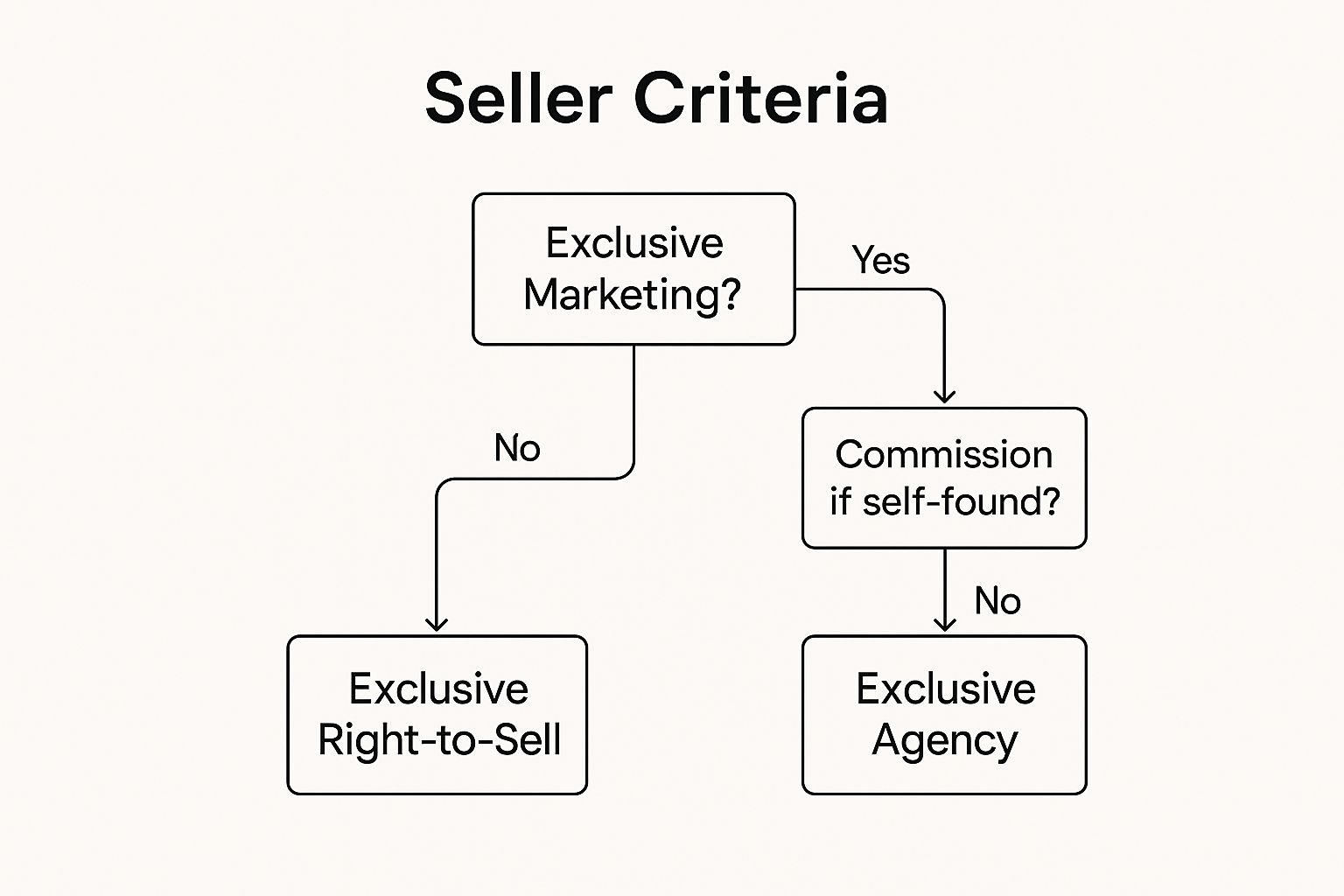
As the infographic shows, the key questions revolve around exclusivity and how commission is handled if you find the buyer yourself.
The Open Listing Agreement
Finally, we have the Open Listing agreement. This is the least restrictive of all, and also the least common. An open listing basically allows you to hire multiple brokerages at the same time to market your property.
It’s like putting out a want ad for freelancers. The only agent who earns a commission is the one who successfully brings a buyer to the table and closes the deal. On top of that, if you find the buyer on your own, you don’t owe a commission to any of the agents you hired.
This approach almost always leads to a chaotic and ineffective sale. Since no single agent has an exclusive claim, none of them are going to invest much in marketing. Your property won’t get the dedicated attention it needs, and you risk confusing buyers who see your Dallas home listed by several different agents. It’s a strategy that rarely works out in the seller’s favor. Selecting the right agent is just as important as the agreement type, and you can learn more about how to choose a real estate agent in our detailed guide.
Decoding the Key Clauses in Your Agreement

A listing agreement can feel like it’s written in another language. But once you understand the key clauses, you’ll see it’s just a detailed roadmap for your property sale. Translating this legal jargon into plain English is absolutely essential for any Dallas seller to feel confident and in control.
These clauses aren’t just formalities; they’re the gears that make the entire sales machine work. They define your rights, your agent’s duties, and the financial terms of your partnership. Let’s break down the most critical sections you’ll run into.
The Listing Period
The Listing Period, or “term,” is simply the timeframe your agent has the exclusive right to market and sell your property. Think of it as the official season for your property sale.
Here in the Dallas market, this period usually lasts somewhere between three to six months. A shorter term might seem appealing, but it can sometimes rush the process. A longer term gives your agent plenty of time to roll out a full marketing strategy, which is especially important for unique or high-end properties in areas like Highland Park.
The start and end dates are always spelled out, so there’s no room for confusion. This clause is crucial because it sets a clear timeline for performance and keeps your agent motivated to sell your property within that window.
Setting the Listing Price
This is the clause that officially states the initial asking price for your home—and it’s one of the biggest decisions you’ll make. While you, the seller, always have the final say, this price should be a team effort between you and your agent, based on a deep dive into the Dallas market.
An experienced agent will come prepared with a Comparative Market Analysis (CMA), which looks at recent sales of similar homes in your specific neighborhood, whether it’s the M Streets or Preston Hollow. The listing price isn’t just a number; it’s a strategic tool designed to attract the right buyers and generate strong offers.
The Listing Price is where market data meets marketing strategy. Setting it correctly from the start is the single most effective way to generate buyer interest and avoid your property sitting on the market for too long.
A well-priced home can create a frenzy of competition, while an overpriced one can scare off potential buyers before they even book a showing.
Understanding the Commission Rate
The commission clause lays out the total compensation the brokerage will receive when your property successfully sells. This is almost always a percentage of the final sale price and is always negotiable.
It’s important to understand how this commission is typically split. The total amount is divided between the listing brokerage (representing you) and the buyer’s brokerage. This structure is what motivates agents from all over Dallas to bring their qualified buyers to your doorstep, maximizing your property’s exposure.
The agreement will clearly state the percentage and the exact conditions under which it’s earned—which is, of course, the successful closing of the sale. Full transparency here is the key to a healthy, trusting relationship with your agent.
The Broker Protection Clause: A Dallas Scenario
One of the most misunderstood but vital parts of a listing agreement is the Broker Protection Clause, sometimes called a “safety” or “carryover” clause. This provision protects the agent’s commission for a set period after the listing agreement expires.
Here’s how it works in a real-world Dallas scenario: Imagine your listing agreement for your Bishop Arts bungalow expires. The very next week, a buyer who toured your home during an open house two months ago comes back and makes a direct offer to you.
Because that buyer was introduced to your property during the listing period, this clause ensures your agent is still paid for their work. This protection period is typically 60 to 90 days. To make it stick, the agent has to give you a written list of the potential buyers they worked with shortly after the agreement ends.
This clause prevents a buyer from intentionally waiting for a listing to expire just to cut the agent out of the deal. However, it’s typically voided if you sign a new exclusive listing agreement with a different broker.
Net Listings in Texas
It’s also worth noting how listing agreements reflect local laws. For instance, net listing agreements—where an agent’s commission is any amount above a set price the seller wants—are illegal in many states because of the potential for conflicts of interest.
However, they are permitted under specific regulations in Texas, California, and Florida. While they are pretty uncommon, understanding that Texas law allows for this type of arrangement just highlights how important it is to read every single clause carefully. You can discover more about the legality of different listing types by state.
How The Listing Agreement Powers Your Home Sale
Think of a listing agreement as more than just paperwork. It’s the moment you and your agent officially join forces, turning a handshake into a strategic partnership. In a fast-paced market like Dallas, this document is the green light that empowers your agent to put their expertise, network, and—crucially—their own money to work for you.
Without it, an agent is just an advisor. With it, they become your dedicated representative, legally authorized to launch a full-scale mission to get your property sold.
Igniting the Marketing Machine
The moment you sign, your agent is cleared for takeoff. They can immediately start investing in the high-quality marketing that makes a home stand out, from hiring professional photographers for a twilight shoot in Preston Hollow to ordering eye-catching yard signs for a corner lot on the M Streets.
This agreement gives them the legal standing to act on your behalf, transforming your private home into a public-facing asset. It’s the key that unlocks the single most powerful tool in real estate: the Multiple Listing Service (MLS).
A listing agreement is the catalyst for action. It’s the formal commitment that allows an agent to confidently deploy their marketing budget, network, and resources, knowing their efforts are legally protected and aligned with your goals.
Once your property hits the MLS, it’s instantly broadcast to thousands of agents across the Dallas-Fort Worth metroplex and syndicated to major real estate websites. This is how you get maximum exposure to serious, qualified buyers.
A Structured Approach to Showings and Offers
A great sale is an organized sale. The listing agreement brings order to the often-chaotic process of showings and negotiations. It sets the rules of engagement, giving your agent the authority to manage showing requests through a centralized system, ensuring the process is both smooth and secure for you.
When offers start coming in, this document truly shows its value. It establishes your agent as the single point of contact for all negotiations. This prevents miscommunication and puts a seasoned professional in your corner, ready to manage offers and counter-offers to secure you the best possible price and terms.
A Hypothetical Preston Hollow Sale
Let’s walk through how this plays out with a home in Preston Hollow:
- Agreement Signed: You sign an Exclusive Right-to-Sell agreement. Your agent is now officially on the clock and ready to invest in your sale.
- Marketing Launch: Within 24-48 hours, they schedule a professional photographer for a stunning photo and video shoot, commission a virtual tour, and create detailed floor plans.
- MLS Activation: Your home goes live on the North Texas Real Estate Information Systems (NTREIS) MLS, immediately appearing in the search results of every active agent in DFW.
- Showings Coordinated: Showing requests start pouring in. Your agent manages them all, vetting potential buyers and scheduling appointments that work for you.
- Offer Negotiation: An offer lands. The buyer’s agent knows exactly who to present it to. Your agent calls you, breaks down the terms, and advises on a counter-offer strategy that leads to a signed contract.
Every one of these critical steps is made possible by the listing agreement. It’s the framework that turns a plan into a successful closing. To make sure your home shines during those showings, preparing the property is key; using an ultimate house cleaning checklist can be a game-changer.
The impact of these agreements is staggering. With the median new home price in the US hovering around $420,000 and over 4 million existing homes sold each year, nearly every transaction is kicked off by a listing agreement. This underscores just how central formal broker relationships are to the market. You can dig deeper into these quick real estate statistics to see the full picture.
Ultimately, the agreement isn’t a hurdle; it’s the launchpad for a successful sale.
Clearing Up Common Seller Misconceptions

Listing agreements can feel pretty intimidating, and frankly, some persistent myths have taken root among Dallas home sellers over the years. These misconceptions can create a ton of unnecessary stress and stop you from making confident, clear-headed decisions. So, let’s clear the air and bust some of the most common myths with the actual facts based on Texas real estate law.
One of the biggest anxieties I hear is the fear of being locked in for the entire term with no escape, even if your agent is dropping the ball. That’s just not how it works.
Most Texas listing agreements include clauses that spell out performance expectations and potential termination. If an agent isn’t holding up their end of the bargain—like failing to market your property or just plain ghosting you—you may have grounds for cancellation. An agent’s fiduciary duty legally binds them to act in your best interest, and failing to do so can be a breach of contract.
Myth 1: Commission Rates Are Fixed
This one is huge. So many sellers in Dallas come to the table believing that real estate commission rates are standardized and can’t be changed. This is a major misunderstanding that can cost you.
Let’s be crystal clear: in Texas, and right across the U.S., there is no such thing as a “standard” or government-set commission rate. All commissions are 100% negotiable between you and the brokerage before you sign anything. Any agent who tells you otherwise is misrepresenting the facts, plain and simple. The rate you agree on should be a reflection of the services being provided, the agent’s marketing firepower, and the unique needs of your property.
Myth 2: You Are Trapped with an Underperforming Agent
The fear of being stuck in a bad partnership is completely valid, but you have far more power than you might think. A well-crafted listing agreement is designed to protect you from this exact scenario.
Before you sign on the dotted line, you can—and absolutely should—discuss adding a clear termination clause. This section can outline a step-by-step process for ending the agreement if you’re not satisfied. It might specify a notice period or require you to reimburse the agent for specific upfront marketing costs, but it gives you a clear path out. This isn’t a confrontational request; it’s smart business, and any professional agent will be open to the conversation.
A listing agreement should be a partnership, not a prison. Negotiating clear termination terms and performance expectations upfront empowers you to hold your agent accountable and ensures they are motivated to deliver results.
Myth 3: Any Agent Can List Your Property on the MLS
Getting your home on the Multiple Listing Service (MLS) is non-negotiable for a successful sale, but some sellers think any licensed agent can just pop their property on there. The reality is a bit more nuanced. Access to our local MLS—the North Texas Real Estate Information Systems (NTREIS) in Dallas—is a privilege reserved for member REALTORs®.
The listing agreement is the document that officially authorizes a qualified agent to enter your property’s details into this powerful marketing engine. This includes everything from the professional photos to critical property details, much of which is pulled from other key documents. For instance, knowing the requirements for the Seller’s Disclosure in Texas is vital, as that information directly populates the MLS listing.
Without that formal agreement, an agent has no legal ground to represent your property on this essential platform. By busting these myths, you can walk into the process with confidence, ready to advocate for your best interests.
Answering Your Top Listing Agreement Questions
Even after you get the hang of the different types and clauses, a few key questions always pop up right before it’s time to sign. These are the practical, “what-if” scenarios that keep Dallas sellers up at night. Let’s tackle those pressing concerns head-on, with answers grounded in how things really work in Texas real estate.
Can I Cancel a Listing Agreement in Texas If I Am Unhappy with My Agent?
Yes, you can often cancel a listing agreement in Texas, but how cleanly you can walk away depends entirely on the contract you signed. Most agreements prepared by REALTORs® have a specific termination clause that spells out the exact rules for parting ways.
This clause might require both you and the brokerage to agree to the split, demand a formal written notice, or even ask you to reimburse the agent for marketing dollars they’ve already spent. If your agent has truly dropped the ball—not marketing your property as promised or just being impossible to reach—you likely have solid grounds to cancel for breach of contract.
Your first move should be to find the “Early Termination” or “Default” section in your agreement and read it carefully. If the language is fuzzy or you and your agent can’t find a friendly way to separate, talking to a Dallas real estate attorney is a smart move to sidestep any surprise fees or legal headaches.
What Happens If My Dallas Property Sells After the Agreement Expires?
This is precisely why the Broker Protection Clause exists. You’ll sometimes hear it called a “safety clause” or “carryover clause,” and it’s a standard part of Texas listing agreements. Its job is to protect the agent’s commission for a set period after your contract is officially over.
This protection window, usually between 60 to 90 days, only kicks in if your property sells to a buyer who was introduced to the home during the time your agreement was active. For the clause to hold up, the agent has to give you a written list of these “protected” buyers’ names soon after the contract ends.
If you end up selling to someone on that list within that timeframe, you’d still owe the commission. There’s one big exception, though: this clause is almost always voided if you sign a new exclusive listing agreement with a different brokerage.
Are Real Estate Commission Rates Negotiable in Dallas?
Absolutely. And this is one of the most important things for any Dallas seller to understand. In Texas, and right across the country, there is no such thing as a “standard” or government-mandated commission rate.
Real estate commissions are always negotiable. Any agent suggesting a certain percentage is “standard” for Dallas or can’t be changed isn’t giving you the full picture. It’s a critical term of service that you need to discuss and agree upon.
The final commission percentage is something you and the brokerage negotiate before a single paper is signed. It can be influenced by all sorts of things, like the level of service the agent is providing, your home’s price, and the current temperature of the Dallas market. Wondering how that fee fits into the final numbers? You can learn more by reading about whether realtor fees are included in closing costs.
Do I Need a Lawyer to Review My Listing Agreement?
While Texas law doesn’t force you to have a lawyer look over your listing agreement, it’s a step we highly recommend. This is especially true if you’re dealing with a high-value property, a complicated sale involving a trust or multiple owners, or if you just feel uneasy about any of the terms.
At the end of the day, a listing agreement is a legally binding contract with major financial consequences. A good real estate attorney can cut through the legal jargon, spot clauses that aren’t in your favor, and suggest changes to better protect your interests.
For most straightforward property sales in Dallas, a trusted and experienced REALTOR® can walk you through the standard Texas Association of REALTORS® (TAR) forms just fine. But for total peace of mind, spending a little on a legal review is a wise investment.
At Dustin Pitts REALTOR Dallas Real Estate Agent, we believe you should feel confident and empowered every step of the way. If you’re thinking about selling your Dallas property and have questions about the process, we provide the expert guidance you need. Visit us online to learn how we can help you achieve your real estate goals.